If football cannot survive without spectators, and museums without storytellers, then the future of the Lithuanian Sports Museum, located in Kaunas Old Town, is bright. I invite you to a conversation with the museum’s educator, historian, and fan Alvydas Žukauskas. The history of Lithuanian football comes to life here in a new way – through the contexts of resistance against the system, strong women, and the spirit of the Šančiai district.
“Football, especially during the interwar period, was the most popular sport in Lithuania,” the museum educator begins. “Despite its popularity, the level of play wasn’t miraculous; we didn’t have many people to learn from.”
(This text was published in the July 2026 issue of the magazine “Kaunas Full of Culture”, titled “Football”)
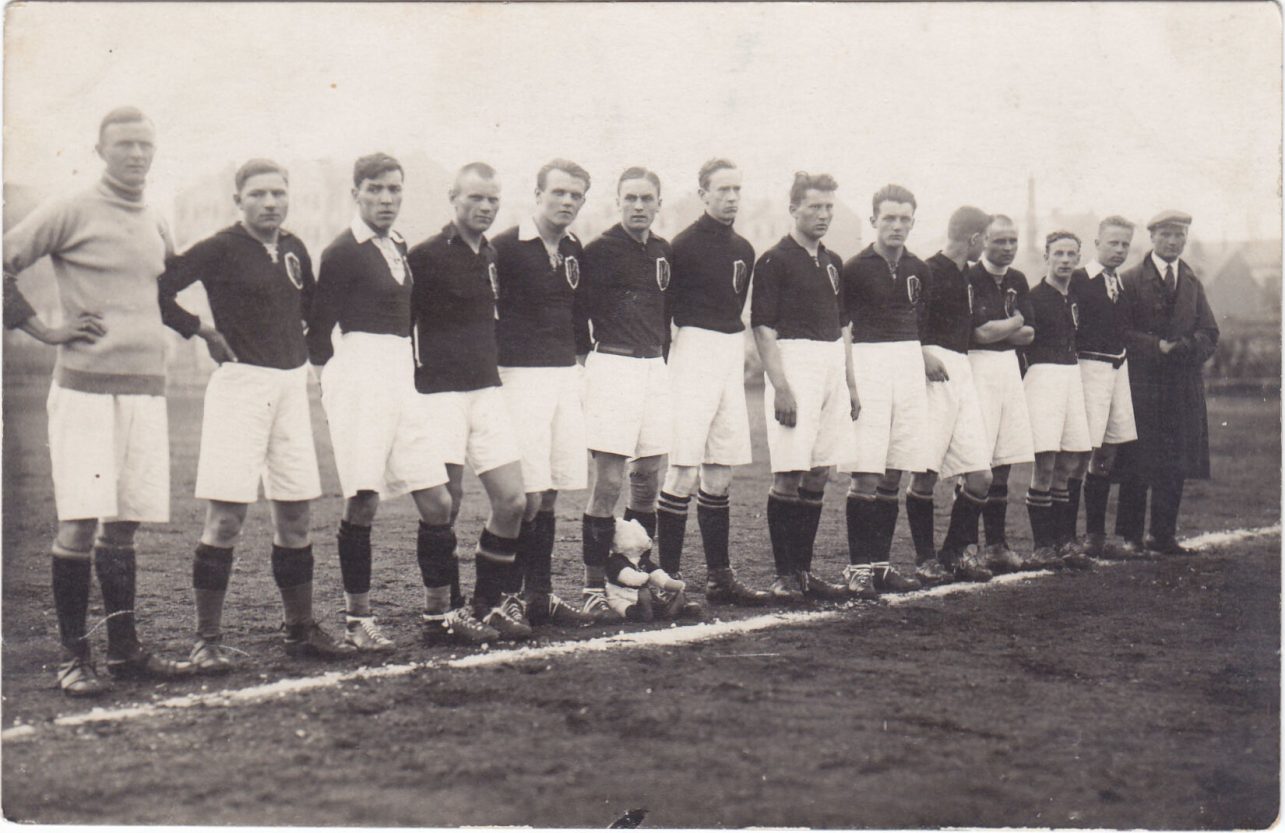
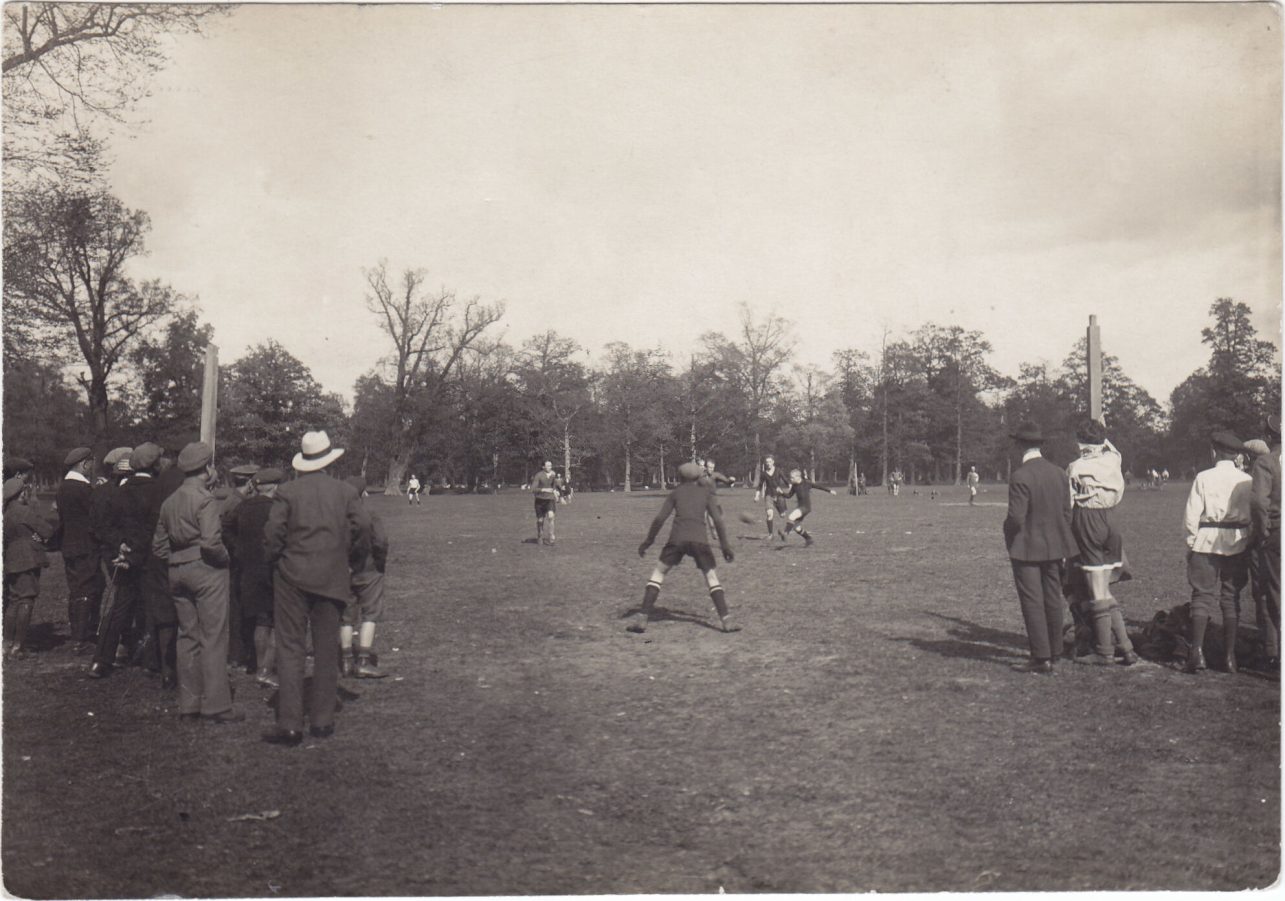
But the fighting spirit was there. In the history of the interwar period, we also find Šančiai: looking back at us from a black-and-white photograph is the men’s football club Kaunas “Kovas”. The narrator corrects himself: “We should say Šančiai ‘Kovas’, because it was a Šančiai club. You can’t tell someone from Šančiai that they are from Kaunas.”
Broke A Window, Took The Passport, And Left
It was actually footballers who were the first Lithuanian Olympians. Although there had been thoughts of participating earlier, the national team for the 1924 Paris Olympics was assembled in a hurry. “It took a bit of a sense of shame: at a meeting of foreign ministers, it became clear that both Latvia and Estonia would be participating in the games. They asked when our lot would be going… It became a bit awkward – it was quickly decided to send a football national team and two cyclists.”
News of funding was received on the 21st of May, and by the 25th of May, the match was already taking place. “In reality, you found out in the morning, and by the evening you had to be sitting on a train. One player even had to break a kitchen window with a stone to get his passport, because his wife was at work at the time and you couldn’t just call like you can today,” says A. Žukauskas (by the way, this story is about the great-grandfather of our magazine contributor Agnė Abromaitytė – Editor’s note).
And the funding was conditional at best. The kits were ordered, but it was unclear if they would be ready in time. There was only one ball for the warm-up, and that disappeared during a train transfer. They had to borrow one from the Swiss, whom the Lithuanians played against after arriving in Paris in the early hours of the morning. “We went out with the 2-3-5 tactical system popular at the time. We conceded four in the first half and five more in the second. 0–9 remains the biggest defeat in the history of official matches for the Lithuanian national football team.”
Such was the beginning and the end – the first and last time Lithuanian footballers appeared at the Olympics. Today, the museum’s collection holds the original diploma from these games belonging to team member Stasys Janušauskas.
Green Versus Red
The green and white shirts hanging in the display stand also recall unintentional anti-Soviet resistance. “At the 1987 Universiade, the World University Games, the USSR was represented by Vilnius ‘Žalgiris’. The team consisted entirely of Lithuanians. They were issued red shirts, but these had neither numbers nor emblems; the men had to sew them on themselves. After sewing them on, it turned out the effort was for nothing – half the players couldn’t even fit into them. And so: the Soviet Union national team walked out in green and white. Of course, there were talks of punishment for such audacity, but they had to be postponed because ‘Žalgiris’ won the Universiade.”
There was also conscious resistance: according to the museum educator, when “Žalgiris” reached the first division, the USSR constitution was burned during spontaneous marches. “There are also claims that the stadium was one of the first places where the forbidden Tricolour was raised,” says A. Žukauskas.
Players, Coaches, Referees
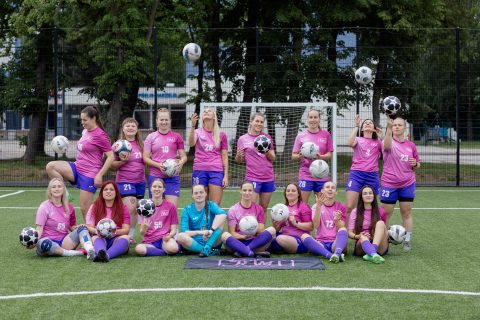
Although there are only a few women’s football exhibits in the museum, this topic is for Alvydas both a personal interest and a field of academic research. He wrote his bachelor’s and master’s theses on the history of women’s basketball, and now you will certainly meet him in the football fan stands. There have been times when you would have met only him there.
Around 1969–1972, the two main women’s football teams in Lithuania were Kaunas “Atletas” and Vilnius “Elektronika”. In Kaunas, according to the historian, the team consisted mostly of handball players.
The very emergence of the women’s team sounds like an anecdote: “1969, Vilnius ‘Žalgiris’ is celebrating the end of the season. Everyone is already well-oiled, someone stands up and says: why do only men play football in Lithuania? Let’s drink to having women’s teams too! One of the players’ wives, who was celebrating with them, didn’t miss a beat: fine, give us a coach, we’ll find the players. And the men didn’t forget – they found a coach, and the work began. When it was announced that a team was being formed, as many as 40 players turned up.”
However, almost as soon as it began, there was no more opportunity to grow: in 1972, women’s football was banned across the entire USSR. The reasons and the scheme were a propaganda classic. Dissatisfaction in letters from “ordinary workers”, alleged comments from women’s sports experts, and doctors’ concerns over injuries, aggressive physical contact, and mud. Interestingly, women’s basketball was not banned. “According to the ideology of the time, basketball develops elegance, which should have been a priority for future wives and mothers,” says the educator.
Women’s football in Lithuania was restored fifteen years later. Again, we see both Kaunas and Šančiai – after the general director of the “Cotton” hosiery factory there allocated sixty thousand roubles, FK “Cotton” was established. There were even women who returned to play from the old “Atletas” team. The team won the right to play in the top division of the USSR championship, but they did not exercise that right for a very pleasant reason – Lithuania regained its independence.
It is a shame that distrust of women’s competence is deeply rooted. In 1999, having become the first woman with a FIFA licence and being invited a year later to referee the U-18 European Championship qualifiers, Aušra Tvarijonaitė (now Kancė) received an order from the then head of the Lithuanian Football Referees Association to tell FIFA that she could not referee due to an injury. A. Kancė strictly refused to obey and went to work. Four years later, she was refereeing the U-19 final.
In the museum’s reading room, do not miss Aurimas Budraitis’s book “The History of Women’s Football” – the players of that time testify that Lithuanian sportswomen held a far from secondary place in the history of the country’s sporting achievements.
Do not overlook the achievements of Lithuanians today either: did you know that Kotryna Kulbytė, the head coach of the Uzbekistan women’s national team, revived women’s football in that country and, after a 23-year break, brought the team back to the Asian Championship?
Horoscopes, Millions, And Princes
The museum educator’s stories reveal the leaps of Lithuanian football clubs from rock bottom to the heights… and back. “Regrettably, the trail of the criminal world was inseparable from football,” says A. Žukauskas.
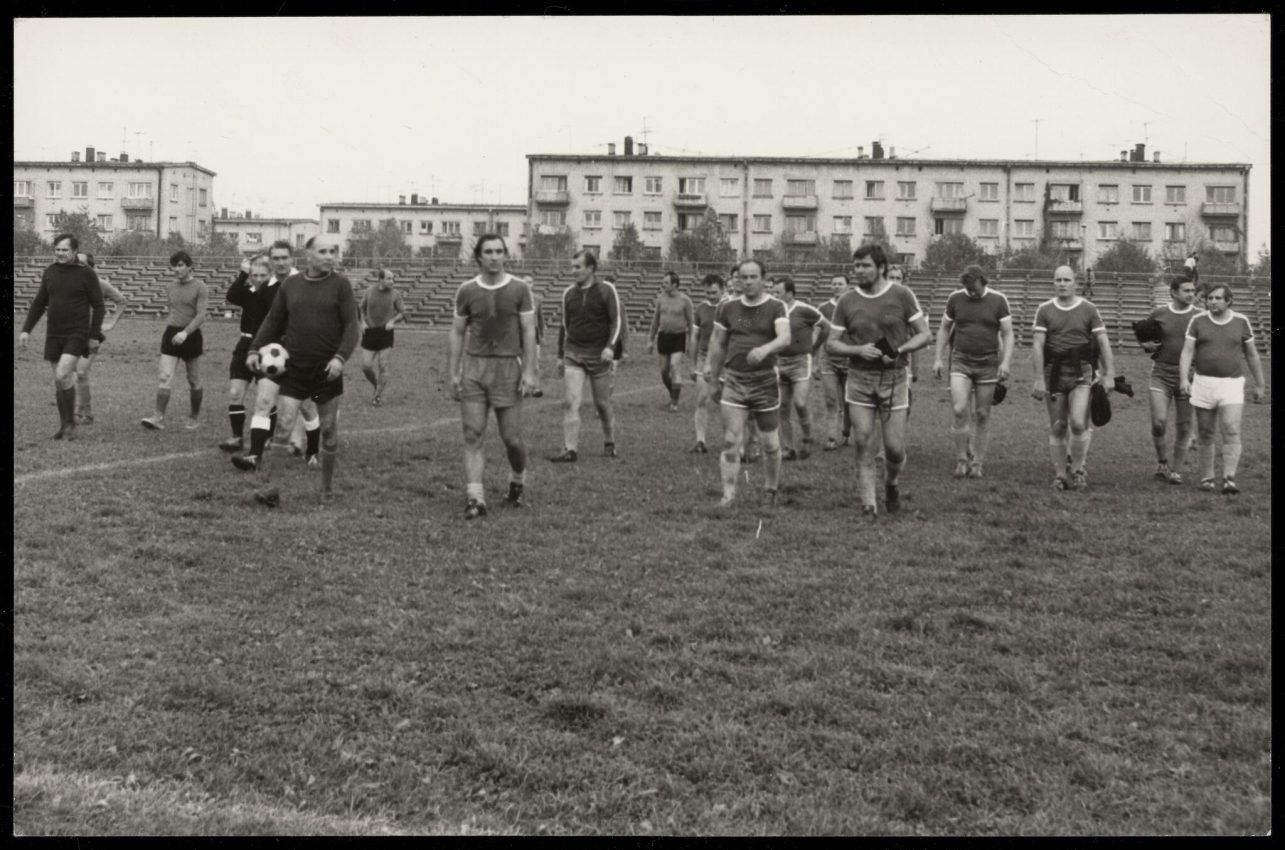
A separate stand in the museum is dedicated to the ambiguous period of FBK “Kaunas” under the leadership of Vladimir Romanov. Lithuanian champions six times in a row, matches against Liverpool in the Darius and Girėnas stadium, but at the same time – yes-men family members on the club’s board and players chosen for the team based on horoscopes drawn up by a personal fortune teller, disregarding sporting capability or general team goals.
In the early days of independence, the Mažeikiai “Romar” team also shone, led by businessman Romas Marcinkevičius, who was linked to the Šiauliai “Princes”. During matches, lotteries would be held to win a car, and parachutists would descend into the stadium. A Mercedes-Benz bus with sleeping berths and a kitchen was bought for the club. At the same time, “while the opponents went to a hotel after the match, the Mažeikiai lot would head to the city public baths – there were no changing rooms in the stadium,” says A. Žukauskas, illustrating the ironic contrasts of 1994.
Perhaps we can find some pluses in the rule of princes and kings? It is said that regular “Romar” matches in Mažeikiai were watched by at least five thousand spectators in the stadium, and once 22 buses of fans travelled to a decisive game in Klaipėda. Does positive propaganda and short-term glamour outweigh the brutal lows of football clubs?
Fan Devotion
Alvydas states that stadium attendance has been inconsistent at all times. Matches against foreign opponents, even from completely unknown teams, attract the most fans.
It is a shame that there are no exhibits in the museum illustrating the activities of the ultras. Perhaps someone will have the idea to donate some? However, I do find devotion to football in the reading room – I flick through a hand-written chronicle of several hundred pages containing the statistics of all Lithuanian football. “This is the work of Algimantas Bertašius; he is an extraordinary man. An engineer by training, but best known as the statistician of Lithuanian sport. Here we find everything from model aircraft flying to fire-fighters’ sport. There are dozens of his books like this,” says the interviewee.
We return again to the female footballers – to encourage attendance at matches, it is important to address the long-standing problem of ignoring women’s sport. According to A. Žukauskas, the popularity of women’s sport is rising strongly on a global scale, and Lithuania is no exception.
He is convinced: this is both a result of general female emancipation and the promotion of women’s sport through a sort of advance. Lithuanian clubs are preparing double-bill tickets with men’s matches, and “Vyčio tribūna”, the main fans of the men’s national team, supports the women’s national team at home and away. “There have been matches where I was the only one there, or I made up 50% of the spectators,” laughs the enthusiast, who organises support for sportswomen himself and actively beats the drum in the stands.
“But the most important thing is that the results are improving. Women are appearing who can serve as examples to follow, whose growth can be observed,” states Alvydas. “If there are no results, eventually the enthusiasm will fade anyway. And as a fan, you can’t keep going on pure idealism forever – at some point, it has to be returned through victories.”
They Are Lithuanians, And That Is Enough
Reflecting on the museum’s activities, I ask the interviewee why the achievements of athletes are important to non-athletes. Why are these stories important to the country?
“Sport is not a phenomenon only for people who do sport,” he says. “Sport has always been and will always be politics. It is a part of both culture and subcultures. When our national team wins, we forget what divides us; all that remains is pride in the country. We don’t know those people personally, but they are Lithuanians, and that is enough.” I also think about the changed pronouns when recounting match impressions: we won, we conceded too.
Another educational mission is to debunk stereotypes about athletes’ narrow education and sport as a pointless occupation.
A. Žukauskas doesn’t mince his words: “Many imagine that athletes are stupid. I have encountered this personally – in a pub quiz, the representatives of the sports centre who won second place were given a voucher for a pizzeria, while other places received books. There are still those who think that sport is nonsense. You want to ask them: have you ever watched a match live? Have you heard the emotions on the pitch? Furthermore, athletes often persevere on idealism alone and don’t earn millions. It is their passion, their way of meeting like-minded people.”
Throughout the conversation, motives of chance and adventure recur. It turns out that one of Lithuania’s most famous football coaches, Valdas Dambrauskas, who previously worked in a parquet factory in Pakruojis, won the money for his life-changing studies in the United Kingdom on the TV show “Six Zeros – One Million”. What a fitting illustration for Lithuanian football, hopefully reinventing itself again and again – with broken windows, ignored orders, riches, poverty, fans who don’t give up… and Valinskas.