After talking to Dainius Burkauskas, the head of the Kaunas State Philharmonic, I realised how fitting the institution’s new slogan, “Music Spreads Here”, truly is. The sounds of rehearsals, the echo of wind instruments, and vocal exercises drifting from the building’s corridors, rooms, and concert hall were constantly reaching my ears.
This slogan is just one of the changes at the institution, accompanied by a fundamental desire not to lose what has become part of the institution’s identity over the decades. Having led the Philharmonic for nearly a year, Dainius Burkauskas aims to preserve its high level of professionalism and long-standing tradition, while simultaneously seeking new ways to open the doors to a wider circle of visitors – including those who are just beginning to discover classical music.
You have been leading the Kaunas State Philharmonic for almost a year. Which impressions and events have stood out most during this time?
The most vivid impressions are related to the tours of the Kaunas State Choir. With this ensemble, we represent Kaunas and Lithuania both in the regions and internationally. The first tour took place in February, when we performed Hector Berlioz’s symphony “Romeo and Juliet” at the 9th Ljubljana Winter Festival with the legendary maestro Charles Dutoit. In May, we travelled to Toruń, Poland, to participate in the 33rd “Probaltica” Music Festival of the Baltic States. In September, we returned to Ljubljana for the closing of the 74th Summer Festival. The Kaunas State Choir performed alongside the London Symphony Orchestra and the legendary conductor Antonio Pappano. Performing with such world-class ensembles is a great achievement. I am delighted that we are able to do this and that we are invited. The tours were also a great opportunity to get to know the Kaunas State Choir better.
Nevertheless, you are not a newcomer to the Philharmonic – you have worked here for several decades, but I imagine the position of director has allowed you to see the institution from an entirely different perspective.
I have worked at the Philharmonic for 28 years; I can confidently state that over such a period I have had the opportunity to get to know the team, the daily work processes, and the traditions. The former director, Justinas Krėpšta, assembled an excellent team, so today I am immensely grateful to each of them. The composition of the staff has not changed since I became director. We are developing ideas and striving for common goals and renewal. I inherited the Philharmonic as a top-level cultural institution with firm foundations.
What was the most important goal you set for yourself when you took up this position?
I set myself the task of maintaining and preserving what we have built over many years, while leading the Philharmonic forward in step with the rhythm of modern life – without losing its uniqueness and while nurturing its traditions. I believe that the ability to combine long-term experience with innovation is one of the institution’s most important principles, and changes must not contradict professionalism and tradition.
Indeed, the Philharmonic is part of the musical tradition of Kaunas. In your opinion, how should the preservation of tradition and the search for innovation be combined today? What seems most important to maintain?
It is vital to preserve a high level of professionalism and respect for both the music and the listener. These are values that should not change, regardless of what innovations emerge. And seeking them is essential because society, its needs, the perception of music, and the forms of its presentation are all changing. It is important to open up new opportunities for discovering classical music. One direction is the combination of different musical genres, various interpretations of classical music, and its synthesis with dance, electronic music, or elements of musical theatre. Such solutions allow us to look at classical music from a different angle, without moving away from tradition but rather combining it with other art forms. On the other hand, classical music itself is very diverse, rich, and interesting, so everyone can find something for themselves within it.
A new season at the Philharmonic began in the autumn, and you welcomed it by introducing several innovations: family and patron tickets, educational lectures before concerts, and a recently launched new visual identity. What general change do you want to initiate with these decisions?
These are only some of the changes beginning. In the long term, we aim for the Philharmonic to be open, attractive, and accessible to a wider circle of people, engaging listeners of various ages and interests. At the same time, we strive to get involved in initiatives important to society. For instance, National Seniors’ Week took place in October, during which we invited seniors to free events. We are also paying more attention to listeners with special needs. We look forward to feedback to find out what we could improve and offer.
Another relevant topic is the upcoming Lithuanian Presidency of the Council of the European Union. A kind of prelude took place on the 24th of September this year, when we presented Ludwig van Beethoven’s Ninth Symphony together with the Lithuanian State Symphony Orchestra and the Kaunas State Choir. In 2027, the Philharmonic will organise a four-concert cycle titled “Resounding Europe”. It is included in the socio-cultural programme of the Lithuanian Presidency of the Council of the EU in Lithuania. This is a significant achievement that strengthens the Philharmonic’s visibility, and it is a great responsibility.
Tell us more about the educational lectures before concerts. To what extent should the Philharmonic today be a place where a person can better understand classical music?
We learn throughout our lives, in the most diverse circumstances. Why couldn’t the Philharmonic be one such place? We want both children and adults to have the opportunity not only to listen to music but also to get to know the creative process better – to understand the musical thought, the composer’s experiences, and the circumstances under which a work was created. The idea behind these lectures is to provide more context, help discover a deeper connection with the music, and notice things that might not have been understood without this knowledge. We have received a good amount of positive feedback from the lectures that have already taken place. Currently, the educational lectures are more focused on evening concerts. However, there is no lack of educational elements in the musical afternoons intended for families either.
What message does the other new feature – family tickets – send?
This is another initiative by which we aim to encourage families to visit the Philharmonic more often by offering discounts and more favourable conditions. We want as many people as possible to have the opportunity to attend concerts and enjoy live music. We prepare separate programmes for young people. We would also like to see more active involvement from students of music education institutions and their teachers. After all, the future generation of performers who will be giving concerts here is currently growing up. Speaking of new things – we are preparing a few more and will share them shortly.
The new Philharmonic logo and visual style, inspired by interwar architectural accents, were recently presented.
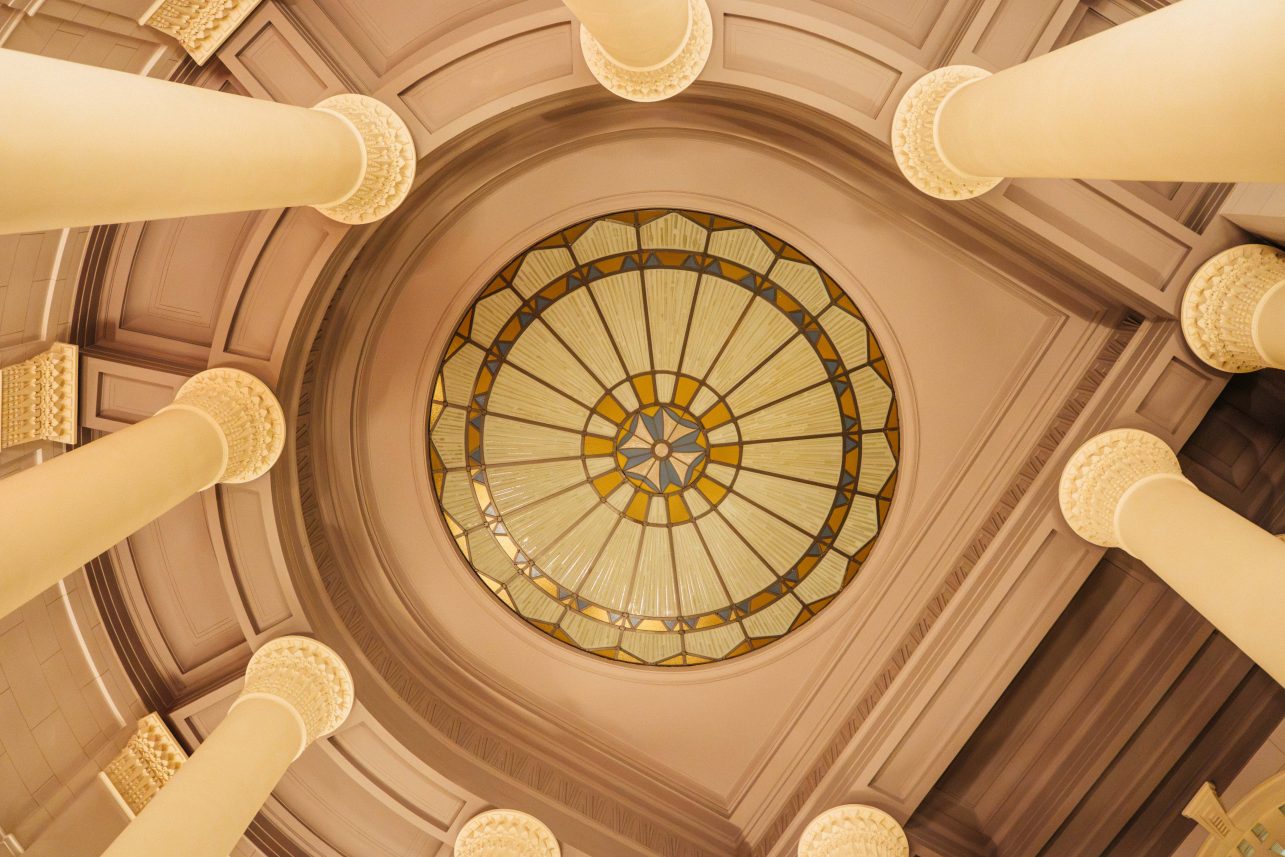
The idea was born in this very office where we are talking now. The visual style was naturally dictated by the Kaunas Philharmonic building – its architecture, interior, and colours. The creation of the new logo was inspired by our impressive stained glass and the columns around it – these architectural elements very clearly connect the heritage building with the music heard within it. The building’s architecture is our ideological field. In the new logo, the dot symbolises both a meeting place and a starting point from which music spreads in all directions alongside the cultural experience.
In a recent interview, you expressed hope that the Philharmonic was, is, and will remain open to everyone: from young to elderly listeners, and from those starting their careers to mature stage professionals. What do you think a person who has never visited before can discover and experience – both in terms of the building and the events?
I would suggest starting the acquaintance with the Philharmonic with a tour; we are currently organising two thematic ones. One is historical, the other is dedicated to the architect Edmundas Alfonsas Frykas. The music sounding in this building will reveal itself differently once you are familiar with its history.
Then I would invite you to review our repertoire. It is very broad – from Baroque to contemporary music. Choose a few concerts, or at least one, that you would like to attend. Some visitors say that once they arrive, they don’t want to leave, and it is always a pleasure for them to visit again. That is when they start following the news.
It is interesting to discuss the future inclusion in the city’s cultural fabric. With the opening of the new M. K. Čiurlionis Concert Centre, the Philharmonic will inevitably have to share the attention of the Kaunas audience. Is this a challenge of competition or an opportunity for cooperation? Or perhaps an incentive to rethink the Philharmonic’s role in the city?
I see it as another opportunity to expand the cultural life of Kaunas and to cooperate, as our direction is essentially the same. Every cultural space arouses curiosity and a desire to get to know and discover something new, but it is also a significant challenge. It is a new sprout that will need to take root, grow, and find its place in the city’s cultural life.
The Philharmonic has deep roots; it has long earned the trust of listeners and has consistently built its history over decades. I do not think it is worth looking at this through the prism of competition. The most important thing is that every cultural institution finds not only its place in cultural life but also its own listener or viewer. We all share a mission to strengthen culture and provide the city with the very best.
This truly could become a new ecosystem for classical music. What kind of Philharmonic would you like to see after your five-year term?
I would like it to be open to everyone – not just a large building. I want people not to be afraid to come here and not to think that they haven’t yet “grown up” to classical music, but rather to discover its subtlety and beauty while listening. So, let us not be afraid: let us come, listen, and take an interest.