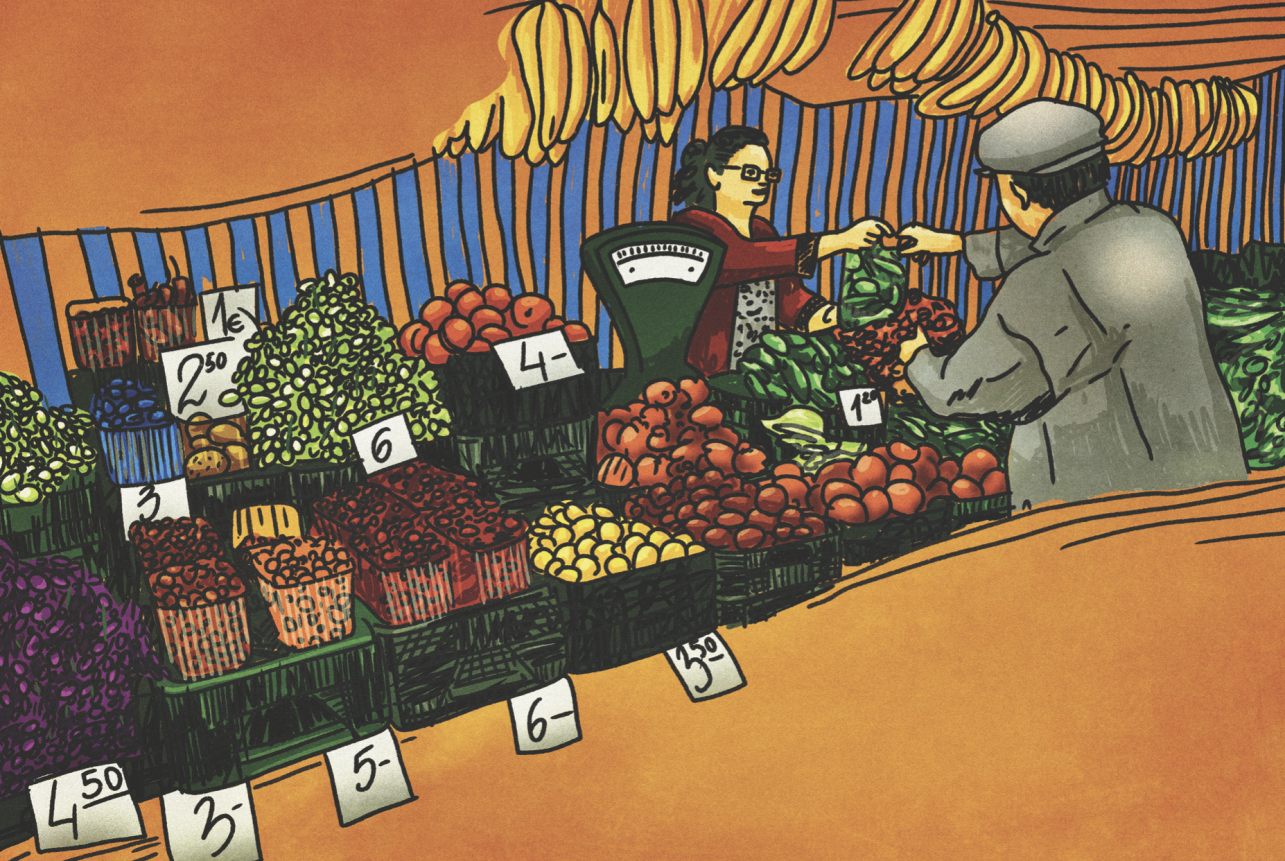
If you want to get to know the city, you must visit two places: its markets and its cemeteries. I hope that we will prepare a separate issue about cemeteries someday, but this time we should talk about farmers’ markets. What interests me is not so much what you can buy there, but rather why they appeared precisely where they did in Kaunas, and why some of them have managed to remain there successfully to this day.
The map of Kaunas’s marketplaces is not random. In the past, farmers’ markets would spring up where trade routes and the paths of merchants and adventurers intersected; where there was still room for bustle and commotion; where a neighborhood began; where a cart, van, or car boot could be conveniently unloaded; and where the authorities had not yet made up their minds about what more presentable structure to build there. Markets changed location, size, and appearance, but their geography still reveals the different layers of Kaunas’s development.
Today, marketplaces document a city’s structure, history, and the spirit of its time. They are unvarnished testimonies of urban development. Some mark the old routes into the city, while others emerged alongside the suburbs. Still others filled gaps left by Soviet-era residential planning. Others took over warehouses and industrial areas when the planned economy abruptly ended, but the need to trade remained. We will not cover all of them today, but we will certainly find one example representing each of these layers. And finally, we will briefly consider what the future of Kaunas’s marketplaces might have looked like.
Since time immemorial
The oldest farmers’ market in Kaunas operated in what is now Town Hall Square. The construction of the Town Hall itself began in the early 16th century in the center of a marketplace that had already been active for a long time. Kaunas has always been a city of merchants and traders, situated at the crossroads of important routes. Craftsmen gathered here; goods were weighed and stored, while the roads leading to the Nemunas riverfront and port ensured a constant flow of traffic. The city authorities simply built their headquarters where urban life was already at its busiest.
The map of Kaunas’s marketplaces expanded considerably in the 19th century as the city grew beyond the boundaries of what is now the Old Town. The best-known market from this period – whose pavements I walk every day – was the Old Market, located in what is now Steigiamasis Seimas Square. According to contemporaries, only those with strong nerves dared to venture there. As early as the beginning of the 20th century, the press was reporting on thefts and growing public dissatisfaction with the place. Nevertheless, the market was not closed until 1976, during the reconstruction of Šv. Gertrūdos Street. Following the construction of the Šauklių Street junction, the area became a “dead” fringe of the transport corridor for many years.
Change, however, is on the way: the winners of the architectural competition for the site have been announced: the 19/20 proposal by Archas, a studio well known to Kaunas residents. This sensitive site has the potential to become a focal point of urban life once again. The project description states that they will employ “a balanced approach to restoring the historic urban fabric”, but, at least to my eye, there are as yet no visible traces of its history as a marketplace, apart from the perimeter development itself.
Around the same time, in the mid-19th century, another important marketplace was established nearby: the Fish Market. Despite what its name might suggest, it sold just about everything. Its main commodities were everyday necessities such as firewood, animal feed, and foodstuffs. Interestingly, the market operated daily and often almost around the clock. Farmers selling vegetables would begin arriving at midnight, while wholesale trading started at two in the morning. Carts laden with goods poured in, and by dawn resellers would distribute their contents among the city’s other marketplaces. It was a real logistics hub and distribution base long before anyone in Kaunas was using such terms.
Following the declaration of Lithuanian independence, attention turned almost immediately to marketplaces and how they operated. In interwar Lithuania, markets were major centers of economic and social life, so improving and modernizing them became one of the priorities of the Kaunas municipality. The rapidly growing temporary capital needed hygienic, well-organized, and aesthetically pleasing spaces for trade. The city actively sought to tackle disorderly trading, dirt, resellers, poor hygiene, and rampant crime.
In 1923, with residents’ convenience in mind (and, of course, not forgetting the importance of tax collection), the municipality decided that every suburb should have its own marketplace. These farmers’ markets were known as “intermediate stops”: if a vendor arriving from the countryside sold all their goods along the way, they didn’t have to travel all the way into the city center. Thus, before the war began, an entire network of markets had developed in Kaunas: the fish market, the old market, Žaliakalnis market, livestock market (on Zanavykų Street), Vilijampolė, Šančiai and Panemunė markets. During the Soviet era, some disappeared, others relocated, while still others became organically integrated into the changing city.
Zanavykų Market: close to the intercity roads
The market in Žaliakalnis operated from the 19th century until 1937 near the Christ’s Resurrection Basilica, on the very site now occupied by the former radio factory buildings, which are currently being transformed into the Radio City quarter. Around 1937, the market was relocated to Zanavykų Street, where a livestock market had already been operating for some time (horses had been traded there since 1926). Interestingly, the press at the time regarded the move as a poor decision. Residents called for the market to be relocated closer to the center of Žaliakalnis, as long-time residents of P. Vaičaičio and Minties Rato streets considered Zanavykų Street “too far away.”
Why was this particular location somewhat remote at the time, chosen for the market? Although I have not found any definitive historical sources, we can assume that the constant noise and smell of the horses played a role, as did the convenient location for those arriving via the Ukmergė road (present-day Savanorių Avenue), the main artery for intercity travel.
Contemporaries praised this marketplace as the only place in Kaunas where farmers had enough room to manoeuvre – there was ample space to park carts and walk the horses. Later, the trade in other livestock and food products was also relocated here. Today, the market is notable for its market hall, where meat has been sold since 1961. Construction of the pavilion had begun as early as 1954. Officially, the market’s opening was delayed by a lack of funds and contractors’ negligence, although I believe this story deserves closer investigation. As I heard on the Kauno plokštelių fabrikas podcast, a record factory producing shellac records also briefly operated in these premises. This adds yet another unexpected layer to the history of Kaunas’s industry and marketplaces.
Aleksotas market that grew with the suburb
Like the Žaliakalnis market, the Aleksotas market was established along important trade routes. In 1923, the Aleksotas marketplace began operating at the bottom of Veiverių Street, opposite the bridge. Farmers and craftsmen arriving from the Suvalkija region could sell their goods here before crossing the Nemunas and getting caught in the traffic jam of the city center. Veiverių Street was one of the main southern routes into Kaunas, so it is hardly surprising that a market has remained along this thoroughfare to the present day, even though it was later relocated to the top of the hill.
It is difficult to say exactly when this relocation took place. One source mentions that traders, while waiting for S. Darius and S. Girėnas to return to Aleksotas Aerodrome, spent the night here in the open air. However, after closely examining aerial photographs of Kaunas taken by German military intelligence in 1944 – an invaluable resource for urban research – I have yet to find any traces of a market at this location. Perhaps older readers could help pinpoint the date more precisely?
Aleksotas Market has endured because its location perfectly serves three functions: it is a neighborhood market for Aleksotas residents, a weekend destination for the entire city, and a strategic trading point along a historic route into Kaunas. As the city expanded southwards, the former “intermediate stop” found itself no longer on the outskirts but within a growing residential district. Only the range of goods on offer has changed: livestock and poultry have been supplemented by tools, car parts, clothes, second-hand goods, antiques, and a whole category of items best described by the phrase, “I didn’t know I needed that.”
Šilainiai – a market in place of a Soviet gap
Built during the final years of the Soviet occupation, Šilainiai became perhaps the most densely populated part of Kaunas. When this enormous residential district was being designed, the plans called not for marketplaces but for standardised shopping centres. However, with the collapse of the planned economy and the chaotic process of privatisation, markets began to emerge organically, not only in Šilainiai, but also in Dainava, near Girstupis, and in Kalniečiai.
Šilainiai Market appeared only after the residential district had already been populated. It was not part of the original plan, but rather a post-Soviet correction – a more flexible and vitally necessary solution in an area where the network of state-run shops no longer corresponded to the new economic reality. Meanwhile, the nearby Žemaičių Highway became a gateway into the city for farmers living to the west of Kaunas.
The market complex opened its doors in 1997 (incidentally, some fascinating footage of the opening ceremony can be found on YouTube). To my mind, Šilainiai Market now best embodies the idea of a “real market”: here you will find everything from ramshackle stalls and an astonishingly wide range of goods to narrow passageways and that distinctive atmosphere in which you might either haggle your way to a bargain or fall into the traps laid by resellers. Until quite recently, Stoties Market was another such artefact of its era, but it is now being dressed in new, more modern clothes.
The king of markets
It would be almost criminal not to mention Urmas, which Kaunas residents still more often simply call “Bazė” (the base). It is an entire retail ecosystem spread across a vast expanse of warehouses, shopping arcades, and open-air lots. Once the pride of the legendary EBSW conglomerate, Urmas continues to attract thousands of visitors to this day.
Divided into galleries and arcades, Urmas was established in 1992 on the site of a former wholesale warehouse complex. As with everything in the Soviet era, trade was strictly centralized, so the city needed an enormous “base” from which to distribute goods to the shops of the time. The figures remain impressive today: the complex has around 90,000 square meters of retail space and 3,000 parking spaces for visitors.
One of its most distinctive features is the row of “little trains” adjoining the former loading platforms – additional retail spaces that have been operating since 2008. The old, elevated loading platforms needed to be enclosed somehow to make them safer and more inviting, so a design inspired by railway carriages was chosen. This is how the country’s third-largest marketplace took on its present-day appearance, evoking the era when goods arrived by rail. Incidentally, the principal architect behind this transformation was the late Audrys Karalius.
The unfulfilled future of Kaunas marketplaces
I have a special connection to the final stop on this route. The sound recordings made in the building that I am referring to once ended up in a performance for which I created the soundtrack. Although the building is a complex of more than 23,000 square meters with an underground car park, most Kaunas residents have never set foot inside it. Construction of the Central Market began in 1998, but the building never progressed beyond a concrete shell.
As early as 1993, architect Vygintas Merkevičius drew up a redevelopment plan for the area around Kaunas railway and bus stations. It was an ambitious yet rational proposal: to relocate trading from the cramped Stoties Market site to a spacious block between Šiaulių and Kaunakiemio streets, reorganize traffic, and connect the two stations with a pedestrian street. The project was never fully realized but work on the market itself began in 1998.
The official version of why we don’t have this giant market is financial problems. Yet while the concrete was setting on Šiaulių Street, the city’s retail geography was changing. Urmas and the shopping centers in eastern Kaunas absorbed the major flows of shoppers. Local markets became firmly established in the residential districts, while the old Stoties Market, inconvenient as it was, continued to operate in its original location. The vast central complex had been designed for a city whose retail activity was still expected to revolve around a single clearly defined center, but it was being built for a city in which centers were beginning to multiply.
The project’s death sentence came in the form of the symbols of the 21st century: large shopping and entertainment centers. They offered a modern, Western-style shopping mall experience, complete with cinemas and restaurants. Less than a kilometer away, Akropolis rose beside the unfinished concrete skeleton of the Central Market, looking as though it had arrived from the future.
The site remained abandoned for almost two decades. The municipality sought to take over the property for public use and establish an educational institution there, but in April 2026 the court ultimately ruled that it lacked sufficient grounds for such an acquisition. The judges were not convinced that a kindergarten or school specifically required this 23,000-square-meter behemoth. And so, the project returned to square one: the property will once again be looking for a buyer willing to figure out what to do with a site of this scale right next to the station. To me, this concrete skeleton is the most fitting monument to the history of Kaunas’s markets. Not because trade ever took place there, but precisely because it never did.