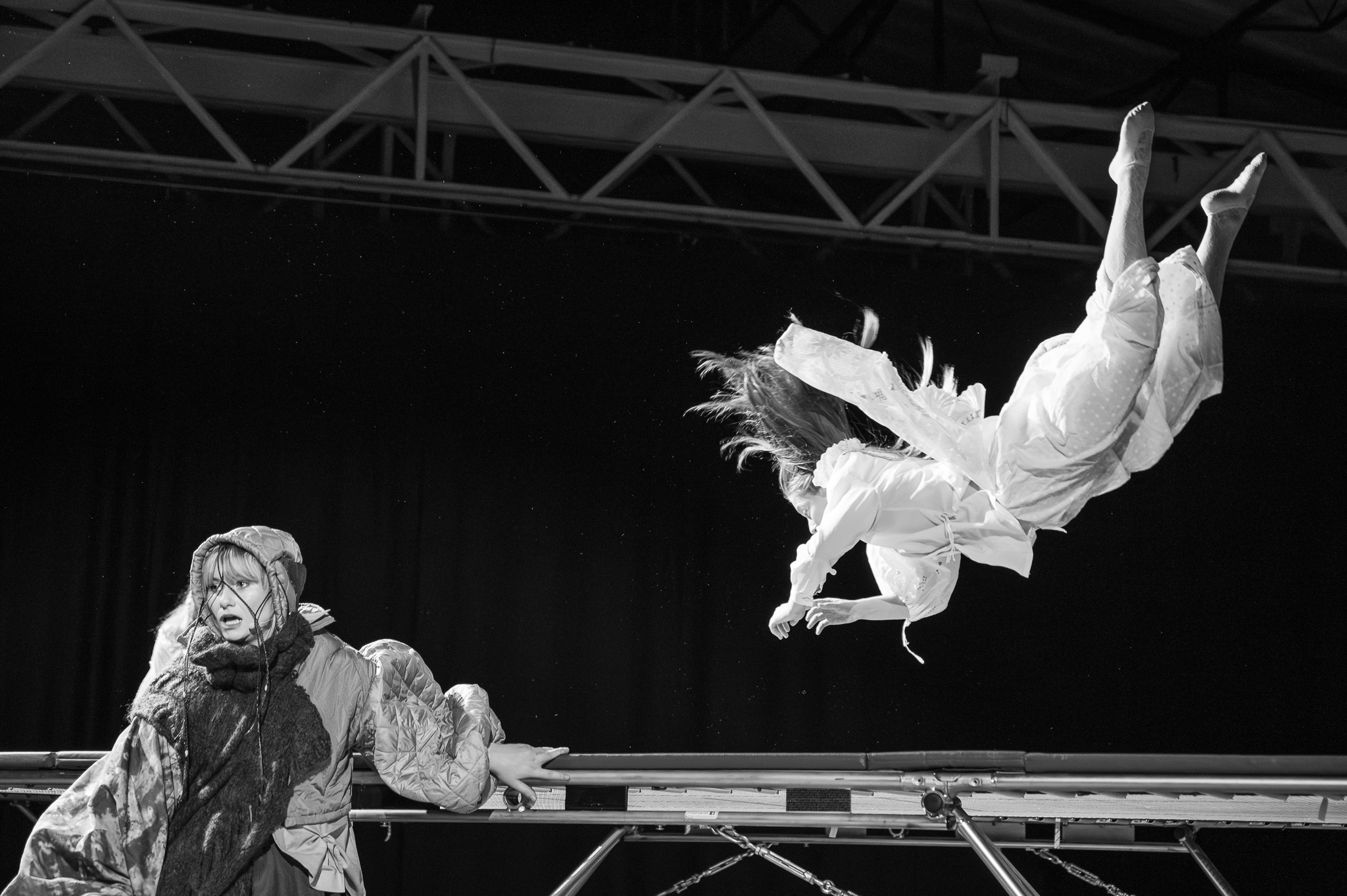
From its very inception, contemporary circus and its creators have sought to break free from stereotypes: the aesthetics of the big top, the entertainment cliché, and hierarchical structures – along with the authority of the traditional director-dictator perched at the top of the theatrical pyramid.
Although the community of contemporary circus creators in Lithuania is small, here three directors who have, in one way or another, touched upon circus directing come together for a conversation. I, Gildas Aleksa, who combines theatre and circus in performances and organises the “Cirkuliacija” festival; Žilvinas Vingelis, a visual theatre director who increasingly incorporates circus into scenic action; and Jason Dupree, a British artist living in Latvia who has worked on several contemporary circus pieces created in Lithuania.
Gildas: I wanted to bring together the few people in Lithuania who, in one way or another, take on circus directing. I’ll ask right away: Jason, why directing? And Žilvinas – why circus?
Jason: Do you want the real answer or the nicely polished one? The real one? For a few years, I was a circus performer myself, but I suffered an injury. I found myself at a dead end: how to stay in this field? After all, this is where I met my people – the ones I want to create with, communicate with, and be curious with. The thought occurred to me: I could direct a show! And so, quite by accident, without having any clue what I was doing, I started creating with others. That was a good decade ago. Today, I’ve read heaps of books, gone through countless masterclasses, created quite a few works, and now I actually feel like a director, rather than just someone pretending to be one.
Gildas: And what would that “polished” answer have been?
Jason: “I have always desired to create art and explore myself through the stage…” (everyone laughs)
Gildas: Žilvinas, how did you find yourself in the circus?
Žilvinas: You say we are circus directors, but until this conversation, I hadn’t even given it a thought – I’m still doubting whether that’s really what I do. I remember three or four years ago being asked how I started working in puppet theatre. After that, it was how object theatre, physical theatre, and technological theatre came about… Every year I find myself in a different rabbit hole, and now, it seems, I’ve fallen into this one.
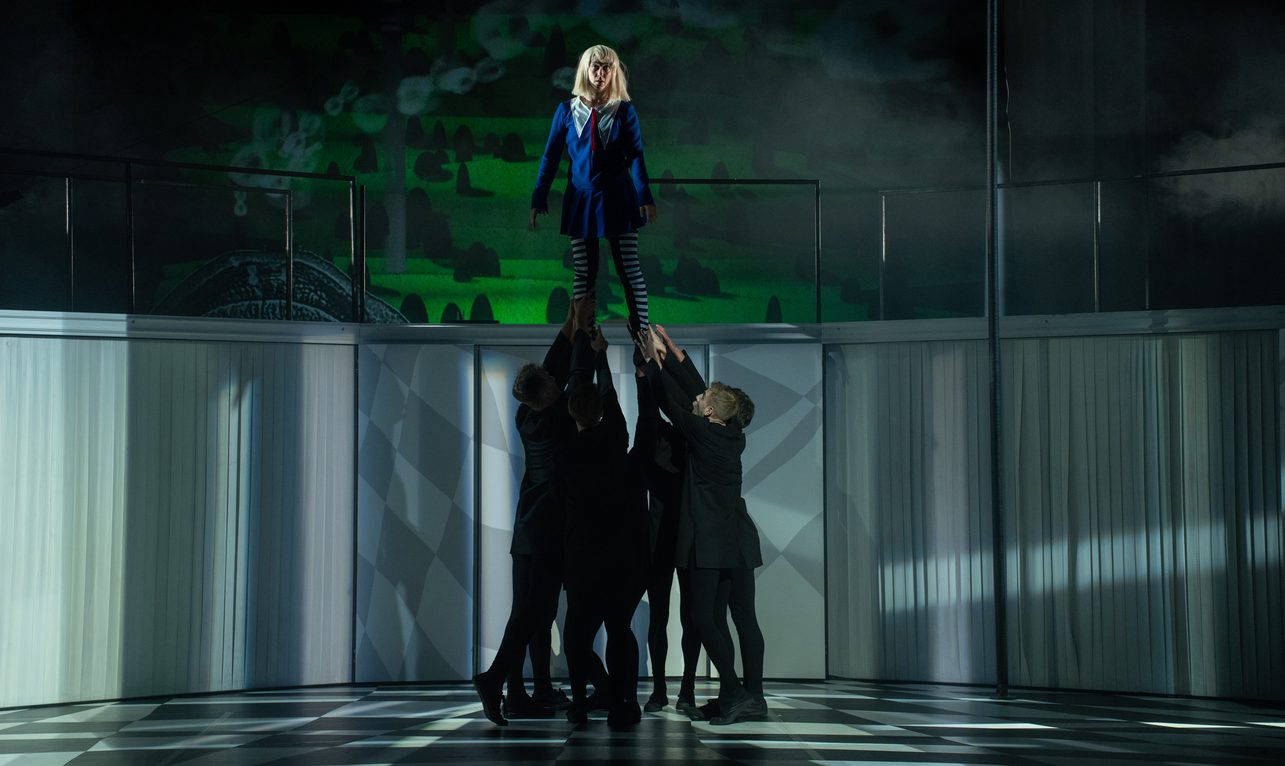
I try to see theatre directing as a transition between fields, as intermediality and interdisciplinarity. I have always liked working with the most diverse range of people. My foundation was drama and psychological theatre, later moving into the visual. When new creators join, the stage language becomes significantly more complex and multi-layered. I try to reach those people, listen to them, and learn as much as possible from other fields. For example, the performance “Alice in the Looking-Glass” is not pure contemporary circus – we use certain circus tricks and the way of thinking itself, but that comes from the people I work with, rather than from me.
Gildas: But was it the people that attracted you, or the circus aesthetic after all?
Žilvinas: I remember a puppet theatre conference in Latvia about five years ago. Mara Pavula, a producer from the Riga Circus, gave a presentation there. Listening to her, we immediately saw a multitude of parallels between contemporary circus and puppet theatre. Both these forms hold a kind of outsider position and fight against stereotypes: that puppet theatre is only for children, and circus is just cheap entertainment and a spectacle for the eyes. Both disciplines rely on a very specific relationship with the object, material, mechanics, and space; both require immense physical preparation, and artists must work with the scenography from the very first day of rehearsals. Since I spent five years at the “Lėlė” theatre in Vilnius, this experience became a kind of lift for me – allowing me not to climb the stairs from zero, but to immediately grasp contemporary circus more deeply and quickly.
Jason: What about you, Gildas? Your roots are also in theatre. How did you start working with circus – after all, you aren’t just a director; you do so many things in circus?
Gildas: I fell in love with the aesthetic first, and that happened when there weren’t even many circus people around. I attempted to direct my first contemporary circus performance with almost no theoretical or practical baggage – simply led by a desire to explore. I quickly realised the main problem: there simply were no performers in Lithuania for me to work with. That’s how the “Cirkuliacija” festival was born – its initial idea was to educate actors, dancers, and musicians so they would fall in love with this form and I would have people to create with. Eventually, the festival grew too large to stop, and it was only a couple of years ago that I overcame my fear of returning to circus directing. As Žilvinas said, my performances aren’t pure circus – they are more of a hybrid with dance and theatre. But now I feel I’ve tamed this language.
Nevertheless, Jason, circus artists usually manage perfectly well on their own – directors are not particularly welcome in their world. In a performance, you can immediately see whether it was managed by a director or if everything originated solely from the performer. How do you view the role of the director, which in our theatrical world with Žilvinas traditionally signifies a position of power, whereas in circus it is far from that?
Jason: That is exactly what I wanted to talk about. You both come from theatre, whereas I am a pure circus person; my thinking and my brain were formed by the circus. Circus performers are by nature kind of egocentric, crazies, sometimes arrogant – in a good way. They want to do everything themselves, to be the axis of the process. They aren’t just vessels for a director’s ideas, which is what drama actors often become. Circus performers want to build, construct, and take risks themselves. Therefore, when I work, I don’t consider myself a director in the usual sense. I only use the word so that it’s easier for others to understand my function. My real role is to create a safe but brave space, provide tools for play, and to observe, reflect, and connect. I don’t dictate what to do. They create their material, and I give form to what is born on the floor.
Gildas: Žilvinas, neither you nor I practice circus in the physical sense. How do you find directing without knowing this specific movement language? Does it cause stress, or on the contrary – does it liberate you?
Žilvinas: It’s hard to give a definitive answer. There are rehearsals during which you understand everything perfectly, and in my eyes, those are poor rehearsals. Circus performers on stage shouldn’t only do what is easy for me to grasp. My job is to see the big picture. If, upon seeing something valuable on stage, I immediately think about where to incorporate it in the show, rather than forcing them to blindly follow a pre-set plan, the true process of co-creation is born. I am responsible for ensuring that a cohesive piece emerges from their suggestions.
The metaphor of a basketball team fits very well here. A circus act, a puppet, an object, or a video projection cannot appear on stage merely as a beautiful visual effect. The plot is the ball, and the different theatrical forms are the players on the court. They must share the ball, create plays, and move towards the same basket to score points, and those points are the viewer’s emotions. There is no point in having five separate balls on stage at once. I always check whether we are repeating the same thought: if we’ve already said something with a puppet, it’s not worth duplicating the same thing with a circus trick.
Jason: That thought is very close to my own. Except I look at the same problem from the other end – you have mastered theatre, while I spent ten years learning circus technique, but in the beginning, I had no clue about dramaturgy. After all, contemporary circus is not a traditional show where an announcer simply introduces one act after another. I had to learn practically from scratch how narrative structure and stage dramaturgy work.
Gildas: Jason, in many French performances I’ve seen, the performers simply execute choreography cleanly, but the personal authenticity disappears. Yet in your works, the truth of the people on stage remains. How do you manage that?
Jason: I am also often disappointed by performances where the human being is no longer visible beneath the technical shine. Again, the sports analogy helps: in sports, no one is faking it. The players are simply aiming for a result; they aren’t acting out a story – the drama is born from the situation itself, here and now. Both the players and the audience don’t know what will happen the next second. When traditional theatre is introduced, the performers on stage already know the outcome, but they must pretend they don’t. Drama actors study this for years, whereas circus artists don’t know how to act – when they try to act, it usually looks poor. Therefore, in a performance, I try to preserve a documentary truth: less straightforward storytelling, more pure dramaturgy and open action.
Gildas: Žilvinas, you work with circus in state-funded theatres. Circus requires a vast amount of time for physical preparation, while theatre has a rigid repertory machine. How do you manage to reconcile these two different rhythms?
Žilvinas: It’s a huge headache. I’ve never considered myself a state theatre director; my background is a small, independent troupe with which we could work on a project for a year without any final deadlines and remount the show five times if needed. Now, the big theatres invite me to conduct post-dramatic, visual experiments, and that becomes a challenge for everyone. For example, while creating “Alice…” at the Kaunas Drama Theatre, we asked for the scenography from the very first day, which meant we had to rehearse constantly in the main hall. That’s difficult for a theatre – they need to perform repertory shows and sell tickets. Eventually, we had to move rehearsals to the summer. Due to the change in dates, Jason could no longer join the team – the theatre cannot wait for the timing to be perfect for everyone. It involves constant, not always comfortable conversations with the administration, which sometimes reminds me of a kind of government ministry (laughs). Nevertheless, some theatres do try to understand. Currently, we are working on the performance “The New Tenant” at the Klaipėda Drama Theatre together with Kęstas Matusevičius – there, the actors themselves come in early in the morning and learn to juggle boxes because they realise this won’t involve three weeks of sitting at a table reading text.
Gildas: Let’s talk about education. We have few contemporary circus creators, and such study programmes are almost non-existent in academies. Jason, you learned practically; Žilvinas teaches at the Lithuanian Academy of Music and Theatre. What do you think is possible in the future – can we expect circus performer and directing studies in the Baltic States?
Jason: It’s not just a possibility – it’s a vital necessity. In the Baltic States, we don’t have a professional training base for circus creators. Yes, the Vilnius Arts Printing House or other centres offer excellent residencies, but performers simply lack a place where they can come any evening and improve their technique. I admire the local artists who manage to create without having a permanent home. Furthermore, in the absence of academic programmes, the most talented people go to study abroad and often don’t return. As for circus directing – there are only a few places in the world where it is taught at all: one at the Bristol circus school in the UK, and a few in France or Sweden. In this profession, you almost always have to learn for yourself through trial and error.
Žilvinas: There’s even a joke: the Estonians will be the first to establish a circus study programme, their students will do a residency in Riga, and present their final work at a festival in Lithuania – that’s how we all collaborate (laughs). But seriously – creating a new study programme at an academy is a massive responsibility and a mountain of bureaucracy. You would need at least twenty new lecturers, circus history specialists, and infrastructure. If you try to break a rigid system from within, you’ll waste decades. I believe a much more promising path would be an independent school or circus centre operating in partnership with academies and festivals, where foreign lecturers could be invited and modules and workshops could be organised. We need to start with joint round-table discussions because for now, everything rests on the shoulders of individual enthusiasts.
Gildas: Would you recommend other directors to embark on experiments with circus?
Jason: Definitely. Theatre today absorbs everything: dance, objects, visuality; and circus brings an incredibly lively, risky energy to it. It would be wonderful if more theatre directors who know nothing about circus simply came and said to the artists: “Let’s go and play.” Both sides would walk away from this encounter with invaluable experience.
Žilvinas: I’m not inclined to recommend that people blindly do something they don’t know how to do. I can’t simply say: go and do contemporary circus, because you risk breaking a leg – and not figuratively, but in the most literal sense. However, I strongly recommend meeting circus people, talking, looking for common ground, and expanding your boundaries. That is the true European idea: bringing together different contexts and worldviews and creating something new from them. As David Lynch said, the life of art is wonderful because you meet other people in it.