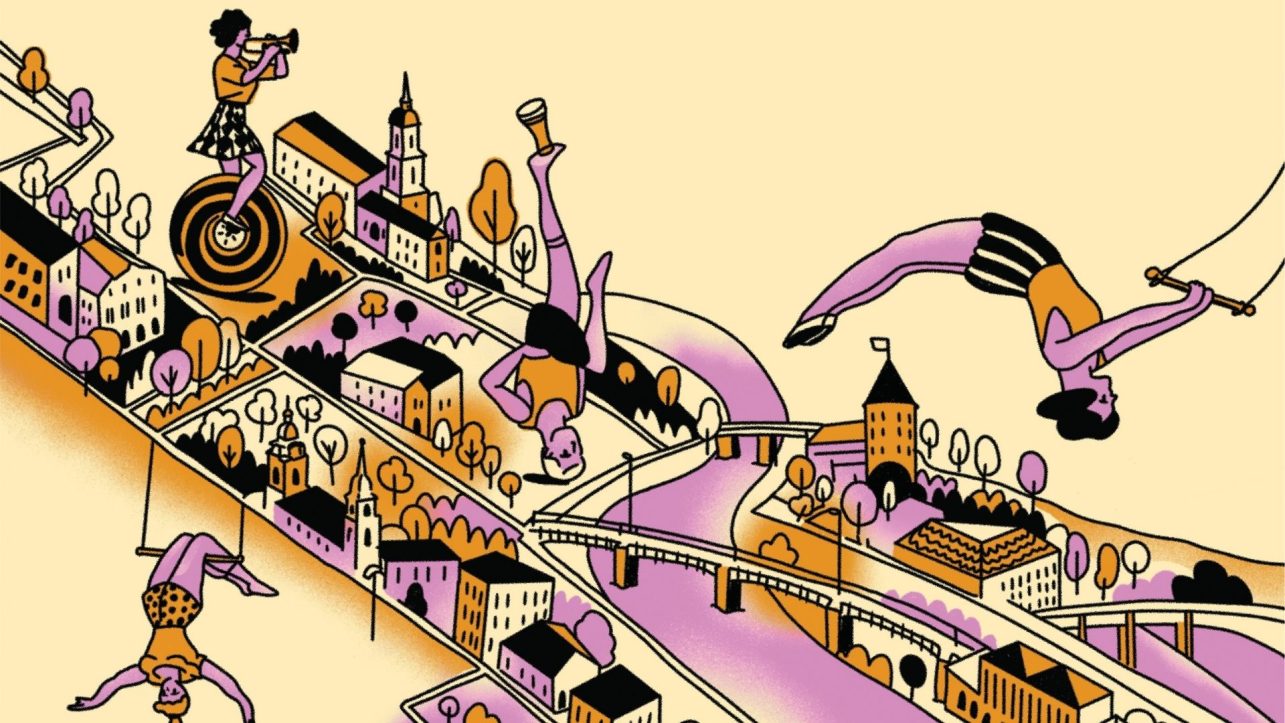
The history of the “Cirkuliacija” (Circulation) festival is closely linked to our magazine – since 2017, we have been announcing every edition, and we have interviewed and filmed the champions of the idea – director Gildas Aleksa and producer Monika Citvaraitė-Lansbergienė from the “Teatronas” organisation – as well as the performers and guests they have nurtured.
However, we certainly couldn’t boast about visiting every single performance, so it was fascinating to sit down with Gildas and try to map out the festival travels across Kaunas, and now across all of Lithuania. On this map are the stops where Lithuanians learned not only circus disciplines and etiquette, but also how to relate to the other and the different.
Prehistory
Although we began our conversation with the festival director from 2017 in Eiguliai, I later read in our own magazine, published in July of that year, that the “international contemporary circus educational festival was being held for the third year.” The internet forgets nothing, so a couple of clicks later, I am reading an announcement in the 2013 edition of “Kauno diena”.
“On 8–9 June, a contemporary circus festival is being organised in Kaunas for the first time. The festival organisers are the Kaunas-based theatre troupe ‘Teatronas’ and the ‘Ugnies ratas’ studio, who have come together specifically for this project. The festival was conceived to introduce the Lithuanian people to the little-known genre of contemporary circus, a name which often still brings to mind trained lions or clowns dragging audience members into the ring. Creators of contemporary circus do not target a specific audience, hoping that the universal expression of body and music will be understood by representatives of all ages and nations. Most of the performers here are artists juggling various objects, acrobats appearing on the ground and in the air, contemporary dance performers, and clowns with professional acting training.”
And there it was! Gildas’s performance “Maja” was shown at “Girstutis”, and a street circus day took place in “Ryšių kiemelis 837”. The festival returned to this Old Town courtyard, as well as to the spaces of Vytautas Magnus University, in the summer of 2015, with the second event highlighting educational contemporary circus events for schoolchildren and performing arts professionals.
2017: Brazilians In Eiguliai
“Everything happened by accident in every sense,” Gildas recalls of 2017. That is to say, it could have taken place in Chile – the first Lithuanian contemporary circus professional, Monika Neverauskaitė, was choosing between that South American country and her homeland when deciding where to perform her graduation piece created at the “Le Lido” circus school in France. She made the right choice, but she didn’t have a tent and had to borrow one from the Swiss performers who came with her. Gildas remembers going to coordinate a permit to put the tent in the city centre. However, they had to settle in Eiguliai, next to a large rubbish container, without any funding or professional advertising, simply hoping that people passing by would drop in out of curiosity.
An unexpected bond formed between the curious locals and Monika’s fellow artists, who likewise spoke no English. Residents of the Eiguliai apartment blocks even began inviting the Brazilian artists into their homes, and the organisers realised that the greatest magic of the festival was not the performance itself, but the sincere communication before and after it. This successful, albeit unplanned, experience became the impulse to consciously continue the festival in other Kaunas neighbourhoods.
2018: A Dive Bar In Šilainiai
“Let’s do this intentionally,” the team decided after the improvised success in Eiguliai, and in 2018 they moved to Šilainiai. This district was chosen as a place where there was almost no cultural action, and Gildas recalls a vivid curatorial vision: a giant, bright pink tent set against the backdrop of grey Soviet blocks. A suitable plot was found near the former Šilainiai market, next to a local bar where beer cost just one euro at the time. Although the beginning was tense – locals were angry about their usual paths home being blocked, threatened to call the police, and the tent had to be closely guarded at night – the neighbourhood eventually warmed to the circus.
Community magic happened again in Šilainiai, but this time through the aforementioned bar. Its owner brought free treats for the artists, and the patrons became regular spectators. At the end of the festival, the bar owner even asked the circus not to leave, admitting that it had helped create the kind of cultured atmosphere she had always dreamed of. This, in Gildas’s words, crazy experience proved that contemporary circus could not only survive but also become part of the family even in the harshest context.
2019: A Children’s Home In Dainava
Having abandoned the expensive tent, the organisers took the path of activism in 2019 and settled “Cirkuliacija” in the former “Atžalynas” children’s care home in Dainava. Gildas’s incessant narrative – to find a permanent stage for independent arts – took physical form here: an abandoned building with interesting architecture became an experimental space. Although the ambitious plan to convince the municipality to establish a cultural centre there failed, the festival gates remain painted pink to this day.
In the courtyards of the Dainava apartment blocks, the artists found a unique way to communicate with the locals: after a performance by the Belgian parkour group BE FLAT across roofs and balconies, even the toughest local lads recognised them as “their own athletes”. The emotional turning point was a performance for the balconies (how prophetic, considering the approaching pandemic), during which the artists simply did nothing for 20 minutes – this generated a strong sense of fellowship between the audience and the creators. Despite initial misunderstandings, it again ended with the residents themselves asking them to stay, because “nothing happens in Dainava either.”
2020: Visiting The Gruodis Family
In 2020, the festival was supposed to reach Vilijampolė, but plans were adjusted by the pandemic and lockdown. All the festival action moved online, and the physical headquarters of “Cirkuliacija” became the home of the composer Juozas Gruodis, located right next to the Varnių bridge, overlooking Vilijampolė.
Although in-person meetings became impossible, the festival did not stray from exploring the theme “Private Zone”. Enlisting foreign artists such as the Canadian Claudel Doucet and the charismatic Ariel Bronz from Israel, the organisers held virtual creative workshops. In these private, unhurried sessions, they delved into the district’s identity and memory, trying to find ways for contemporary circus to exist even under strict lockdown conditions.
2021: A Very Strange Festival
When restrictions eased, “Cirkuliacija” took place not just in one location, but simultaneously in Vilijampolė, Kaišiadorys, Smalininkai, and Raseiniai. “We could finally do events, but they had to be held outdoors, which meant almost all the works had to be adapted,” Gildas sighs. In Vilijampolė, the festival moved into a wonderful historical site, an old beer brewery. Today, nothing much of a cultural nature happens there, though it certainly could.
The year 2021 was also etched into Gildas’s memory due to the political climate – the first “Family March” was taking place at the time. Local bikers worked as security at the brewery; being participants in the march themselves, they met openly queer artists in the same space. The festival director remembers that it was good to watch the circus become a bridge: everyone together, despite radically different views, watched the performance through the rain and wind.
2022: A Debt To A Boxing Club In Šančiai
2022 was a massive year for the festival: Kaunas, as the European Capital of Culture, hosted a meeting of the international “Circostrada” network in Šančiai, with over a hundred professionals attending. Since Šančiai lacks traditional cultural spaces, they had to improvise: events took place in a stairwell (after getting permission from the community to hang equipment), in educational institutions, a former factory, and even a boxing club. Gildas suddenly remembers that he still owes the club a few hundred euros for rent because they haven’t managed to issue an invoice.
That year, “Cirkuliacija” continued to travel across Lithuania. Foreign guests even took Bolt taxis from Kaunas to Prienai to see the shows. It was in Prienai that a rapid education of the audience occurred: after discussions about the language of contemporary circus, locals realised that it wasn’t necessary to applaud after every trick – it was better to let the atmosphere of the performance linger uninterrupted until the very end.
2023: Further From Europe
“Cirkuliacija” consciously turned towards non-European creators, inviting artists from Palestine, Morocco, Chile, Brazil, and Senegal to show their work not only to Kaunas residents, but also to people in Vilnius, Prienai, Šiauliai, Varėna… or perhaps just to circus fans who enjoy chasing shows across Lithuania. This year’s idea was born when Gildas noticed that the European festival scene had become too “white and French”, so he wanted to show his colleagues and the audience a different, more diverse range of work. The technical decision to move from informal spaces to professional halls was not only financial, but also based on values – it was a sign of respect for artists who often don’t have the opportunity in their own countries to prepare elaborate technical riders or high-quality video recordings. The hall allowed them to present themselves with dignity and the highest possible quality.
This programme brought incredible contrasts and cultural collisions. The Moroccans “soaked up the full European experience”: partying until dawn and falling off the teeterboard the next day, while the Palestinians moved the audience with “the saddest performance in the world”, as critic Rūta Oginskaitė called it. The latter was watched by the current mayor of Vilnius, who at the time was clashing with the circus community over his vocabulary; he was sent by the administration to look for common ground and perhaps discuss new spaces for art, which never materialised.
There was no shortage of emotion elsewhere: from a Senegalese artist who fell in love with night-time Vilnius to the success of the Palestinians currently conquering Edinburgh. The Moroccan troupe, incidentally, has since disbanded. I remember those days at “Girstutis” myself – it was a time to think about freedom, identity, and different realities of life. Perhaps a little too early, a little too quietly, but nevertheless.
2024: The Last Summer
In 2024, “Cirkuliacija” raised the theme of “Biographies”, and it was also the last year the festival was held in the summer. The logic was simple: to use outdoor performances to attract audiences into the halls because, according to Gildas, it often only “dawns on people” that there is a circus in town at the very end of the festival. Performances reached unexpected spaces – from Lukiškės Prison in Vilnius to the square near the Kaunas State Musical Theatre. The core of the programme became sensitive pieces that tell stories, such as the performance “Head Over Wheels”, in which an artist in a wheelchair flew through the air. Gildas recalls that seeing the surprised looks of the audience gave him the feeling that the festival was doing something truly meaningful. “We tried to move towards the idea that circus tells stories, rather than just showing tricks,” says the director, who considers the 2024 programme a very successful attempt to establish circus as a profound narrative art.
2025: Hunger For Kaunas Halls
For many spectators, last year’s festival programme, “Returns and Discoveries”, seemed the strongest yet. Its main idea was to encourage the audience to follow not just the performances, but the journeys of specific artists; hence, those who had already performed here returned to Lithuania. The festival became massive not only in content but also in geography: “Cirkuliacija” took over “Dūmų fabrikas” and “Arts Printing House” in Vilnius, and travelled to Palanga, Anykščiai, Prienai, and Tauragė. A new format also appeared: first touring Lithuania with one performance, then concluding the action in the major cities.
Despite the success, Gildas wants to raise the question of Kaunas halls. Although the festival’s ambitions are growing and they would like to bring in world-renowned troupes, the city lacks suitable spaces – after giving up “Girstutis”, only the 99-seat “Kamerinis” theatre remains, which is simply too small for events of this level. Future plans include even more focus on Kaunas, perhaps even changing the traditional timing of the festival, but the main question remains the same: where to show contemporary circus?
2026: Celebrating, And What Next?
In November 2026, “Cirkuliacija” announces “The Celebration”. You can find a conversation with one of its participants in this issue of the magazine, and a more detailed announcement of events in the November issue. What next? The answer lies in the already confirmed theme for 2027 – “Is it circus?”, which will question the very boundaries of the circus. Gildas emphasises that the constant denial of stereotypes remains the festival’s engine.
As we say goodbye, we agree that from that tent next to the dumpster to the present day, the main idea of the festival has remained unchanged – to prove that contemporary circus is not cheap entertainment, but a professional and multifaceted art. Although the essence remains the same, the festival has grown unrecognisably in terms of professionalism: from working for a percentage of ticket sales to ensuring dignified conditions for artists and curating a high-level programme.
The most striking change has occurred in the festival’s geography and mission. If “Cirkuliacija” initially rooted around the courtyards of Kaunas neighbourhoods, it has now expanded to the regions of Lithuania. Gildas sees this as an essential task – ensuring that contemporary professional art is accessible to everyone, regardless of where they live.