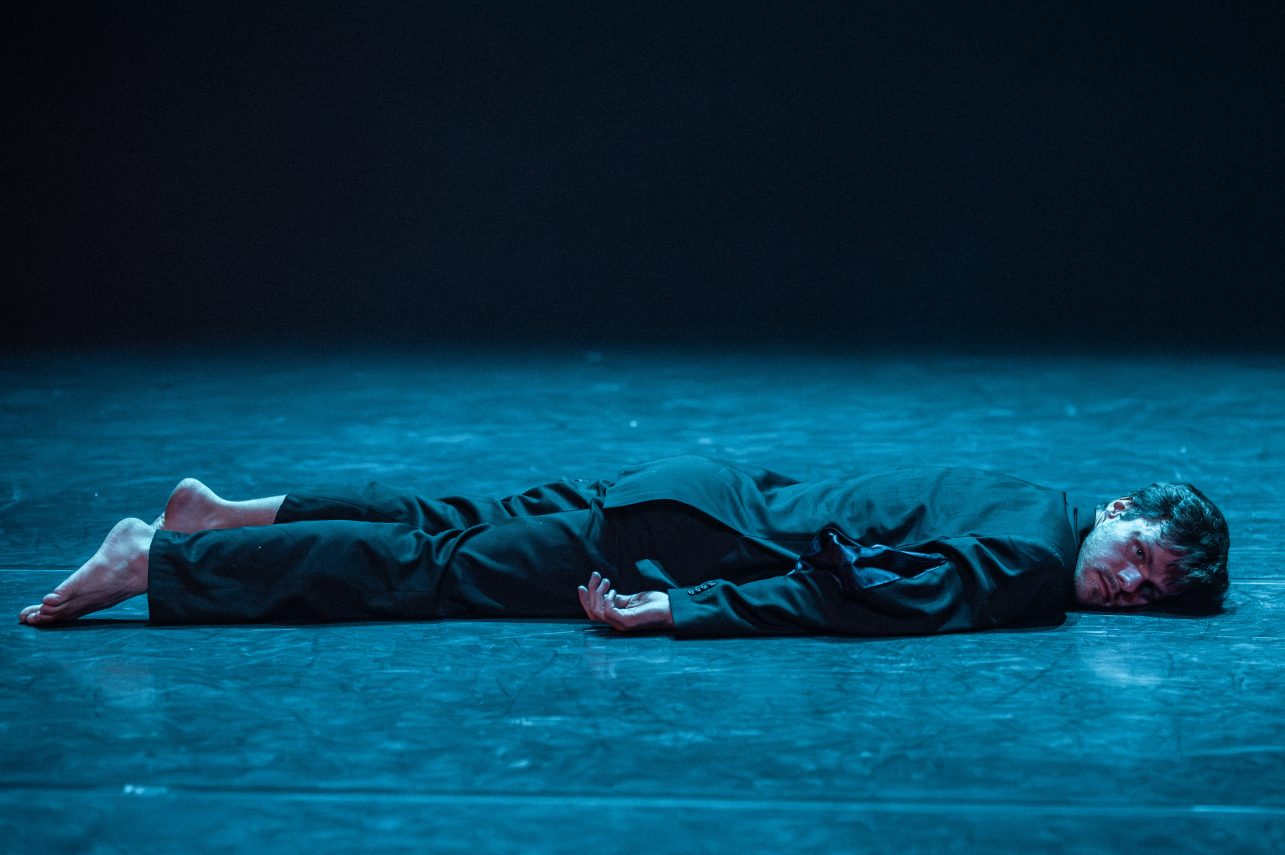
The contemporary circus community is small, so it is no surprise that our paths constantly cross – in the wings of festivals, at performances, or in educational workshops. This meeting feels less like a formal interview and more like a gathering of old colleagues. Both interviewees, Kęstas Matusevičius and Džiugas Kunsmanas, are Kaunas natives and contemporary circus creators representing the same generation. However, their language of movement was shaped by two different foreign schools and unique experiences.
You both left Kaunas to study in different countries: Džiugas went to Italy, to the Flic school in Turin, and Kęstas to Finland, to SaSak in the city of Lahti. Tell us what fascinated you about contemporary circus.
Kęstas: I was introduced to the circus thanks to fire performers. I remember attending the EJC (European Juggling Convention) and seeing aerial acrobatics and handstand workshops; it was a total shock to me. I thought, “Do people really just do this for an hour and a half?” Then you realise they live for it their whole lives. I also saw an open-stage act where a guy simply peeled a banana, and it blew the minds of a couple of thousand spectators. It wasn’t clearly circus, nor theatre, nor dance – just a specific manipulation of an object that completely engaged the audience.
Džiugas: For me, the very beginning was accidentally discovering recordings of James Thierrée. We had nothing like that here, and I was fascinated by the synthesis: theatre, dance, music – everything combined into one. Later, I found out about festivals and workshops where you could meet professionals. That was a huge help because previously I hadn’t even considered that circus schools existed at all.
Kęstas: When I arrived in Finland, I was amazed: a huge hall with every possible apparatus. Mind you, comparing Finland to Southern or Western Europe, we were far from everything. In the West, circus students are constantly going to premieres and festivals, whereas in the North, we felt somewhat isolated – you don’t even experience FOMO because you don’t know how much is actually going on.
Džiugas: The differences are massive: France, Spain, and Italy have one kind of tradition, while in the Nordic and Baltic countries, contemporary circus looks completely different.
When talking about Lithuanian contemporary circus, the name Roberto Magro naturally comes up. What was his role in your creative journey?
Džiugas: For me, he radically changed my life from our very first meeting. Roberto is a long-term mentor I can always turn to; over time, we evolved from teacher and student into collaborators. It’s rare to find someone who invests so much in community building and human connections. He might appear to be just a director with crazy ideas – for example, at the Cirkuliacija festival, he once asked for an 8-metre anaconda, only to announce the next morning that it was no longer needed. However, his ability to see potential and value every individual is a huge lesson.
Kęstas: He gave me an incredible amount – my entire creative output is based on notes from his workshops. Roberto’s methodology is very open: it doesn’t turn you into a copy of him, but rather shows how much consistent work needs to be put in. There is no miracle – you just work non-stop, step by step. This helped me learn to analyse other performances and understand why one work resonates while another does not. At the same time, he has an incredibly warm, down-to-earth side: during rehearsals, like a caring grandmother, he’ll pull out and offer you an apple or a sweet.
Džiugas: He stands out for his firm focus on education. Others often care only about their personal style or creation, but Roberto strives to be a true mentor.
Kęstas: And his sense of humour is great – you quickly realise that without humour, you’ll get nowhere in life.
If you had to name one most important lesson from Roberto Magro, what would it be?
Kęstas: A working principle: “Repeat till you find the freedom”. Sometimes when learning choreography, it feels like nothing is working, but through constant repetition, you find a freedom where you can do whatever you want.
Both of you have worked at the Cirko Sapiens centre and continue your educational activities. How are the circus lessons going?
Džiugas: Experiences depend heavily on the context. Last year, I worked for three months in four schools in Kaunas. In some places, everything went so smoothly that the children started putting together their own performances – even eighth or ninth graders, who are usually hard to persuade, became incredibly fired up.
Kęstas: I worked with a class that the teachers called the worst in the school, suggesting I shouldn’t bother with them. But I liked them from the very start. Working with teenagers is a huge responsibility: you go home and keep overthinking why they reacted a certain way. Of course, teaching is like a muscle that needs constant training.
Džiugas: One of the most memorable projects was a four-year education programme in Linksmakalnis. Admittedly, we faced a challenge there – it’s hard to ensure continuity when you are only there temporarily, even though the young people want to keep learning. However, over those four years, they started following circus news and festivals, met artists from all over the world, and gained a deep understanding of what contemporary circus is.
Kęstas: In one school, after a few months, I thought, “That’s it, I’m never teaching anyone anything ever again.” However, later everything changed – the children saw me off with tears in their eyes. Most importantly, as they said themselves: “We started interacting as a class.” Circus isn’t just about creativity. In acrobatics, you must help others, touch them, and protect your partner. A sense of community and caring for one another emerged – a kind of positive side effect of the circus.
Džiugas, you worked with seniors at the Ąžuolynas Library, and Kęstas encountered older people through the Social Prescription initiative. What was that experience like?
Džiugas: It was total therapy for both me and the seniors. The activities were calm, although we did try acrobatics where possible. It wasn’t easy to adapt the exercises, but it was incredibly interesting. It’s good to see how sincerely they engage, buy tickets to performances, and come to discuss them. Circus activities for seniors are a wonderful thing.
Kęstas: While studying in Finland, I saw a group of seniors who prepared performances for the open stage. And working with seniors in Lithuania is true therapy. They are interested in everything; they ask questions and practice incessantly. They’d say, “I saw some balls in Decathlon,” and they’d bring them along to the next lesson having bought them.
The performance “The New Tenant” is showing in Klaipėda, where Kęstas is working as a circus choreographer alongside director Žilvinas Vingelis. How is it working with theatre actors?
Kęstas: My first priority is safety. When working with people from outside the circus, the main task is to discover their best physical qualities and, through them, search for a unique circus language. The process is very interesting, especially when the director sincerely cares that the circus blends organically with projections, lights, and music. The actors won’t become circus professionals, but they will leave with a much broader library of movements. I’ve noticed that theatres sometimes lack a culture of movement and warm-ups, and by introducing circus methods, the body moves much more freely on stage.
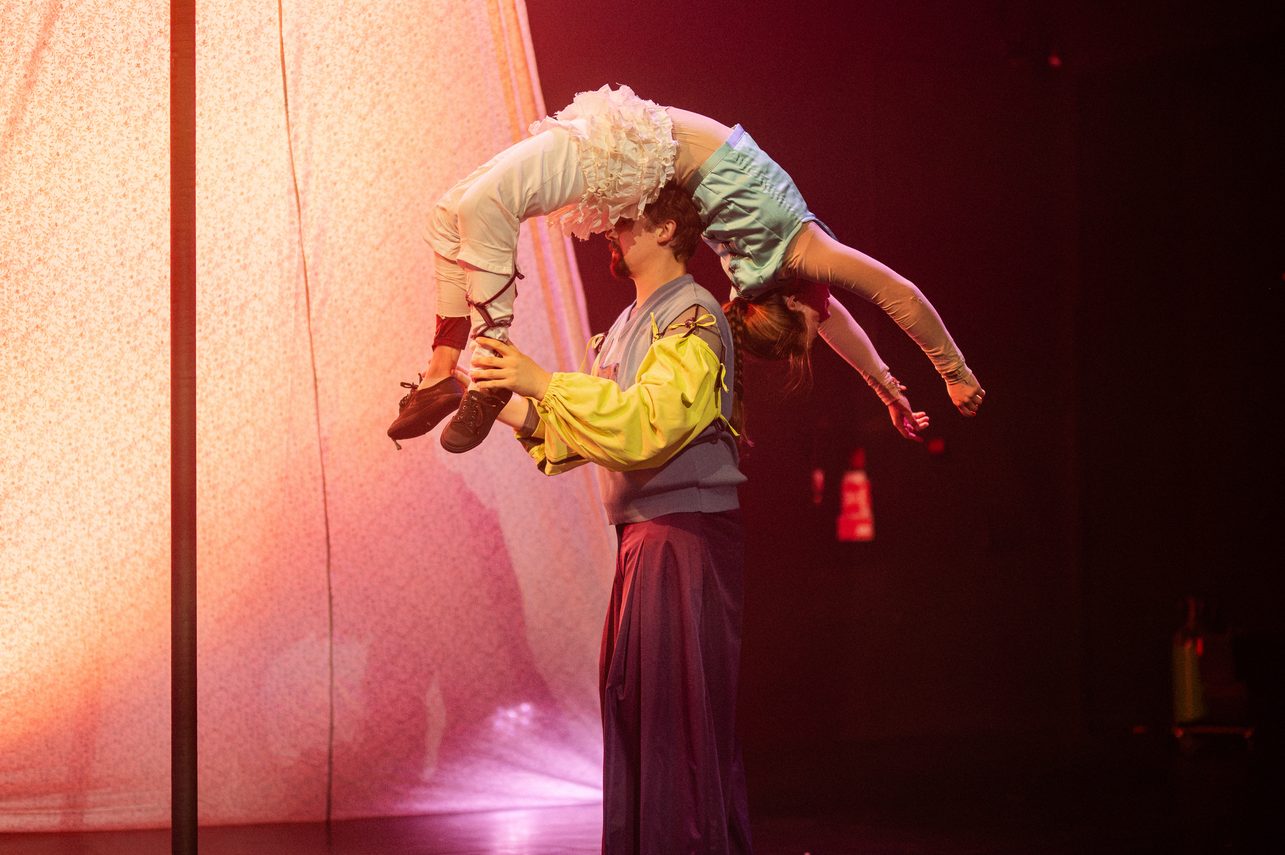
Kęstas is creating choreography for the National Kaunas Drama Theatre performance “Alice in the Looking-Glass”, and Džiugas’s solo performance “Icarus” is being shown at the Kaunas Chamber Theatre. How is theatre receiving contemporary circus?
Džiugas: The past few years have been a turning point – contemporary circus is establishing itself in the regular repertoires of theatres. This is an important stage that changes the accessibility of the circus. The first performance was born in Šiauliai (“Biedermann and the Fire Raisers”), and later I staged my own. The field is new, but it is gradually gaining trust. Working with colleagues in theatres has been excellent, and audiences are receiving this language very positively.
What are your plans for the near future?
Kęstas: A performance for babies is coming up – that is a new challenge for me. We are also continuing the Stork project: we hope to create a special circus apparatus by next summer that meets high European standards. We are further developing our podcast about the circus; I dream of setting up a dedicated studio for it. And, of course, the idea of a circus residence centre is swirling in our heads. We are going to Denmark to gain experience from the Dynamo centre, which was established by artists. We want to follow a similar path and establish such a centre in Lithuania – for now, we have nowhere to invite audiences, but we are keeping our fingers crossed and continuing our work.