Finally, the sun, for goodness’ sake. It is 23 degrees outside. I have just run 5 kilometres. It is hot; my shirt is soaked with sweat. My lips and mouth are as dry as the Sahara. I finish my route in Ąžuolynas, somewhere near the Darius and Girėnas monument, and wonder where the nearest place to quench my thirst might be.
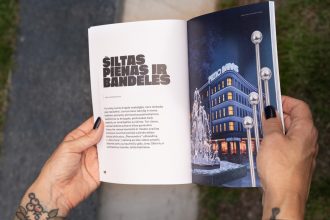
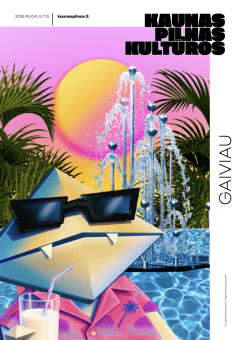
(This text was published in the August 2026 issue of the magazine “Kaunas Full of Culture”, titled “Refresh”)
At that moment, I didn’t yet know that there was an outdoor water station right nearby. Therefore, I head to the “Match by GREEN Cafe”, which recently opened its doors in the athletics arena, and with my fingers crossed, I ask for tap water. “Here you go, help yourself, there’s a whole pitcher ready.” With greedy gulps, I drink the most delicious water in the world (in my humble opinion as a Kaunas resident).
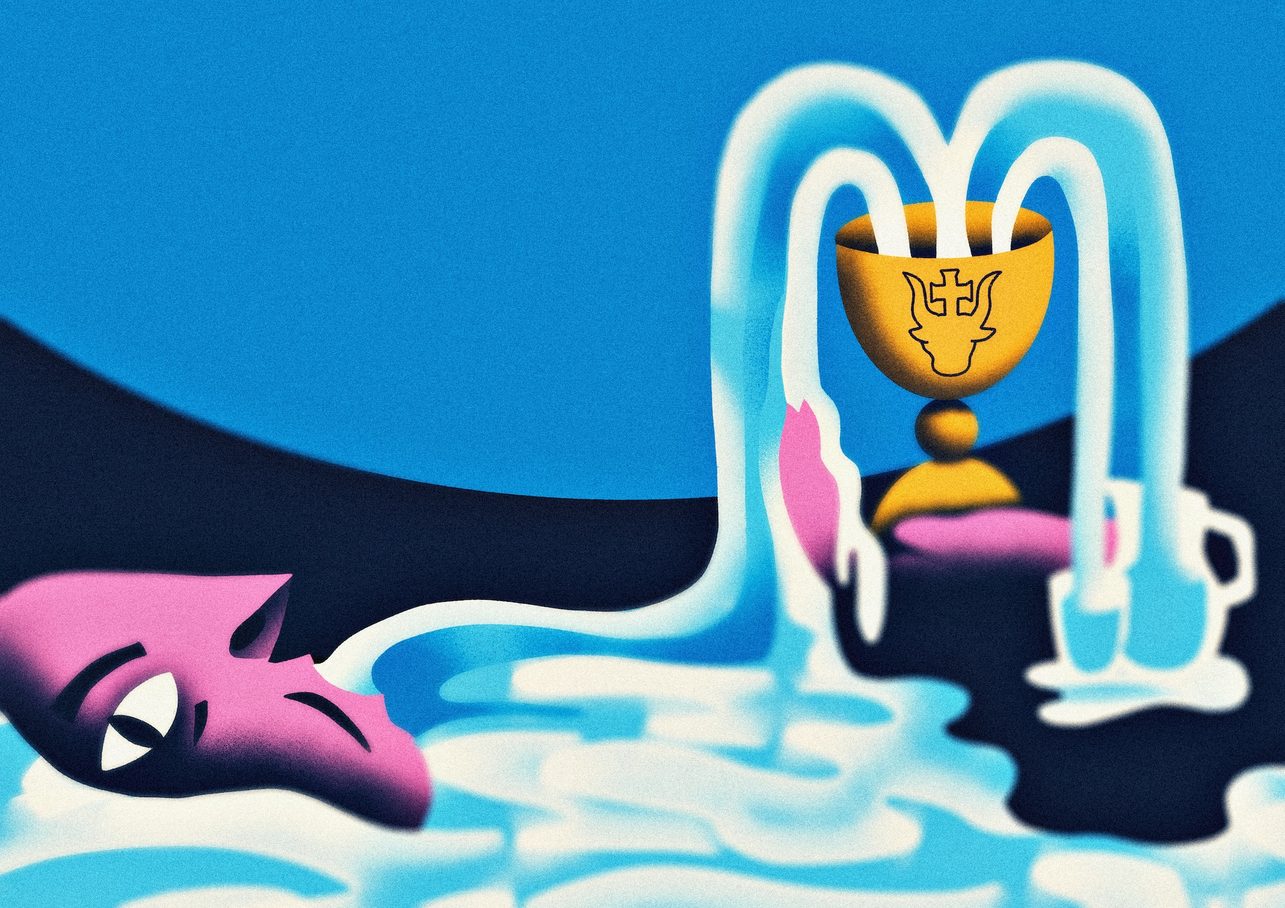
So far this summer, I have rarely made it out onto the track. But then again, the question of where to refresh oneself hasn’t been that frequent, as the answer is clear. One only needs to stand under the open sky and wait for the heavens to open.
However, Kaunas residents still need to drink enough water – at least two litres a day. Thus, the essential questions of this text are as follows: where and how to refresh oneself with Kaunas tap water if another heatwave strikes while you are out on the street and you don’t want to spend money. Are Kaunas cafes and bars happy to share it? Is the network of outdoor water stations wide enough? Objective and not-so-objective answers – right now.
A Unique Phenomenon On A National Scale
Let’s start with the backstory – where does “Kauno vandenys” get the water that sprays in fountains and flows from taps and outdoor stations?
Kaunas is supplied only with groundwater from the Eiguliai, Kleboniškis, Vičiūnai, and Petrašiūnai waterfields. The first two are near the Neris, while the others are connected to the waters of the Nemunas. And although extracting water from boreholes is not unique in the Lithuanian context, the distinctiveness of Kaunas water is determined precisely by its close relationship with Lithuania’s longest rivers.
The river water that feeds the city’s four waterfields spends 3 to 12 months permeating through layers of sand and gravel, naturally purifying itself before reaching consumers via boreholes. Thus, Kaunas drinks not just river water, but groundwater filtered by nature itself, its path and composition shaped by the two largest rivers in the city.
A slightly boring but important part – the latest chemical indicators of Kaunas water comply with hygiene standards. For example, in the Petrašiūnai waterfield, nitrates were found at 1.2 mg/l (the limit is 50 mg/l), iron at less than 10 µg/l (the limit is 200 µg/l), and manganese at 17–26 µg/l (the limit is 50 µg/l). Drink to your health.
Admittedly, Kaunas water is quite hard – usually around 2.5–3.2 mmol/l, or roughly 14–18 °dH. This is precisely why limescale builds up quickly in kettles. However, this poses no health risk – the hardness is caused by calcium and magnesium salts.
Of course, the taste and colour of the water in a specific house can also depend on the internal plumbing, and after repairs or a long period of disuse, iron sediment may appear.
Bars Generous With Water
How do Kaunas cafes and bars dispose of this delicious water? To find out, I decided to conduct a small field study and map out the water situation in the city centre and Žaliakalnis. Do cafes and bars charge for a glass of tap water? How do they react to a request to refill a bottle? Do they frown or say, “With pleasure”?
I begin my journey at the top of Parodos Hill – at the bar “Kiemas”. It is a warm evening. It seems as though the whole of Žaliakalnis has squeezed into the courtyard. I order a drink outside and ask for tap water with it. Despite the queue, the bartender climbs the steps inside and, without batting an eyelid, fills a glass.
Let’s move to the nearby “Kaukita”. There are no queues; a request to pour a glass of water alongside a drink is met with a nod. Here, I also notice a bowl of water from which dogs or other pets can refresh themselves outside.
Staying at the top, we visit a still undiscovered gem, the bar “Funikulierius”, located in the Žaliakalnis funicular building. Again, the bartender helps me quench my thirst.
I head down the Kauko stairs. At the bar “Kultūra”, as always, there is a mile-long queue. And, as always, the staff respond positively to my now well-worn request.
Let’s cross over to Laisvės Alėja. Bar “Godo”. Nothing new to report – five out of five.
Bar “Plus plus plus”. I go in during the middle of the day. Things are going too well, so I try a new approach. Perhaps I’ve been lucky so far because I was asking for water while buying a drink? Let’s try without one. The bartender at “Plus” fills a glass without hesitation. I drink it quickly and leave.
Although I didn’t test any more bars, the verdict is quite clear – whether you are buying a drink or just passing by, you can boldly step inside to refresh yourself.
Cafes Or Watering Holes?
I enter most cafes armed with a water bottle and a bladder prepared to suffer. I walk down the hill and march into “Habits”. A tap adorned with a blue spout, much like the baristas, invites you to use it. The water pressure is optimal – neither too fast nor too slow. Incidentally, an identical tap is installed at “Kasdienybės Bakehouse” – another cafe where no one frowns but, on the contrary, they let you refresh yourself with a smile.
All three “Caffeine” locations on Laisvės Alėja also have taps, though nothing out of the ordinary. The answer here is the usual one, but the water pressure is not. Be careful when turning the tap on fully, otherwise you will get splashed. A perfect choice for those in a hurry.
If you are in no hurry, head to “Kavalierius” on I. Kanto Street. Apparently, the relaxing atmosphere and friendly staff make the water run slower here.
I travel to the legendary “Spurginė”. A woman who jumped the queue in front of me is complaining that there are no doughnuts with curd: “Well, can’t you just buy some curd from the shop?” she asks in a spiteful tone and orders two with meat. I discuss the situation with the staff member and we have a little laugh. When I ask for water, she points to the sink in the common area. My Vytautas Magnus University bottle doesn’t fit in the sink – it’s too big. Why did that Vytautas have to be so Great? No matter: “Give it here, we’ll fill it up for you,” the employee says and quickly returns from the back with a half-full bottle.
As you have probably gathered by now, my experiment continued to go as smooth as butter. The barista at the small coffee shop “Kava virė” even asked if I wanted cold or lukewarm water. Two “Prezo” bakeries on Laisvės Alėja poured water from a special pitcher. Both “Vero Cafe” locations on Laisvės Alėja also had taps; furthermore, there were bowls for dogs here too.
What is the situation in restaurants? Here, table water is usually paid for. I didn’t conduct a separate study (it would have been quite expensive), but a quick consultation with AI suggests that the average price for a litre of table water is roughly 3 euros. Whether that is a lot or a little, I leave for you to decide.
Trailing Behind Klaipėda And Vilnius
But what if you don’t want to feel embarrassed or simply don’t wish to face bartenders and baristas eye-to-eye? Or if you are not in the city centre? To the rescue come the outdoor water stations maintained by “Kauno vandenys” – there are fifteen of them in total across Kaunas. Moreover, they are all pet-friendly.
The map of stations is quite broad: according to “Kauno vandenys”, you can refresh yourself at Studentų Square, near the Zoo, at the Kaunas Reservoir pier, in Draugystė, Girstutis, Kalniečiai, and Santaka parks, near Lampėdžiai beach, and on S. Daukantas and Sporto streets… It will be more convenient if you find the Kaunas water station map via Google search. At the start of last year’s warm season, eleven stations were operating, so the network is expanding.
“Kauno vandenys” does not yet have usage statistics for this year’s stations, but last year’s figures show that thirst is quenched most in the parks: the stations in Draugystė, Kalniečiai, and Santaka parks were the most popular. In total, during the season, Kaunas residents and guests filled up as much as 441,000 litres of water from them.
However, how does the accessibility of outdoor water stations in Kaunas compare with other major Lithuanian cities? For now, Kaunas has little to boast about. The Kaunas fifteen is smashed to pieces by 57 stations in Vilnius and 33 fountains in Klaipėda. This means that the Vilnius network, if we calculate the number of stations per inhabitant, is about 2 times denser, and Klaipėda’s is about 4 times denser than that of Kaunas.
After installing two more planned stops at Lampėdžiai beach, Kaunas would have 17 stations, but would still significantly lag behind its competitors. I hope that such a comparison will serve as an incentive to expand this network even further.
It is worth mentioning that Kaunas residents are also refreshed by four water misting stations, which are popular with adults and especially children. Of course, children often choose to refresh themselves in fountains, where pets also enjoy frolicking. For example, one can play with the jets shooting into the air in Vienybės Square or splash around in the small pools near the BLC building. However, “Kauno vandenys” does not recommend bathing in or, even more so, drinking fountain water – keep that in mind.
What Does That Water Taste Like?
And what do Kaunas residents say about the taste of the city’s water? I decided to ask my friends on Instagram and Facebook. Here are the results of another study that doesn’t claim maximum representativeness.
Of roughly 50 respondents, 20% stated that, like me, they find Kaunas drinking water to be the most delicious in the world. Another 30% indicated that it is “very, very tasty” to them. As many as 35% simply consider water a physiological need and don’t even think about its taste. And 15% responded that Kaunas water is not tasty to them. I disagree and am hurrying to unfriend them.
The final splash of this text is a wish for you. While the Kaunas public water network is running behind the backs of Klaipėda and Vilnius, don’t be afraid to strike up a conversation with bartenders and baristas – they certainly don’t bite. After all, you do need to drink two litres of water a day.