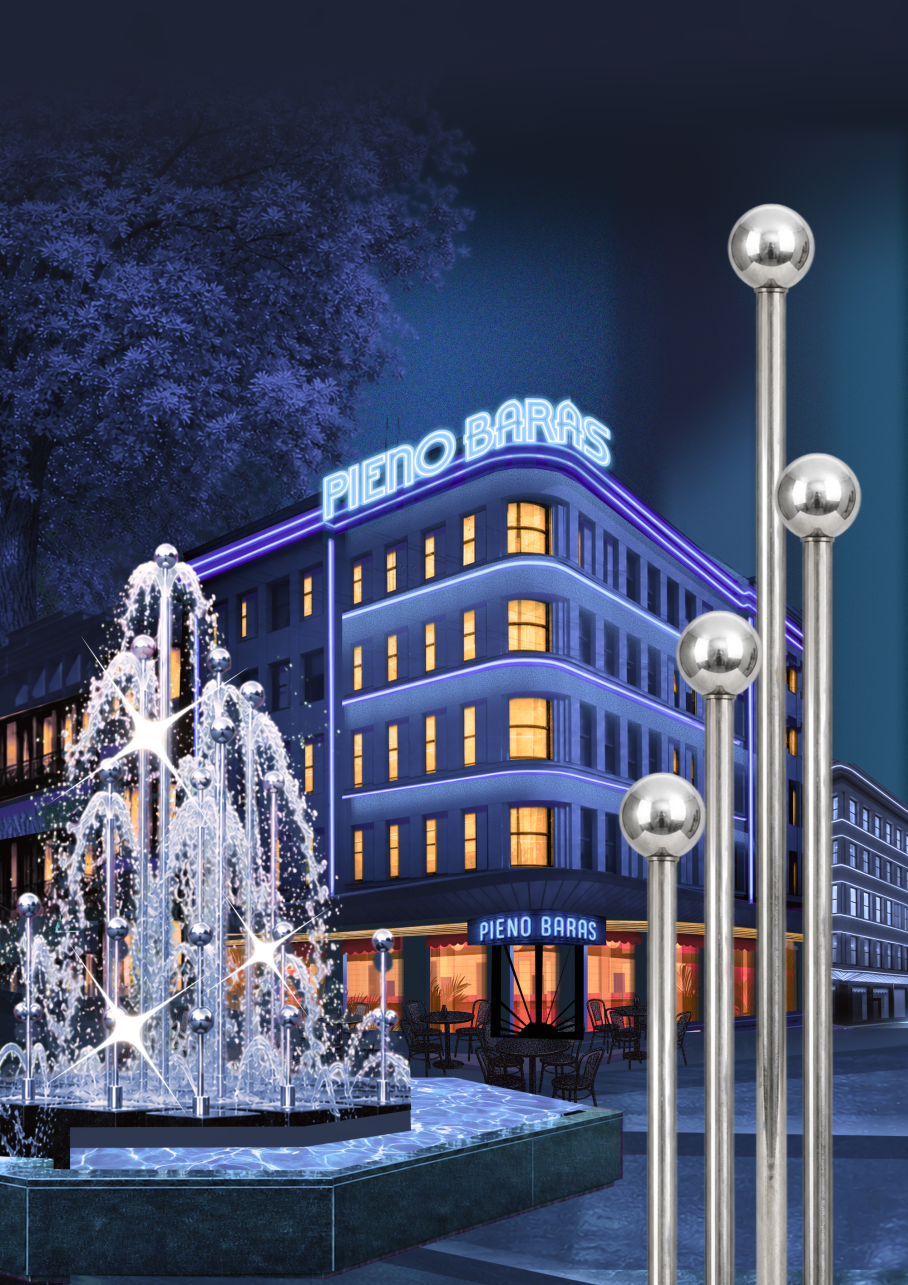
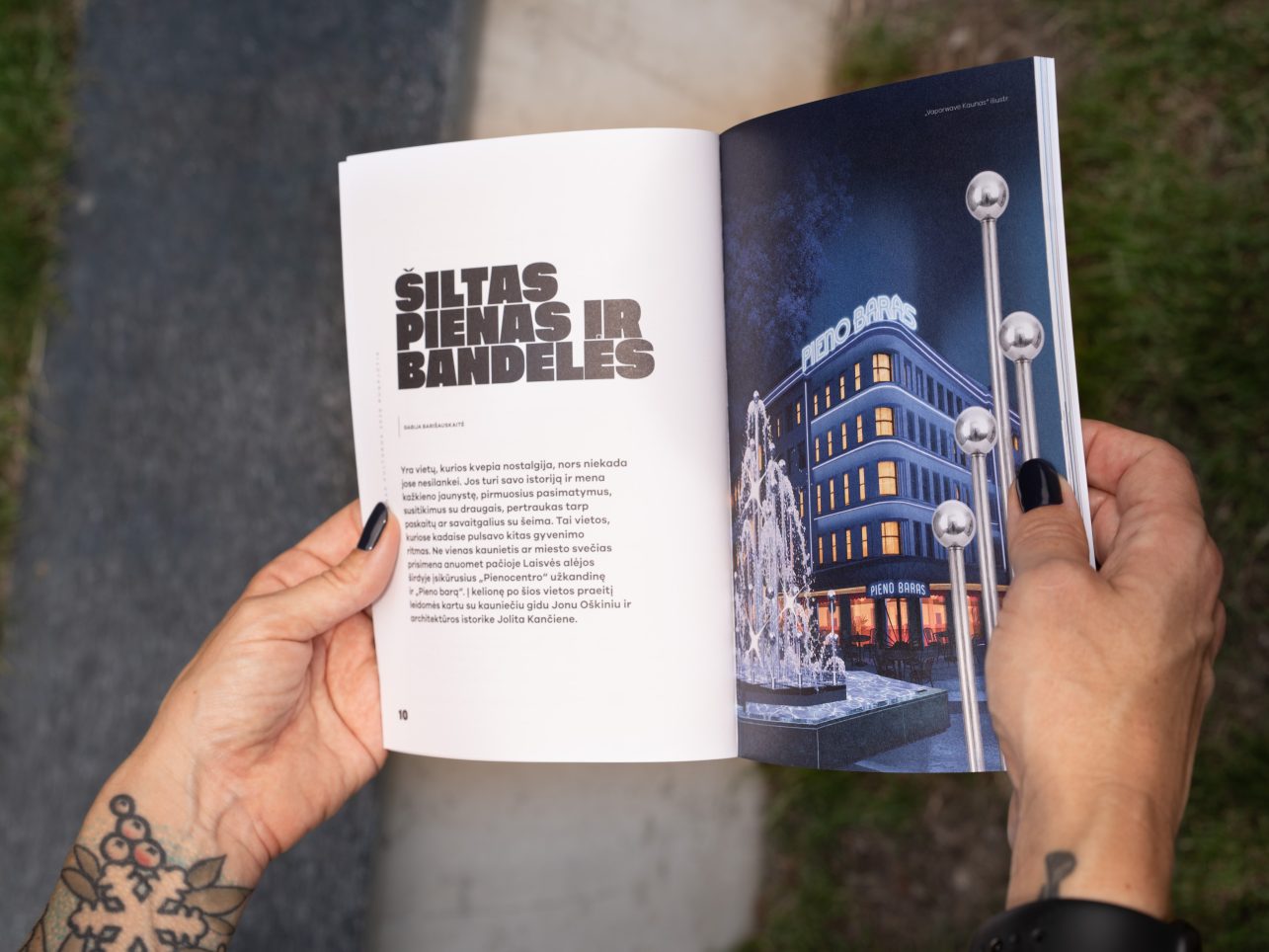
Some places carry a scent of nostalgia, even if you have never visited them. They have their own history and remind you of someone’s youth, first dates, meetings with friends, breaks between lectures, or weekends with the family. These are places that once had a different pulse of life. Many Kaunas locals, as well as visitors to the city, remember the Pienocentras canteen and Pieno baras. We embarked on a journey through the past of this place together with the guide Jonas Oškinis from Kaunas and architectural historian Jolita Kančienė.
(This text was published in the August 2026 issue of the magazine “Kaunas Full of Culture”, titled “Refresh”)
A journey through history
Although for many people this place is primarily associated with Kaunas in the 1980s, its history actually began during the interwar period. Guide J. Oškinis explains that the origins of the Milk Bar (Pieno baras) can be traced back to a decision by one of the largest companies in interwar Lithuania – the Central Union of Lithuanian Dairy Processing Cooperatives, Pienocentras – to construct a large administrative building in the center of Kaunas.
Discussing the building’s architectural solutions, J. Kančienė notes that its designer was Vytautas Landsbergis-Žemkalnis, the most prominent figure in Lithuanian modernism and modernist architecture.
The building was constructed using what was then an advanced technology: a monolithic reinforced concrete frame. Its façades had a granite finish, and the ground floor was decorated with black labradorite. “Another innovation – though one already tested in F. Vizbaras’s Central Post Office – was the use of curved glass windows. A hallmark of Western modernism was the illuminated glass canopy,” the architectural historian says. This multifunctional building housed commercial, administrative, residential (the upper floors housed Lithuanian government ministers with their families!) and even industrial facilities.
According to J. Oškinis, the concept of the interwar Milk Bar appears to have been similar to Poland’s bar mleczny tradition, which still exists today (the first such establishment opened in Warsaw in 1896). These were simple urban cafeterias where people could enjoy quick, inexpensive meals based on dairy products and flour. This is also supported by a remark in Kaunas Memories 1938–1939 by Leon Mitkiewicz, the only Polish military attaché stationed in Kaunas before the war. He wrote that Kaunas had eateries “similar to milk bars, where for a very modest price one could get a hearty meal.”
The first Milk Bar in the Pienocentras building opened its doors in the spring of 1932. Initially, it occupied a small space next to the dairy shop on S. Daukanto Street, but demand proved so great that it had to expand within just a few months. According to J. Kančienė, the flow of visitors never subsided. The establishment’s popularity was due to its cleanliness, orderliness, courteous service, and inexpensive, wholesome food. “For just 25 cents, customers could buy a glass of hot milk and a bread roll. Cream, kefir, and coffee were also available. The menu was later expanded to include sour milk with potatoes and even… milk champagne! It was a carbonated fermented milk drink produced under the premium-quality Rūta label,” the historian explains while describing the menu.
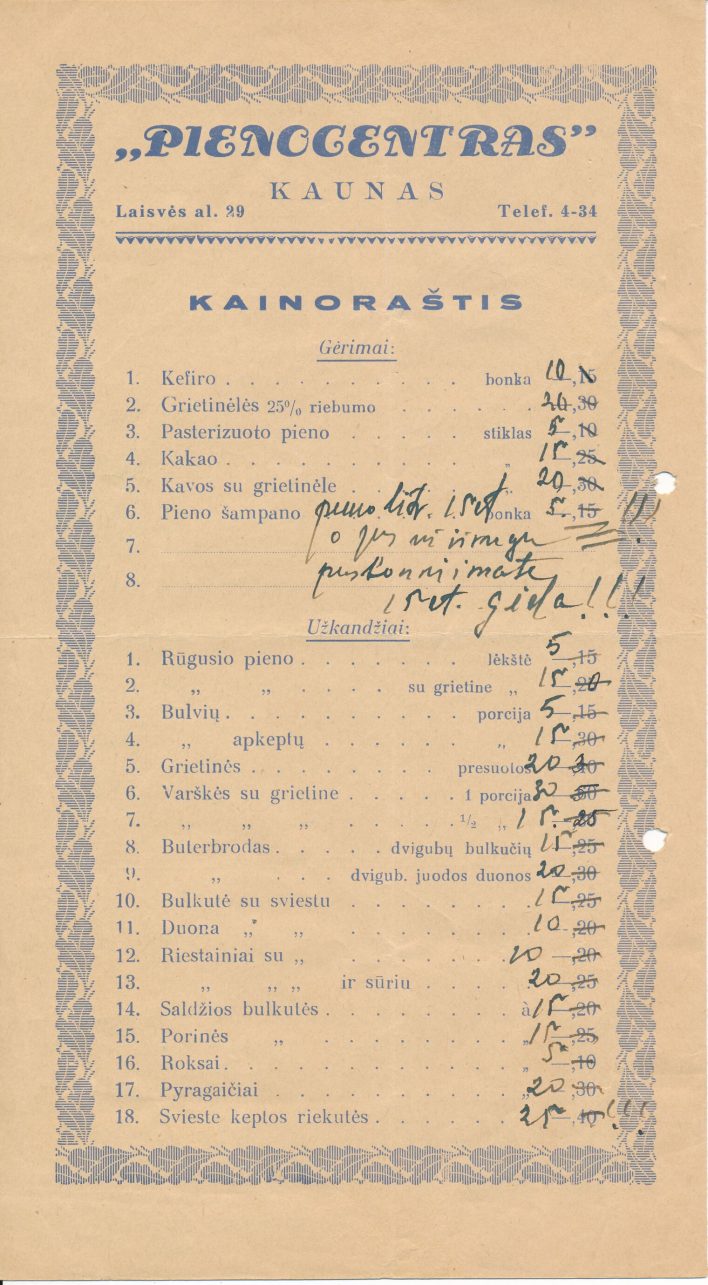
In 1934, a summer outdoor café was set up next to the palace. The townspeople nicknamed it The Garden of Pienocentras. According to the interviewee, it quickly became the subject of local legend, while the name Pieno baras (Milk Bar) first appeared in written sources in 1938. Its operations were interrupted during the war and were not revived until four decades later. Guide J. Oškinis explains that in the autumn of 1982, the reconstruction of the entire Laisvės Avenue was completed according to the plans of architects Alfredas Paulauskas and Vanda Paleckienė. At that time, the site still housed the Dairy Combine’s flagship store, but in 1983, the Milk Bar officially opened there, featuring an interior designed by architect Jonas Maciulevičius. “By then, they were no longer serving sour milk with potatoes. Instead, they began baking fresh, refined pastries that stood in sharp contrast to the canteen-style “three-kopek buns” or ordinary sandwich bread. In addition, they were presented in a decorative interior with wood carvings, and were served by waitresses, so the managers of Soviet Kaunas companies – for example, the Pieno kombinatas (Milk Combine) – could boldly and proudly invite guests from both Lithuania and abroad,” J. Oškinis explained.
After Lithuania regained its independence, the Milk Bar was forced out by one of the many banks that took over the premises. An attempt was made to revive it in 2009, but about a year after reopening, it closed its doors once again. Why did the legendary Milk Bar fail to make a comeback? According to J. Kančienė, the most likely reason was the change in public tastes and eating habits. In her view, milk had once been a staple of everyday nutrition. “The post-Soviet generation rushed to eat pizza and sushi and drink Coca-Cola and kombucha. The Milk Bar closed because, in the end, that’s how the market works.”
More than a place to eat
Although during the interwar period this establishment was valued primarily for its inexpensive, high-quality food, over time it became an important part of everyday life in Kaunas. As the decades passed, not only did the menu change, but so did its clientele, and, with them, the role the place played in the city’s social life. J. Kančienė states that during the interwar period, the eatery was primarily oriented towards the urban middle class. “Its primary customers were office workers, university students, and high school pupils. It was affordable, the food was familiar – just like home – and you could have a quick, tasty meal. Were people going on dates or having lively discussions over sour milk and hot potatoes? I doubt it. The potatoes would have gone cold,” she jokes.
According to J. Oškinis, however, by the 1980s the Milk Bar had taken on an entirely different role. Located in the very heart of Laisvės Avenue, it became a natural meeting place. “During the interwar period, people arranged to meet by the clock, and from the Soviet era onward, by the fountain. If they didn’t want to continue getting to know each other over coffee or cocktails, they often went to the Milk Bar instead,” the guide explains. According to him, the clientele had also changed. Whereas in the interwar years the establishment was frequented mainly by visitors from the countryside and more budget-conscious residents of Kaunas, during the Soviet period the Milk Bar attracted people looking for a distinctive atmosphere and high-quality pastries.
Many still associate Milk Bar with fresh buns and a glass of hot milk. The first thing they remember is not the interior or the pace but the taste. Yet, J. Oškinis is convinced that it was not the food alone that drew people in. “I think that, in the drab reality of the Soviet era, people were impressed by the pastries’ exceptional confectionery quality – with icing, raisins, and other ingredients that were available here despite shortages – as well as by the fact that they were served warm, which was considered a “Western” or “Smetona-era” style of presentation. Even as a child and a teenager, I was fascinated by the fact that they served warm milk. Although, to be fair, if you let it sit for a while, it developed a skin on top, which I wasn’t particularly fond of…”
Not just a memory
Although the Milk Bar is gone, it is still remembered with great nostalgia. According to J. Kančienė, places like this matter not only for their architecture or the food they served. They become part of a city’s collective memory and help shape its identity. “If a city’s public spaces and buildings do not reflect its history, there is little point in searching for its identity. A great deal depends on what remains constant rather than changing with fashions or market whims – not only the exterior of buildings, but also what they contain. In Europe’s old cities, century-old theatres, cafés, bookshops, and pharmacies are still in operation. Those are cities with a spirit and a sense of identity.”
Places like these may disappear from the city’s map, but they continue to live on in people’s memories. For some, they evoke the taste of warm milk and freshly baked pastries straight from the oven; for others, they bring back memories of student lunches or walks along Laisvės Avenue. And it is from memories like these that a city’s history is ultimately woven.