“Kalnietis finishes his career and dives into football,” such headlines circulated in the media at the beginning of 2023. At the time, it seemed unexpected, but we all quickly got used to it.
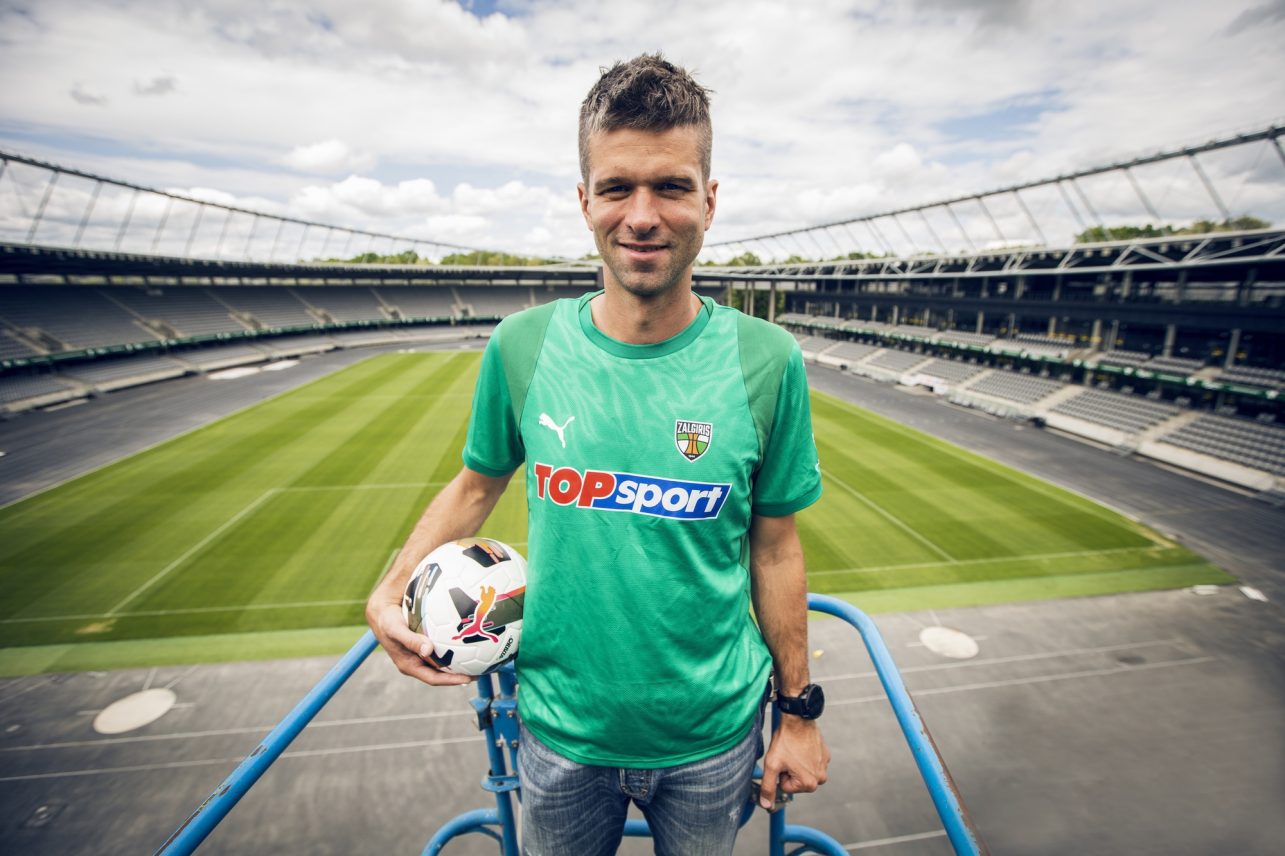
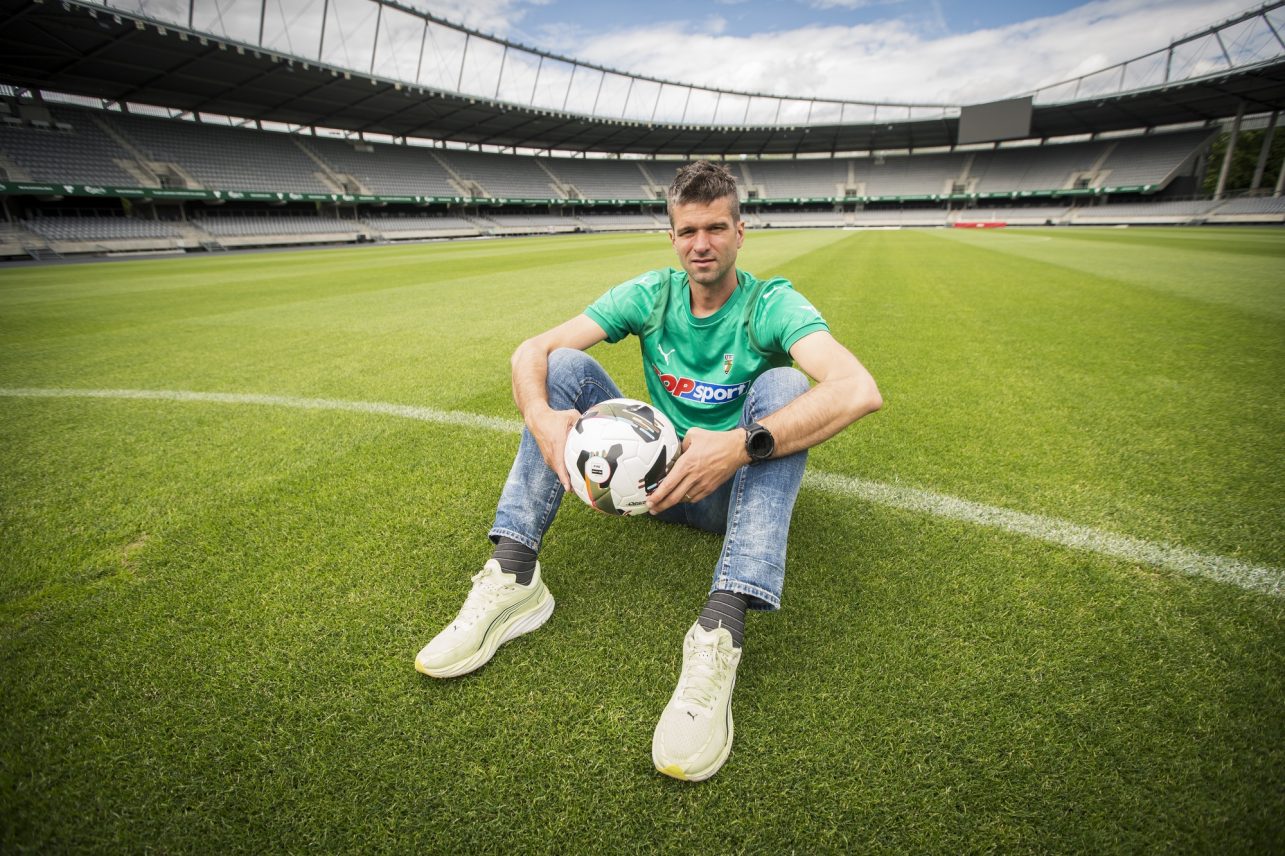
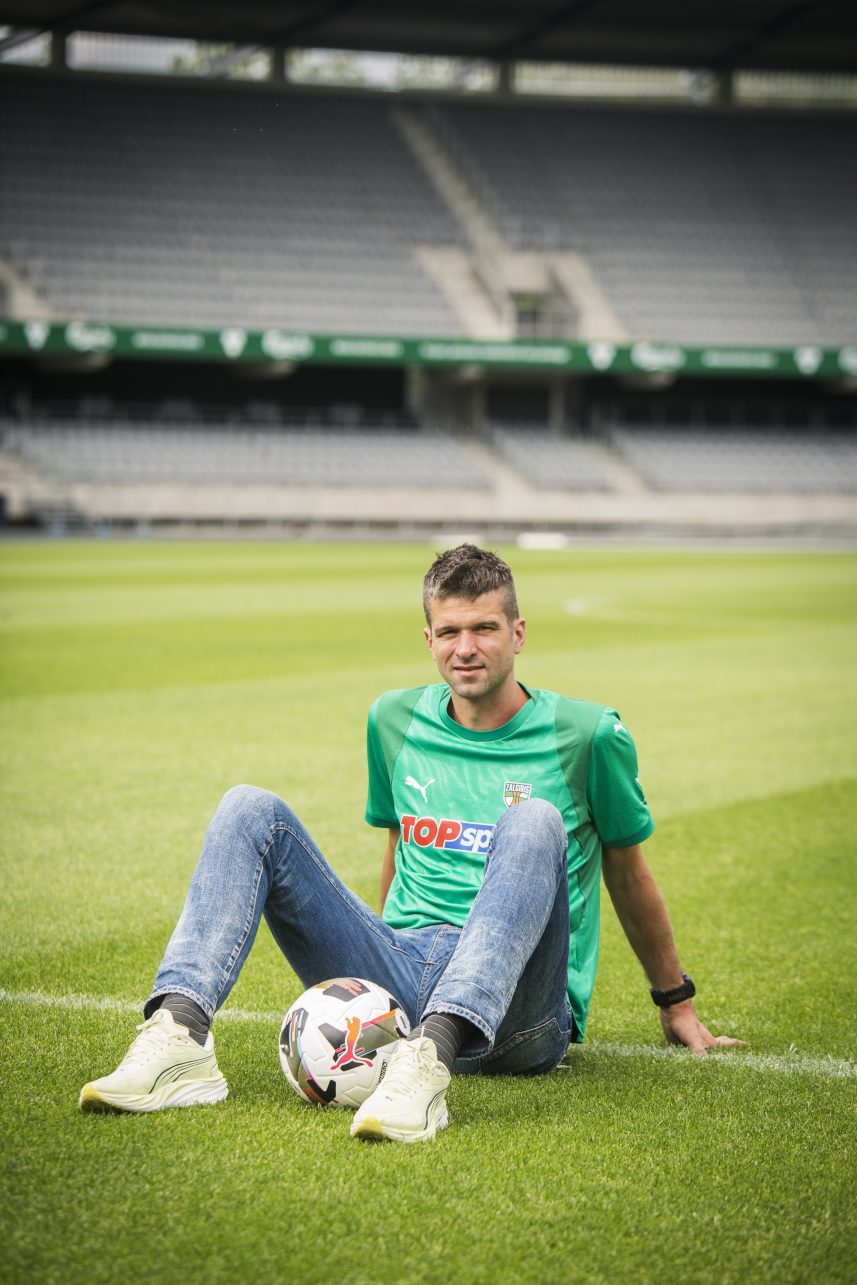
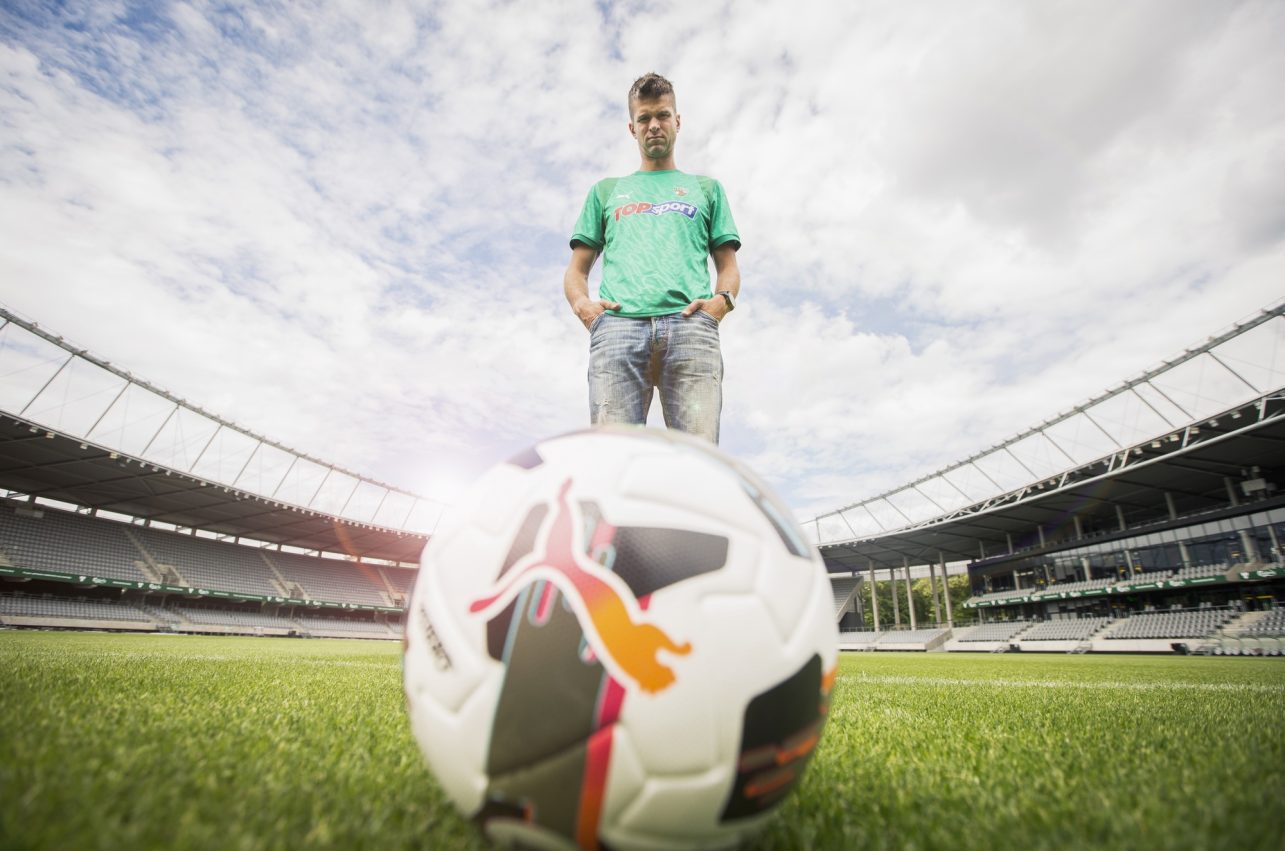
We met with the former captain of the Lithuanian men’s national basketball team, and now the president of Kaunas’s representative men’s football team, FK Kauno Žalgiris, at the Darius and Girėnas Stadium in mid-June. By the time this magazine went to press, several pieces of news important to the club and Lithuanian football had already emerged. For example, the draw for the second UEFA Champions League qualifying round took place. Also, in June, following a prolonged lack of points in the TOPLYGA, the club said goodbye to coach Eivinas Černiauskas, who had worked here for a year and a half, and welcomed new players as soon as the drought ended. However, Mantas Kalnietis still finds time to tune into the World Cup broadcasts. But let’s start from the beginning.
Did an athlete, whose days were always organized by coaches and other specialists, find it easy to transition into a new role?
In fact, at the beginning, when the athlete’s routine had to be replaced by the rhythm of a manager, it was a shock. I think this is difficult for all athletes; after all, we are used to exercising a lot and resting accordingly. I’ll admit that, even after more than three years, I often get sleepy in the afternoons. Sometimes I stretch out on the sofa at work and black out for at least ten minutes; then I’m fresh again (smiles). As for being a manager? There are ups and downs, but when I finished my basketball career, I knew immediately what I would do. So it is very nice to remember the past, but I quickly distanced myself from it, and other tasks and other challenges began.
Most basketball players stay in the sport in one form or another. Why wasn’t the basketball court your future path?
During the pandemic, I realized that I didn’t want to be a coach, even though I had thought about it before. I played abroad for almost ten years, and we always traveled with the family. The last stop of my career abroad was in russia; I played there even before the war. When the family arrived, my oldest daughter was about eleven, and she needed an international school like the ones she attended in other countries. We realized there were simply no opportunities for her to study there; based on her knowledge at the time, she probably could have worked there as an English teacher herself.
The family returned to Kaunas, and I stayed alone. It was then that I realized I would not choose the path of a coach; those years abroad had exhausted me. Not so much physically as emotionally; I felt a strong longing for home. Every free chance I got, I would take several planes just to be in Kaunas for a short while. I realized that I value the city and the people here more than any coaching profession.
I started looking for other paths, and I always liked football. I saw huge potential here: a new stadium and the strong Žalgiris brand. Of course, if it weren’t Žalgiris, I don’t know if I would have gotten involved in this whole thing. I see our greatest advantage over all other Lithuanian teams: synergy with the basketball club. We can use all the resources, experience, and groundwork that basketball already has.
And what does the president of a football club actually do? From the outside, it might look like a purely ceremonial position: waving, shaking hands, and giving interviews.
In fact, the activities are extremely diverse. This includes youth football; this year we revamped the reserve team, basing it on the basketball model. I try to attend the main team’s training sessions as often as possible. Although football tactics are not my strongest suit, I see many commonalities with basketball that I genuinely care about. Also, improving infrastructure, working with partners…
Sometimes I joke that I stand there like a Christmas tree; I just have to be there and wave because people recognize me. But the next day, I am personally delivering tickets to partners to make sure they actually come to the match.
Interest in football in Kaunas and Lithuania as a whole is certainly growing. How do you feel: can basketball and football passions coexist in our city?
FK Kauno Žalgiris are already Lithuanian champions. Of course, we cannot yet compare in terms of attention or history with basketball, but I think such a partnership is very healthy. There are plenty of examples abroad where several strong sports coexist perfectly in large cities, like Madrid or Barcelona. There, you simply feel like part of one large organization, whether it’s basketball or football.
One of my main jobs is to gradually build the understanding that this is the same team, just a different sport. We have to convince people with our results and our play to come to the Darius and Girėnas Stadium. We want it to become as pleasant a routine as visiting the Žalgirio Arena, so that Kaunas residents simply enjoy their city’s team.
And the fans would support you even when things aren’t going well?
When I played basketball myself, a full arena and chanting fans were the norm for me, something that went without saying. Only after coming here did I realize: it’s not that simple at all.
This year, I spoke with the “Green White Boys” myself and told them: we absolutely need you at the stadium, because with you, the players feel completely different. I understand them perfectly: there are many basketball games, the loads are high, people have jobs, families, and other hobbies. So we agreed that they would come when they could. However, I told myself internally: that alone is not enough. We have to do something ourselves to ensure organized support at every game. That’s how a youth group emerged this year to carry this banner. It’s a gradually growing group, brotherly to the GWB, who are like mentors to them. A few dozen young people already gather for whom football is a priority. I tell them: “You are the beginning of this movement. Maybe in twenty years, getting a ticket to football will be just as hard as to basketball, and then you will bring your children and tell them, this is where it all began.”
And how many spectators do your club’s home games attract now?
The TOPLYGA average at the Darius and Girėnas Stadium would probably be close to three thousand. However, the numbers vary significantly. For example, for the last match against Vilnius Žalgiris, over eight thousand spectators gathered, which greatly raises the general statistics. But when we play at an alternative stadium during the cold season, only a few hundred show up.
The number of visitors is our priority. As soon as I started working here, I realized it couldn’t stay this way; we must grow our fans. We go to schools, invite families, and encourage interest in football. It’s very nice that this groundwork is gradually bearing fruit and people are coming to the stadium.
When the Žalgirio Arena opened, few people dreamed that fifteen years later all EuroLeague home games would be sold out.
Yes, this is where a Lithuanian trait manifests: we often follow the result. If we didn’t count the core of the most loyal fans who always support the team, there aren’t many fans who would go to all the games no matter what. I would agree that this takes time and effort. In addition, it is important to note that the Žalgirio Arena is packed for international matches, while ordinary LKL matches do not attract as many local spectators. The football situation is similar, so the most important thing for us now is to move forward step by step, not to fall behind, and to consistently grow that number of interested people.
Football is a commercial affair. How do you manage to balance sporting spirit and financial results?
True, football culture in Lithuania still struggles to pay off from a business perspective, but with consistent work, the situation is improving. I think that the football system in the world is created much better than that of basketball. Here’s a simple example: if we made it into even the third strongest European tournament, the UEFA Conference League, we would earn more than the basketball team winning the EuroLeague. The motivational system created by European organizations, which encourages effort, winning, and attracting spectators, makes football a much more promising business than basketball. We are working in that direction.
What are Žalgiris’ goals now? You are the Lithuanian champions, what’s next?
We want to reach new heights as quickly as possible, but I evaluate everything soberly: we still need to learn quite a few lessons so that we don’t bite off more than we can chew and then fall painfully back down. Of course, our greatest ambition is to reach the main stages of European tournaments. For now, we are talking about the Conference League. This would give a huge boost to interest in football in Kaunas.
And if Kaunas were a football player, what position would he play?
A very good question. Over the past years, I have formulated another goal: I want Kaunas to be a forward. Observing national teams of various ages, I strongly miss that winner’s mentality. We really aren’t such bad players, but we still have that inferiority complex: we go onto the field to “hold out,” to close up in defense. This annoys me terribly.
I constantly hammer it into the heads of my team, and especially the coaches and players: if we want to see people in the stands, we cannot just stand in defense and not play football. We must attack, dominate, score goals, and want to tear their throats out. So, unambiguously: Kaunas is a forward.
If you had to be a guide for colleagues from abroad and show them the modern city, where would you take them?
Probably our greatest pride is still the Žalgirio Arena. Whenever I have the chance, I always take guests to show them the level of conditions basketball has here. But for me, Kaunas is not places, but people. Kaunas residents are simply different. As much as I lived abroad, sometimes it was difficult to adapt due to certain cultural differences; only when I returned home did I always feel like I belonged.
What is your all-time favorite football team?
My sympathies have changed over time, but for the past twenty years, I have supported Liverpool. My wife’s family infected me with this passion, and so this team stayed in my life.
Since this issue of the magazine appears in the heat of the World Cup, where does your heart lie when it comes to national football? Maybe you have a favorite country or style of play?
Earlier, although it was a fairly unpopular decision, I used to root for Germany. However, later, many “international” players appeared in their national team, the team changed, and that specific “vibe” that fascinated me before was gone. So now I don’t have one very big favorite; I just watch the football itself.
When watching a game from a box, do you catch yourself thinking: “I would have done it differently”?
Often! (laughs) I understand perfectly how easy it is to criticize everything from a fan’s perspective. Since I am very emotional, during matches I try to move away from the guests sitting behind the glass; I just disappear and go to watch the game on the roof. There I can freely get nervous, scream, or swear more colorfully. No one sees me or hears me there, and later I don’t have to feel ashamed of my emotions.