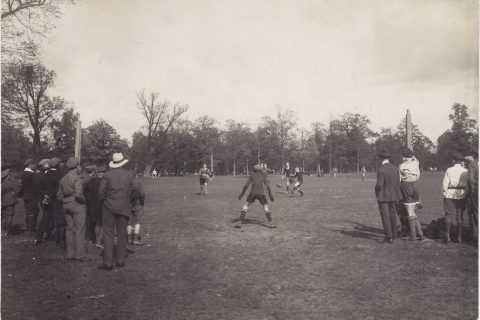
The year 2014, the World Cup final, Germany vs. Argentina. I am nearly kneeling in front of the television, just as a passionate fan, the former goalkeeper of the local football team, my grandfather, once knelt. This is my first vivid memory of the World Cup.
Hearing the word “football” more and more often in advertisements, on social media, and in conversations with friends, I set out in June, as this year’s championship approached, to interview six representatives from different cultural fields and find out why they love football, who they will support in this championship, how they will watch it, and who will be the winners. The topic of football brought together very different people: an Egyptologist, a bibliographer, the chairman of the Kaunas Jewish Community, a poet, a slammer, and an actress. Their relationship with football varies, but each has their own story and list of favorites.
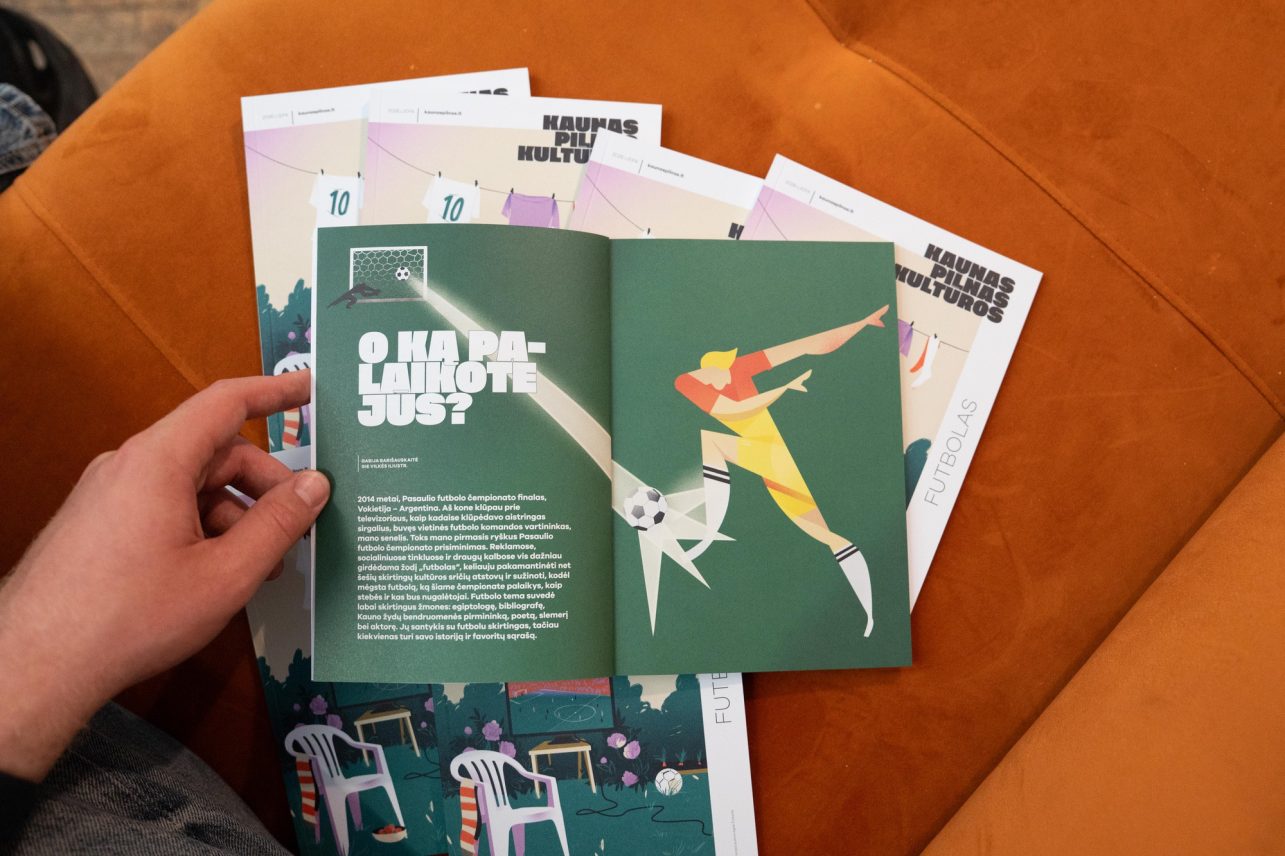
(This text was published in the July 2026 issue of the magazine Kaunas Full of Culture titled “Football”)
Why football?
Although the professions and life experiences of the interviewees are different, for many, the love of football came from the family. Bibliographer and historian Skaidra Grabauskienė remembers the fateful 1994 World Cup final, where Brazil faced Italy. Sitting down at night with her father, a huge fan of the Brazilians, she ended up not only finishing the match but supporting them for the rest of her life.
A similar origin story is told by her colleague, Egyptologist Sandra Veprauskienė, whose father also brought this sport into her life. As she says, she was always a “daddy’s girl,” so football was around since childhood. However, the World Cup was best experienced in 2014, when she lived in Belgium with her family and strongly supported the Belgian national team.
The atmosphere of football has also accompanied actress Rūta Waller since childhood. “The acquaintance with the ‘king of sports’ began in childhood when I spent summers in Aleksotas. My grandfather would take holidays to watch the World Cup on television, so I grew up during those summers with the sounds of the stadium, the chants, and the black-and-white ball,” Rūta shares. Later, even more football appeared in her life; her husband Michael is also a big fan, supporting Manchester United, so she even gets to see a match or two live in a stadium occasionally.
Slam poet and writer Jovaras Kelpšas calls his relationship with football multifaceted. He began to take an interest in the seventh grade; as he states himself, it was very difficult to match his classmates, so it was a good incentive to become better. In later grades, he started playing in his spare time and actively watching championships; he has not missed a single one since 2012. After enrolling in a master’s degree in social anthropology, he chose the fans of the Vilnius Žalgiris football club – the ultras – as the object of his research. Joining their ranks, he had an extraordinary opportunity to observe everything up close: he chanted like them, dressed like them, traveled to matches, shared emotions, and saw the club from the inside.
On the other hand, Gercas Žakas, a former football player, coach, referee, and chairman of the Kaunas Jewish Community, turned his love of football into his life’s path. “My father was a great football lover; he would take me, still a small child, to matches, where I would play with other children. That is how I fell in love with this sport and couldn’t see myself anywhere else,” said G. Žakas. The athlete’s journey continued for almost 30 years, during which he graduated from the Institute of Physical Education, played for the Lithuanian national team, and represented several Lithuanian football clubs. After finishing his professional career, he refereed, obtained an international category license, and later became the president and inspector of the referees’ association. As he states, his love for football has never changed; it was both a job and a hobby.
Poet Tomas Vyšniauskas calls himself a constant news follower or a “stealthy follower.” “During the major championships, the eyes bulge, the gaze sharpens, the hearing becomes more sensitive, the heart rate speeds up; in short, the interest deepens,” Tomas confesses. A special place in his life is occupied by FK Kauno Žalgiris; he follows the team’s activities closely and, when given the chance, shouts along in the stadium stands.
Who are we rooting for?
It was clear who S. Grabauskienė was supporting this year as soon as I saw her. Dressed in a Brazil national team shirt, she remains loyal to the team she has supported since childhood. As she states, she is impressed not only by the team but by the entire history of Brazilian football, calling South American football simply a celebration.
S. Veprauskienė is rooting for Egypt this year. As an Egyptologist, this choice seems completely natural. Although the Egyptian national team is not considered among the favorites, she hopes that the team will finally manage to win its first victory in the history of the World Cup.
Several interviewees express sympathy for Germany. J. Kelpšas has supported Germany since 2012, after spending a month’s vacation in that country as a child. Germany seemed to him such an orderly, utopian country that he later chose to learn German at school, became interested in the culture, and naturally chose to support the German national team. Tomas Vyšniauskas also supports the German football team for several reasons. “I am a consistent person; I have supported this team since 1990. During that time, I have seen mountains and valleys, hills and pits, the clear blue sky of triumph, and the mists of fiasco. Another reason is that, in my time, I was fascinated by the organization, teamwork, and discipline of German footballers,” the interviewee explained.
Gercas Žakas, who does not have clear favorites, will primarily support the championship organizers for their hard work and the celebration they organized for the people. He will also support states with which his views and values coincide – for example, Germany.
Meanwhile, R. Waller’s choice was determined by her family. Since Lithuania is not playing in the World Cup, she will support England, the country with which she is connected through her British husband.
Watching habits
Although all the interviewees were sincerely looking forward to the World Cup, their match-watching rituals are quite different. As soon as I asked about watching habits, S. Veprauskienė almost shouted: “Wigs are a must!” For her, watching football must be fun, colorful, and noisy, a chance to shout a little. She usually watches the matches at home, inviting friends, and this year she is preparing gold-glistening Egyptian costumes.
S. Grabauskienė usually watches the matches at home. She also has ritual symbols that have accompanied her for ten years: a football whistle and earrings in the shape of footballs. She confesses that during the football championships, she does not part with these decorations for a whole month.
J. Kelpšas watches football at home or on his phone wherever he happens to be at the time. He likes not only to watch but also to listen to podcasts about football to better understand the context.
Former coach and player G. Žakas also chooses to enjoy the championship at home. He says that you see more when watching alone because those around you often talk about other things, while he likes to go deep and notice mistakes.
Tomas Vyšniauskas also watches international tournaments at home, jokingly explaining: “So that no one sees what is poured in the goblet.” He remembers nostalgically that in pre-digital times, with the help of a ruler and a ballpoint pen, he would draw and fill in the result tables himself, and during championships, he would archive the newspaper “Lietuvos sportas.”
Like the other interviewees, R. Waller usually watches the matches at home, but does not rule out the possibility of watching the broadcasts in the city.
Brightest memories
When talking about the brightest football memories, the interviewees list not only legendary matches or players but also personal moments that turned this sport into an important part of their lives. S. Veprauskienė does not hide her admiration for the goalkeeper Oliver Kahn, whom, as she jokes herself, she still dreams about. She is fascinated by the idea that one person can have such a great influence on the fate of the entire national team.
S. Grabauskienė highlights memories of the Brazilian legend Ronaldo Nazario and his impressive individual runs.
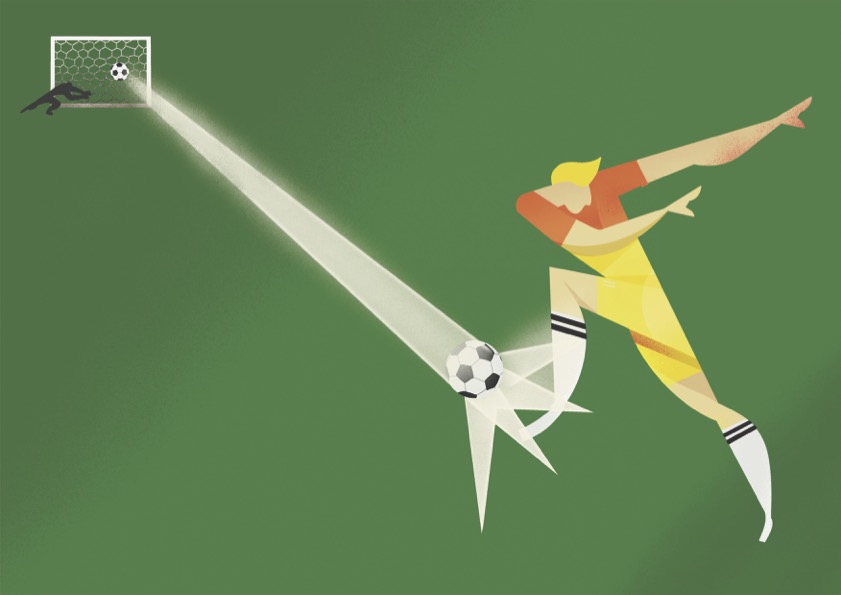
In J. Kelpšas’ memory, a special place is occupied by the 2014 World Cup final. He watched the final on television with his father, and after the latter fell asleep during extra time, Mario Götze scored the winning goal. “I went to sleep with the thought that the Germans are world champions. I was overwhelmed by a strange feeling of fulfillment,” the interviewee shares.
For G. Žakas, the most memorable moment is related to his own career. Around 1975, in a football tournament in Vilnius, he played against the Vilnius Žalgiris team and scored an impressive winning goal. The next day, he read the headline in the newspaper: “Gercas Žakas disarmed the Vilnius Žalgiris goalkeeper with a deadly shot.” The brightest memory related to international football is Maradona’s winning goal, “The Hand of God.”
Tomas Vyšniauskas points to the same memory. Besides this, the spit of F. Rijkaard in R. Völler’s hair and the bite marks of L. Suarez on G. Chiellini’s shoulder stuck in his mind. Ibra’s overhead kick from outside the box, M. Neuer’s pass across the whole field, and M. Klose’s one-touch goal. He mentions that, in the end, the failures of a favorite team also get etched into memory.
Memories of football take actress R. Waller back to her childhood. “June, long days, bright evenings, endless matches, and cracking sunflower seeds,” the interviewee shares nostalgically.
Who will win?
Some interviewees remain loyal to their favorite national teams, others observe trends and team composition and possibilities. S. Grabauskienė remains loyal to the Brazil national team. S. Veprauskienė, although she supports Egypt, senses that the trophy will go to South America.
Although J. Kelpšas’ heart belongs to the Germans, in his opinion, the Portuguese will lift the championship trophy. “Having consulted with a roadside stone, a constantly breaking down but faithful German Golf, and my own desires, I guess – Germany,” Tomas Vyšniauskas remains loyal to his favorite team. Although he would not be surprised by the success of Spain or France.
The hunch that the Spaniards or the French will lift the trophy also does not leave G. Žakas. And R. Waller half-jokingly, half-seriously reveals her sympathy: “How can the country that invented football fail to win the championship ever since 1966?”
Representatives of different cultural fields, different experiences, yet everyone agreed that football is not only a sport but also a large part of culture, carrying clear messages, educating values, and bringing together like-minded people. As I finish writing this text, Portugal and the Democratic Republic of Congo draw. Yet another reminder that the World Cup does not like advance predictions, and that is exactly why football continues to be the sport everyone talks about.