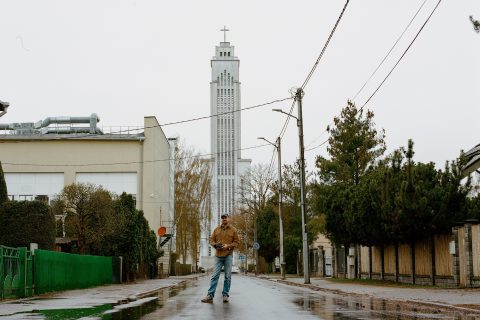
“It was not for nothing that Maironis established himself in this palace with a clear mission. Today, I continue that mission, feeling that the Lithuanian word still has the power to speak to a person,” says Tadas Jakubauskas when asked why he treasures his work. He began leading tours at the Maironis Lithuanian Literature Museum (MLLM) four years ago. According to Tadas, who comes from a background in philosophy, the museum is a space where metaphysical exchanges take place, reminding us that the Lithuanian word has a universal meaning that transcends the boundaries of time.
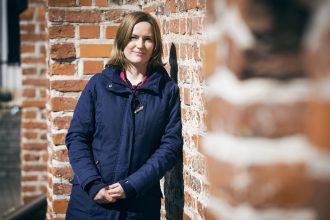
I sat down on the third floor of the palace with Tadas and his colleagues: Jolanta Mickienė, Deputy Director for Museology; Audronė Meškauskaitė, exhibition curator; Asta Zenkevičienė, Head of the Cultural Activities Organization and Communication Department; and public relations specialist Aistė Sabutienė. To get to the staircase, we had to push through a large group of schoolchildren, and the footsteps of curious visitors could be heard from Maironis’ apartment on the second floor, where an experiential tour was taking place. Even though it wasn’t the weekend; it was just a weekday morning.
(The text was published in the May 2026 issue of the magazine Kaunas Full of Culture, titled “Words”)
“Someone from above wants this museum to exist, so that the Lithuanian word can speak to the visitor. With everyone who comes here, we search for the value that Maironis himself encoded here, in his home,” Tadas shares another poignant and sensitive thought. I asked him to begin the story of the museum’s past and present.
Bard of the National Renaissance
The development of Lithuanian literature is divided, for good reason, into periods “before” and “after” the poet and priest Jonas Mačiulis-Maironis (1862–1932). The appearance of “Voices of Spring” (Pavasario balsai) in 1895 marked a turning point: the poet raised the Lithuanian language to the highest standards of Romanticism, so the nation stopped being ashamed of its identity. According to T. Jakubauskas, Maironis formed a vision of a unified Lithuania, where a glorious past, grand dukes, and castles became the moral foundation for future freedom.
The decision to write in Lithuanian was determined by a combination of factors. The foundation was laid by his father’s upbringing; in the Mačiulis home, despite the surrounding trends, everyone stubbornly spoke Lithuanian. The authority of Motiejus Valančius and a secret society of Lithuania lovers at the Kaunas Priest Seminary also had a significant influence. Although he wrote his first poems in Polish at the gymnasium, his studies in Saint Petersburg and his ties with the intelligentsia finally formed his patriotic direction. Maironis felt a moral injustice regarding the suppression of the language by the Tsarist Empire, and the echoes of the 1863 uprising experienced in childhood, as well as his father’s interrogations, only strengthened his determination to awaken the nation.
A Palace, Not Just a Residence
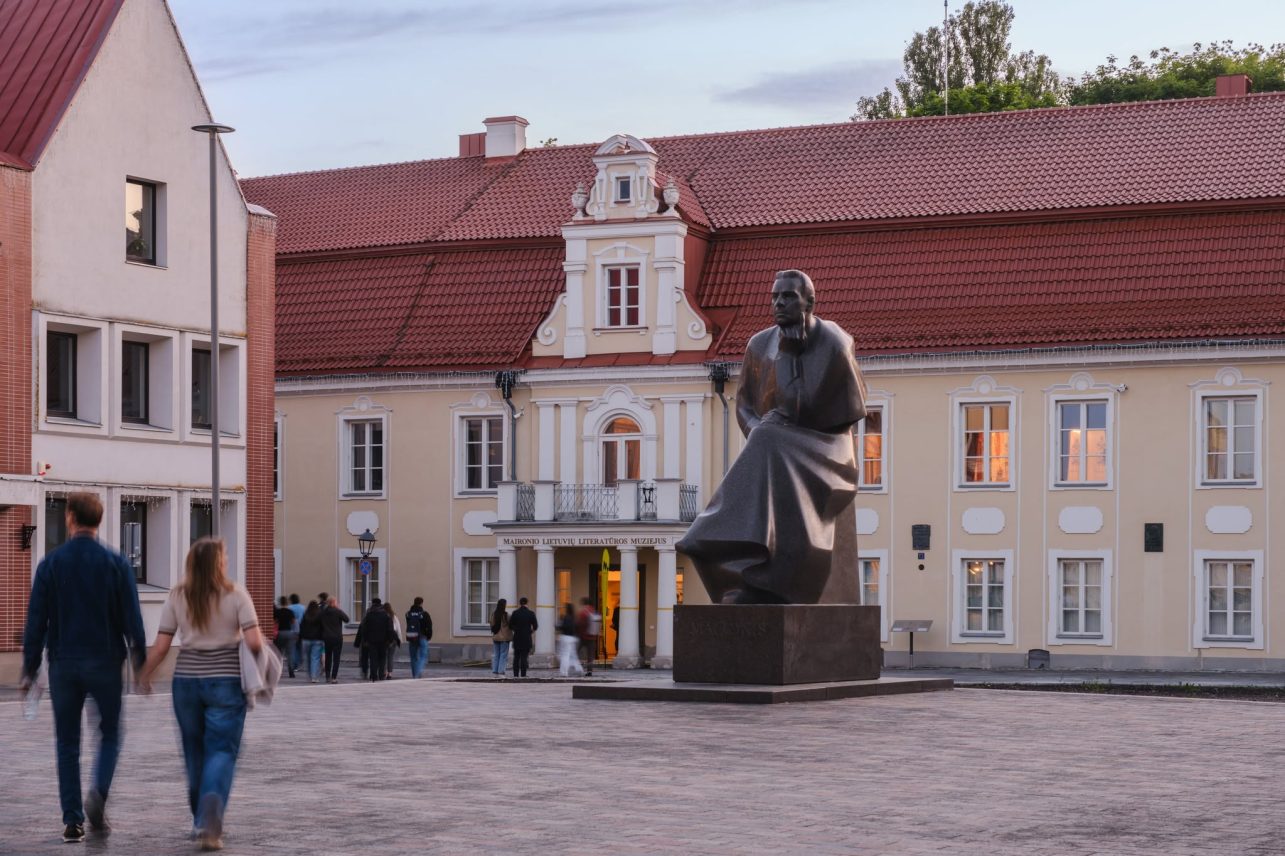
The museum operates in the southwestern corner of Town Hall Square; its building is also known as the Sirutis Palace, as it was built in the mid-18th century as a residence by Simonas Sirutis, the then-elder of Kaunas. After Sirutis’ death, the owners and purpose of the palace changed many times, until finally, in 1909, Maironis purchased the palace upon his return from Saint Petersburg. According to Tadas, the decision to buy this building was strongly influenced by Maironis’ friend Povilas Januševičius. He wanted a space in the very heart of the city to strengthen Lithuanian self-awareness, which had begun to weaken in the environment of the priest seminary after the death of M. Valančius.
Various organizations found refuge in the palace. The famous Sakalas publishing house operated on the first floor; Maironis provided a room for its founder Antanas Kniūkšta and supported him in every way, even though the publishing house often printed the work of young people who criticized the poet’s own writing. A humorous story survives about a shelf Kniūkšta hammered in the corridor: when a colleague sent by the poet complained about the noise, the publisher retorted that he was hammering shelves for books, not for vodka, which later made Maironis merely smile in approval. The Catholic magazine “Garnys”, edited by Adomas Jakštas, and the Society of St. Casimir also operated in the palace. This intellectual neighborhood turned the palace into a true bastion of the Lithuanian word.
What Do the Plaques Symbolize?
The Maironis Memorial Museum opened in 1936, becoming a “literature” museum four years later as it was decided to collect the legacy of other writers as well. During the first Soviet occupation, the institution was handed over to the Academy of Sciences and became… Tadas takes a deep breath… the Museum Named After Maironis of the Institute of Literature of the Academy of Sciences of the Lithuanian Soviet Socialist Republic. In 1955, the museum came under the care of the Ministry of Culture and… became the Kaunas Literature Museum. Audronė Meškauskaitė notes that such changes reflected the spirit of the times. During the years of occupation, the museum went through a difficult period; “Glavlit” dictated the content, and Marxism-Leninism corners along with the writings of Stalin and Lenin had to appear in the exhibitions; it was the only way for the museum to survive at all.
Tadas mentions a surviving letter from Bernardas Brazdžionis in America; in it, the first head of the museum deeply regrets that almost nothing was left of the poet’s legacy. While three memorial rooms greeted visitors when the museum was founded, at the beginning of the occupation they were compressed into a single small room where individual items belonging to Maironis were simply piled up. The remaining spaces in the palace were filled with Soviet propaganda and the writings of Lenin and Stalin at that time. The palace spaces were divided up: a kindergarten operated here, and part of the premises was turned into apartments.
It is symbolic that Maironis’ true “return” to his home began only in 1977, when it was finally possible to restore and reopen those same three authentic rooms to visitors. And only in 1989, with the National Renaissance already underway, did the Maironis name officially return to the institution. As the writer Aldona Ruseckaitė, who began leading the museum that year, remembers, the process was not complicated; it was enough to prepare a letter to the Ministry of Culture explaining why it was worth restoring the historical name. To be sure, discussions arose internally as to whether it should be a “literature” or a “Lithuanian literature” museum.
The history of the statue of Maironis, unveiled in 1977 in front of the museum on the site of a gas station that had operated there for half a century, is also interesting. Although there are no direct sources, a popular legend says that the sculptor G. Jokūbonis purposefully depicted the poet leaning on his hand in such a way that it would cover the priest’s clerical collar. This could have been a conscious decision to protect against censorship, which was bothered even by the word “priest” mentioned on memorial plaques.
All Authors are Convenient
For several decades, the legacy of the national bard was compressed into a single room. That is to say, out of the 90 years of the museum’s existence, 50 were “red”, therefore, when preparing new exhibitions, including the exhibition dedicated to the anniversary which will open in June, the aim is to clearly declare the relationship with this period. Soviet ideology is now presented as a “grimace of life” or a farce that doesn’t even need additional staging; the slogans and exhibits of the time themselves testify to the absurdity experienced. One can only look at that uncomfortable era as historical theater. Speaking about “inconvenient” writers, A. Meškauskaitė emphasizes: “All authors are convenient for us.” The museum maintains a position of not playing politics and not hiding facts, because without the writers of the Soviet period, the picture of literary history would be incomplete.
Digital Manuscripts and Switched-off Screens
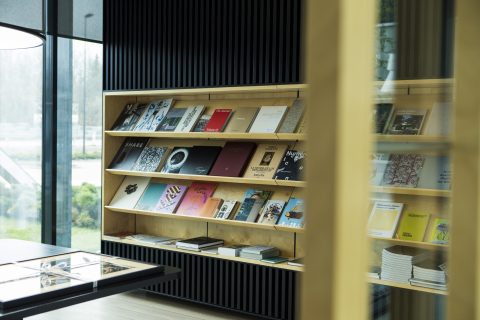
There are currently over 340,000 artifacts kept in the museum’s collections, and every year this number is supplemented by several thousand new treasures. Jolanta Mickienė clarifies that, although the storerooms are full of writers’ personal belongings, furniture (even large items such as pianos), and photographs, the foundation consists specifically of manuscripts; the living written word. The collections are located not only in the Sirutis Palace but also in branches, however, the lack of space forces museum staff to sift through every newly offered artifact very carefully. In addition, the digital age is changing the concept of an artifact: instead of paper manuscripts, USB drives or computer files are increasingly received today.
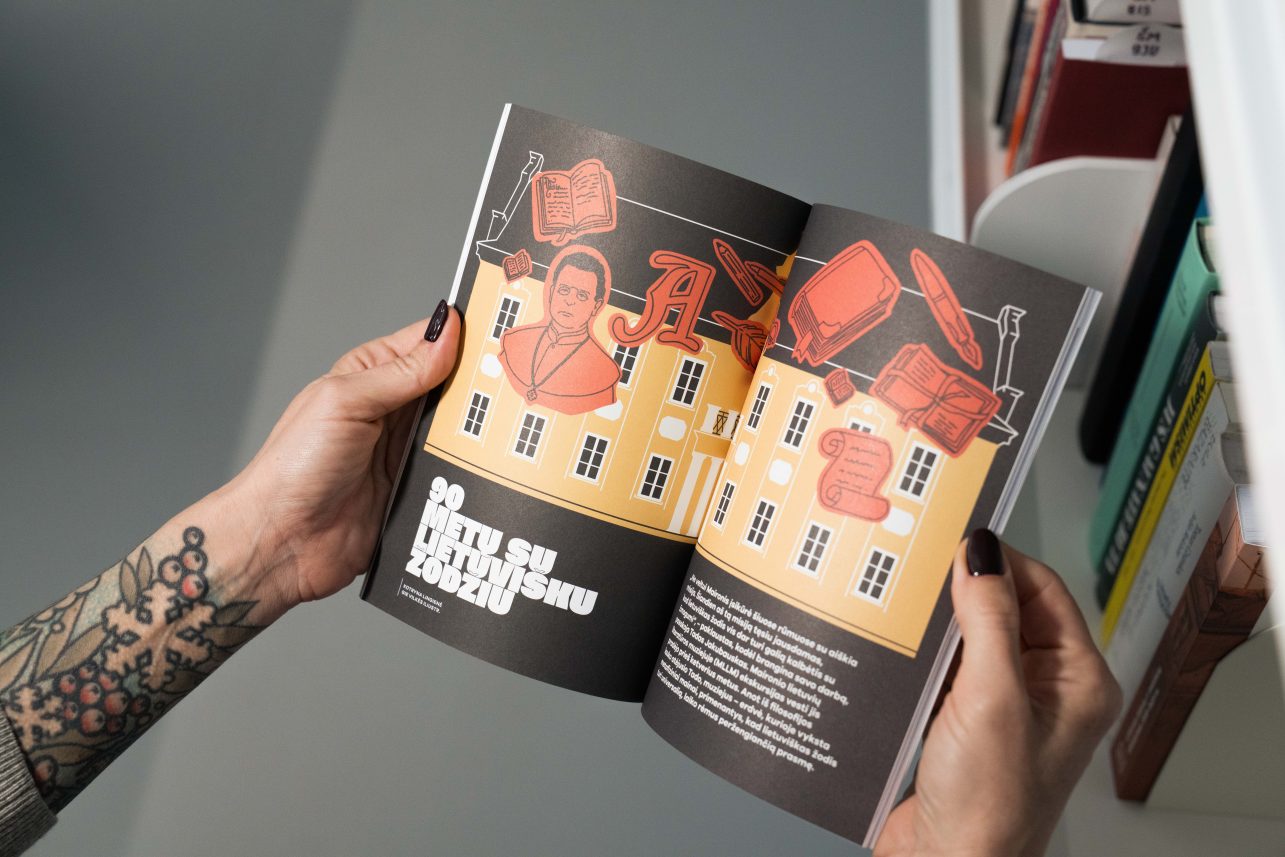
Technology helps to manage the information overload; a vast amount of data can be “hidden” on screens without cluttering the space. However, museum staff emphasize: visitors long for tangible objects and a live connection. In an overload of podcasts and apps, the greatest value becomes a direct meeting with the creator and authentic emotion, which no screen can replace.
For Future Generations
It is time to discuss how the 90-year-old institution is communicating with the youngest generation. Many children come here with their classmates and return with their families. Deimantė Cibulskienė, the director who has led the museum since 2019, states that it is very important to find the right form for presenting Lithuanian literary authors and their works to the modern visitor, especially the student, in a fresh way every time. “Our classics are talented and very interesting personalities, therefore, museum colleagues, while creating educational programs, try to reveal what cannot be found on the internet or read in school textbooks through protected museum values and less-heard facts,” says the head of the museum.
Maironis in English
What about the world? Spreading the word about our culture, language, and literature abroad is the concern of other institutions, but this museum also carries out various outreach projects every year; for example, an exhibition about Dalia Grinkevičiūtė and the tragedy of Lithuanian exile was presented during the Season of Lithuania in France.
For the past few years, a lot of attention has been paid specifically to Maironis. Since the only way for other countries to know the poet is through the word, in 2024 a book of Maironis’ poetry, “Voices of Spring”, was selected, translated into English, and published. The translation by Rimas Užgiris was edited by the writer and translator Marius Burokas, and the poetic language was corrected by the US poet Malachi Black.
Another highly successful project is a traveling exhibition: a diorama of Maironis’ apartment recreated on a 1:20 scale.
Furthermore, although the word “Lithuanian” is important in the museum’s name, international exhibitions telling stories about authors from other countries take up residence in the exhibition spaces of the palace almost every year.
90 Years, Voices, Occasions
The institution intends to commemorate its 90th anniversary, which will coincide with Free Museum Sunday on June 28 (the program for the day is announced here), throughout this entire year. The festive program will be graced by a play created by a friend of the museum, Vytautas Balsys, in which Maironis, Adomas Jakštas, and Vaižgantas will come to life. Among the most important highlights of the year is the “90 Voices” project, which will unite ninety cultural institutions throughout Lithuania.
In libraries, cultural centers, and other institutions, visitors will be able (virtually, to be sure) to get to know museum treasures specifically related to that area. After all, the museum located in Kaunas is the center of the literary field for the entire country, and its content belongs to Lithuania. Through this and other birthday activities, the museum aims to remind us that the Lithuanian word is not just a historical relic, but a living value nurtured by modern means, and a testimony that hope and freedom begin with language.