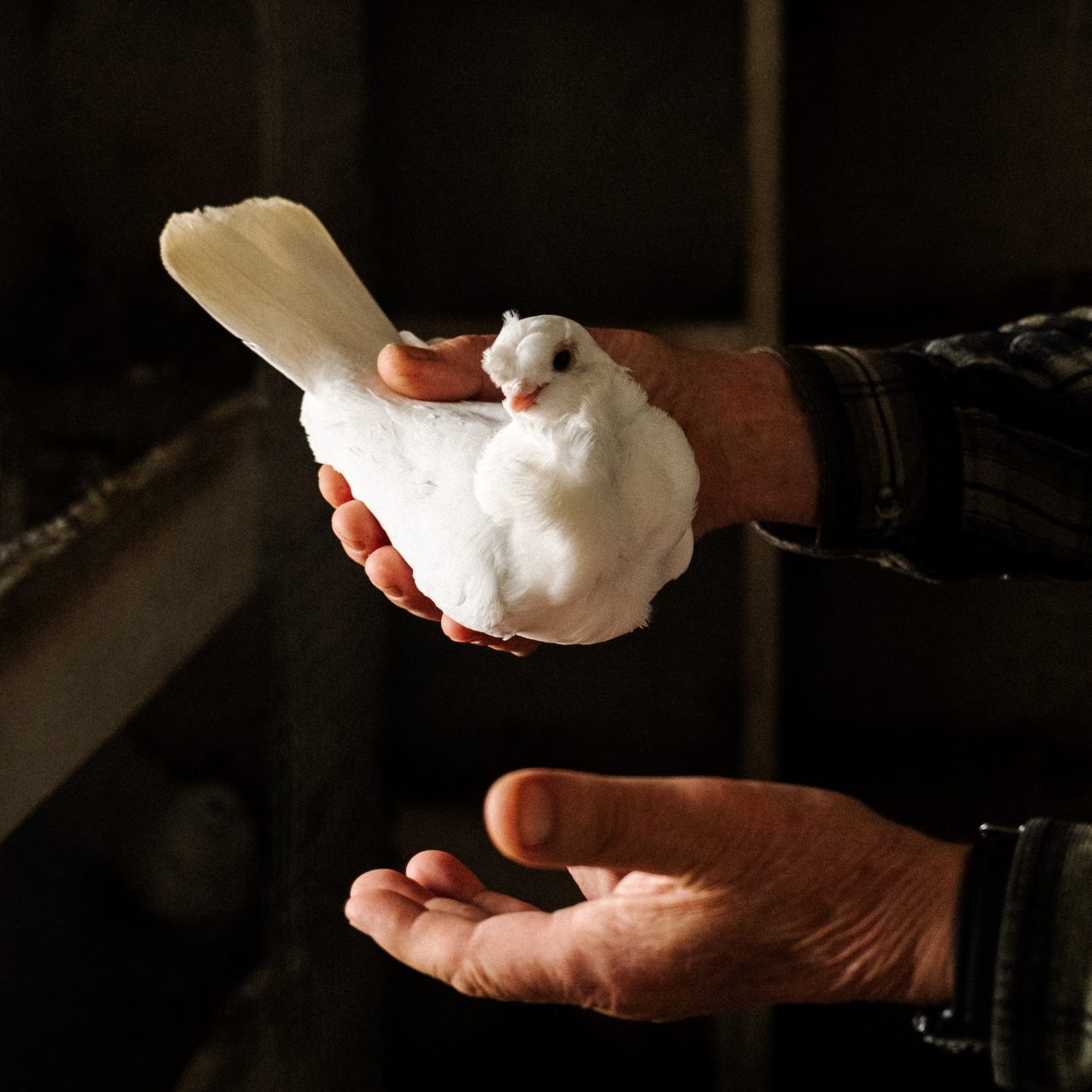
I knew nothing about Stasys. Third floor on E. Fryko Street, a pigeon loft in the attic of an apartment building – it was all I was told. As I walked through Vytautas Park, I kept thinking about Jim Jarmusch’s film Ghost Dog: The Way of the Samurai and a track by RZA. There is one scene in the film where a big man takes a bird in his big hands, and the whole dramaturgy of the film – the samurai code, mafia, gunshots – becomes a backdrop. Only one movement remains – big man, small bird. But we are not here to talk about the mafia, although we will return to it later.
I ring the doorbell.
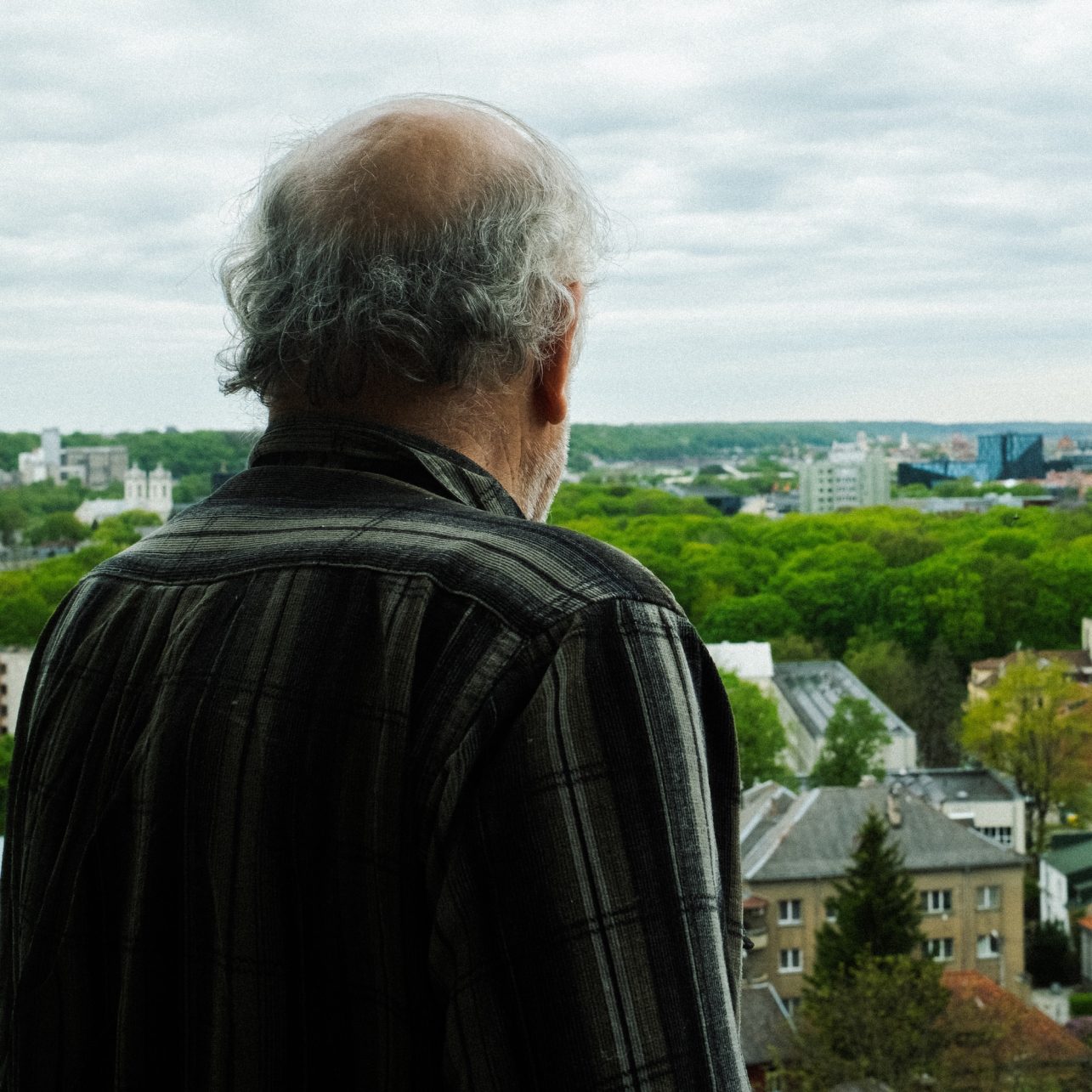
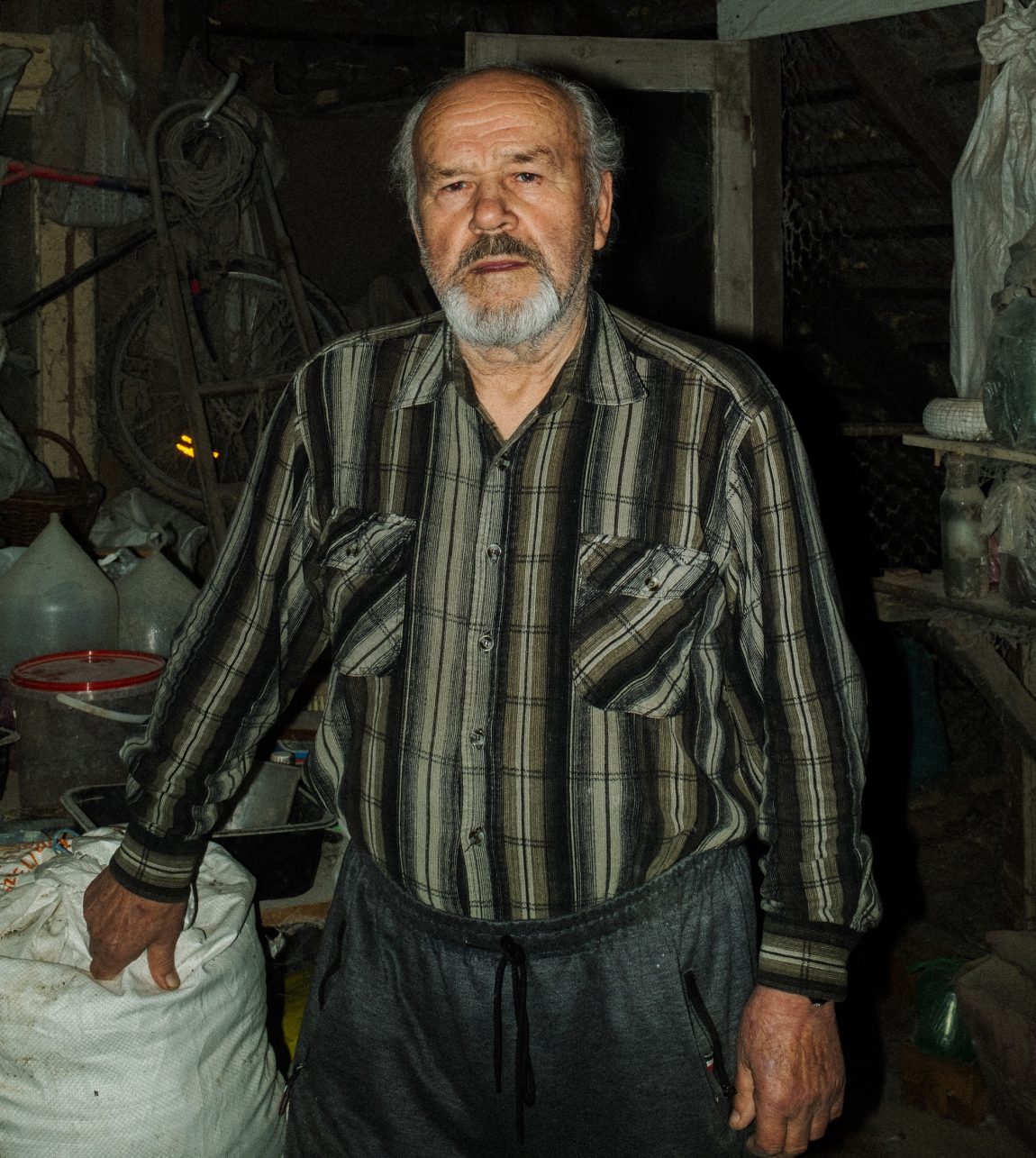
Stasys opens the door dressed in a multicolored striped shirt, with a smile and genuine earnestness. I have a feeling this is going to be an entertaining conversation.
(This text was published in the June 2026 issue of the magazine Kaunas Full of Culture, titled Birds)
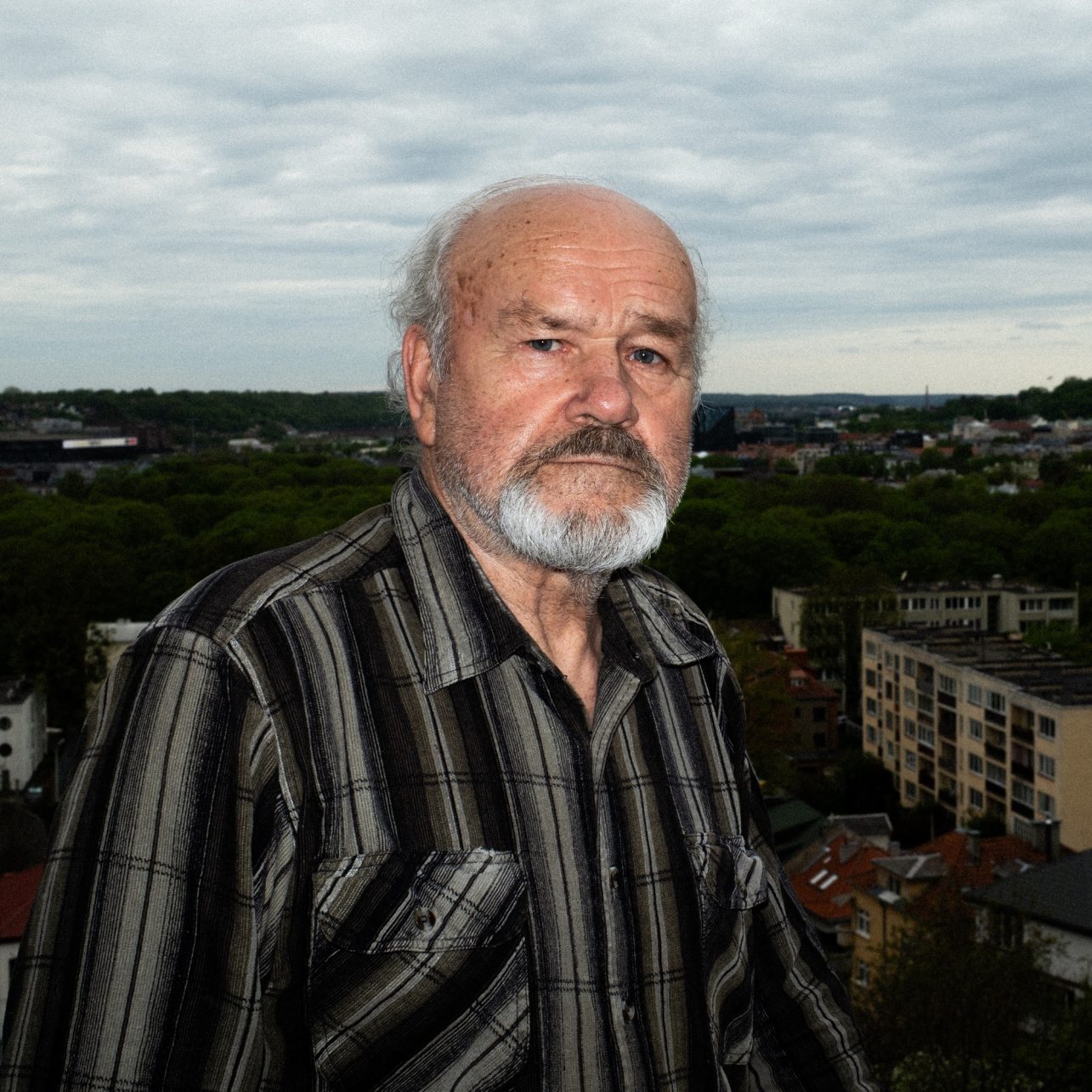
“Hello, I didn’t expect so many of you,” he tells the photographer and me.
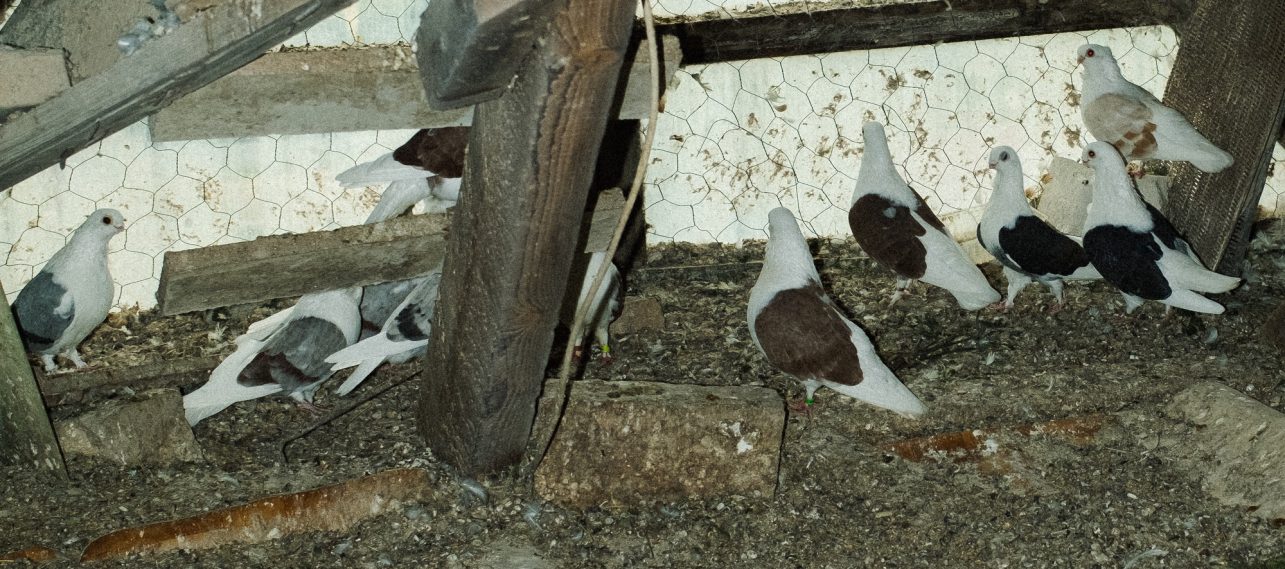
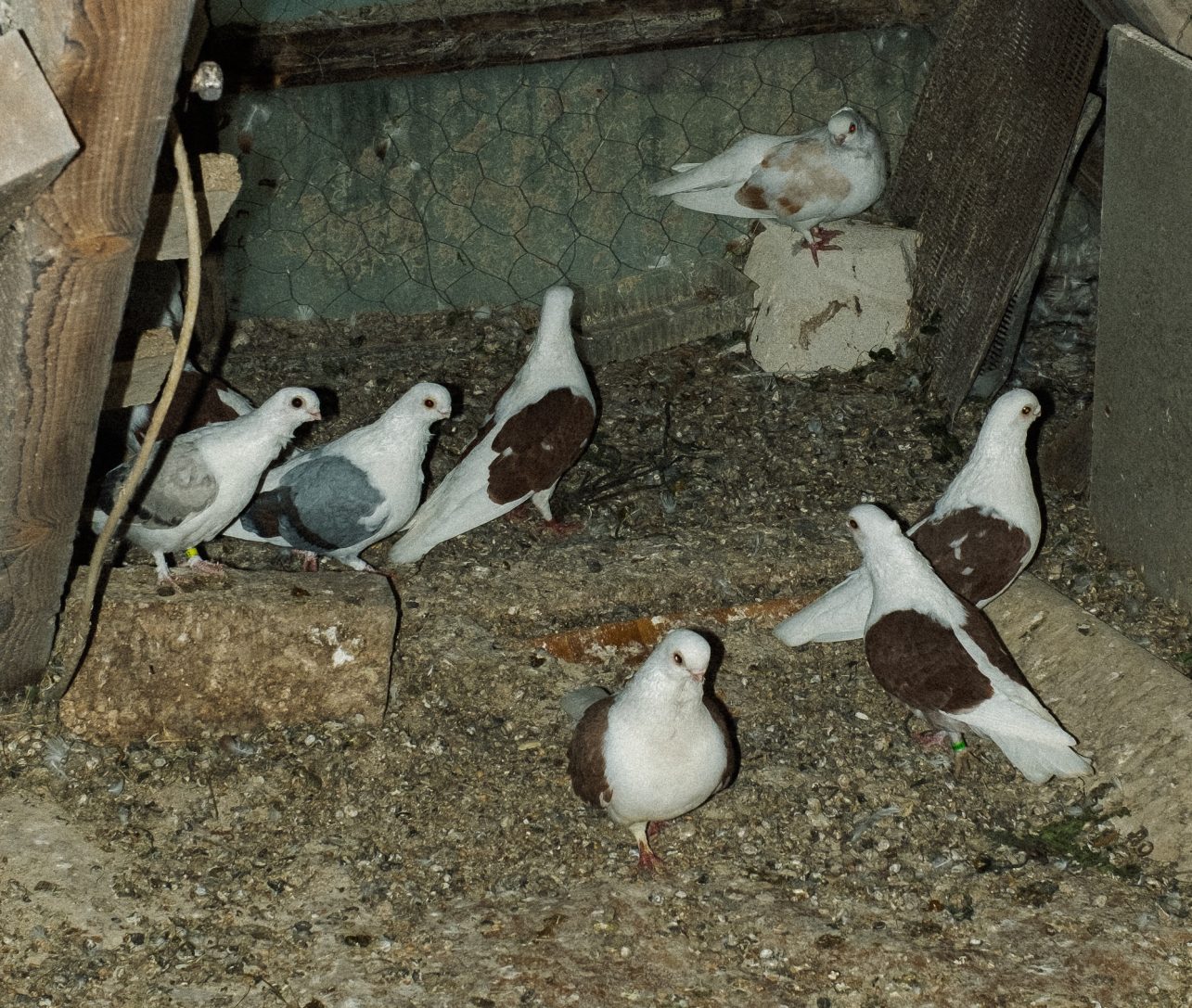
Hunched over, we step into a space that can hardly even be called a room. Lower than a typical attic, with improvised crossbeams, cages lining the walls, and sacks of grain piled in a corner. A rustling sound can be heard all around us; something between bubbling and the hum of a machine. Forty eyes are watching us from the perches.
There is a bird on Stasys’ forearm: orange eyes, small pupil.
– Their name is Mėsačiūbai.
– Mėsačiūbai?
– Yes, it is a Lithuanian breed. Came about in the late eighties. Before, when the russians were still here, we had nefcai, blue in color. But the čiūbai started only during the time of the Reform movement. Now they don’t exist elsewhere, only here.
That “here” includes everything: Lithuania, Žaliakalnis, third floor. It also includes this pigeon breed, which appeared between the 1990s and us, and which now sits on Stasys’ forearm, as if it had always sat there.
Centrolitas, dances, and the march of white shirts
Before becoming a man of the Žaliakalnis pigeon house, Stasys was an employee of the Centrolitas factory. He was a polisher. Stasys would polish the sides of cast-iron pots that were manufactured in sections. Once the machine was switched on, a cloud of dust would rise.
– You turn it on, and everyone runs away. Cast iron dust. I’d go to dances every day. In the summer, I wear a white shirt, I sweat, and rust comes out of my body. Then I said to myself: I need to quit that job.
The dance was held in the Carmelites neighborhood, Inkaras factory, and the sisters’ school in Laisvės Avenue. Every day, across the entire city.
The man who danced all over Kaunas now stands quietly on the third floor with a pigeon in his hand. The rust has long since washed off his body. Like the well-cared-for birds, he has found a place to return to.
Stasys has been keeping pigeons since 1973. In this building. In this attic. Fifty years in one place, in Kaunas, where, during that time, states, currencies, balcony-glazing fashions, and telecommunications antennas have all changed sounds quite incredible.
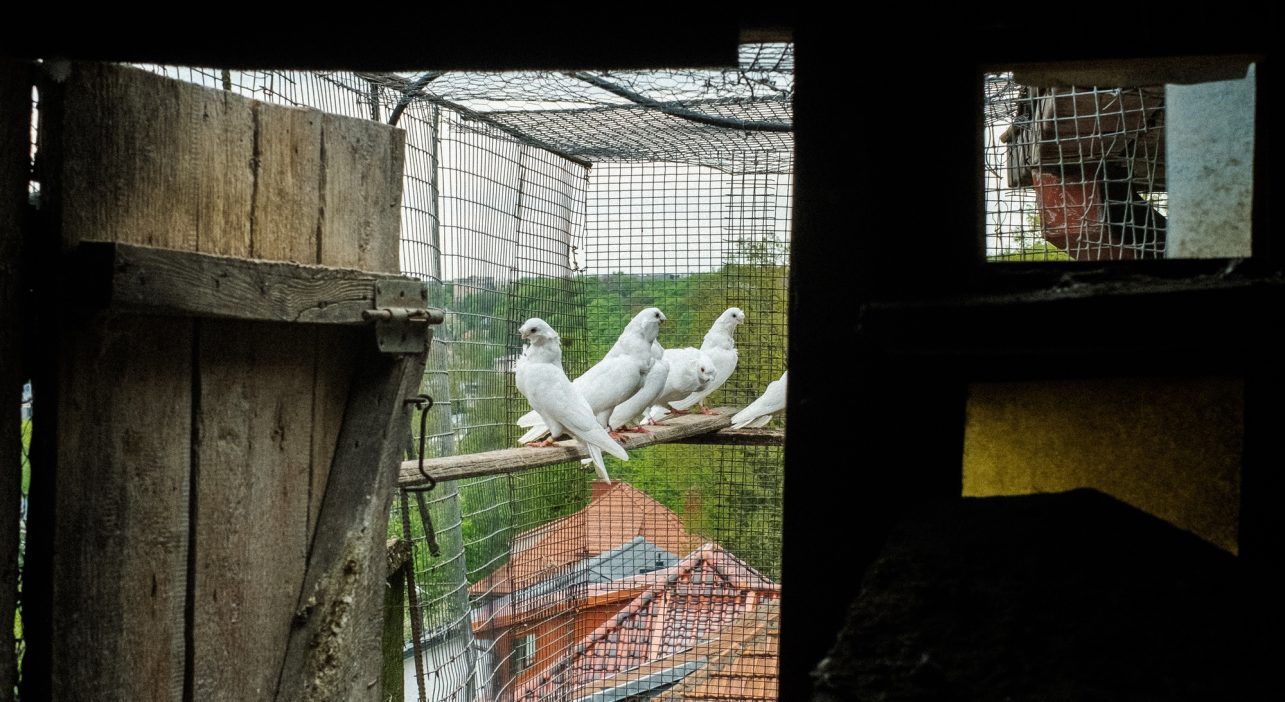
But he started even earlier, in Žemieji Šančiai, on the riverbank. He was fourteen then.
– In Šančiai, – he says, – each friend would erect a pigeon loft on the house. They raised several pigeons.
At that time, Šančiai was a patchwork of illegal architecture and backyard livestock, where everyone maintained a parallel little farm of their own. Some kept pigs, some chickens, and others – birds. Stasys remembers a neighbor named Karosas, who gave him his first gonzas – racing pigeons. The test was simple: the bird would take off, disappear for a week, and if it returned, then it was yours.
– And that was popular?
– Yes, very. In Poland, people still keep more of them. We don’t have youth involved in this in Lithuania.
He stopped and glanced through a small window leading to the closed mesh aviary.
– I went to the cemetery, and I saw that my neighbor, a fellow pigeon keeper, had passed away. He was older than me, close to ninety.
He says without grief, almost as if he’s presenting the weather forecast. But the sentence lingers in the air between us.
Mėsačiūbas, šėrikas and one bird named Kaunas
Stasys has three main breeds. First are mėsačiūbas, the main ones. He has been keeping them for about 40 years. The second one is šėrikas, a larger pigeon with a wider beak, and the third breed is brown- and black-sided, short-beaked ones. He uses russian names for them because “most of the names come from russia.”
Šėrikas has a separate function for Stasys. If mėsačiūbas hatches a chick, it often cannot raise it on its own – the beak is too small. With great effort, it may manage to raise one chick. Two are out of the question. That is when šėrikas comes in: a large bird feeds another pigeon’s chick with its “bird’s milk” – a nutrient-rich, partially digested food that the parents regurgitate directly into the chick’s beak.
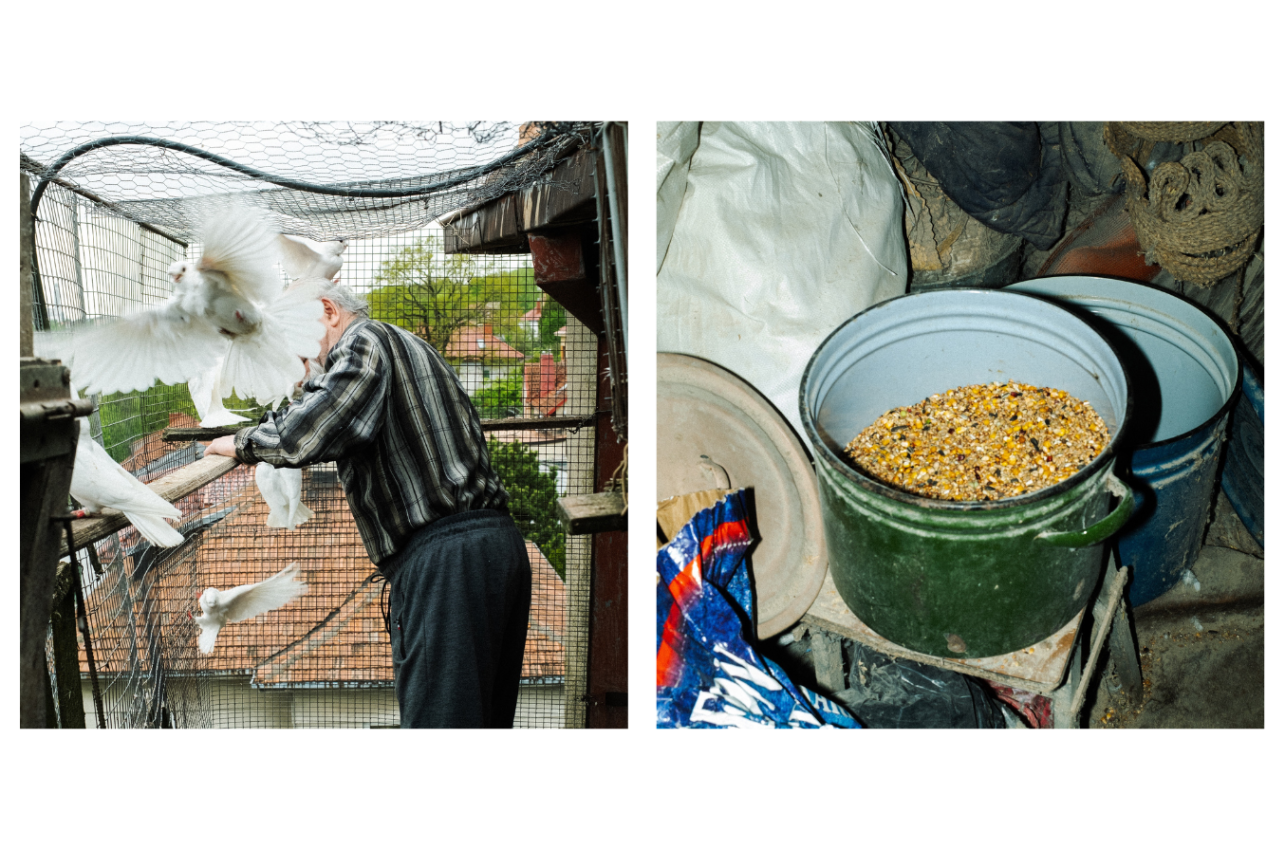
– Here, look at this one, – Stasys says, showing a tiny chick and its crop. – You can’t give it grain yet. Look, its crop is soft. It only needs milk – a liquid food. Later on, it starts pecking grain on its own.
Half biology, half fairy tale. On the third floor in Žaliakalnis, the same process takes place every hour – a process that was happening in Šančiai in 1956 and, quite possibly, in Pompeii centuries before.
– Is there a pigeon breed with Kaunas mentioned in its name? – I ask.
Stasys smiles at me.
– Vartiklis of Kaunas. It is dark brown, chocolate-colored, with a wide stripe across the tail.
– Why is it called like that?
– Because they make flips. It flies, flies, and then, pow, flips over. It dives downward, straightens up, and then keeps flying.
We fall silent. I try to imagine a stunt-performing bird.
– I don’t keep them anymore. You know, once my wife was in the garden and started shouting through the window, “Stasys, come quickly!” I ran over. One vartiklis was making flips with no end and then dove right into the plum tree. And the plum tree has sharp shoots. It got caught on them, impaled itself. I had to take it down.
We watch a brown-sided pigeon peck at a handful of grain and waddle across the shelf like a tiny plush tank. We say nothing more. You don’t meet a bird named after a city every day.
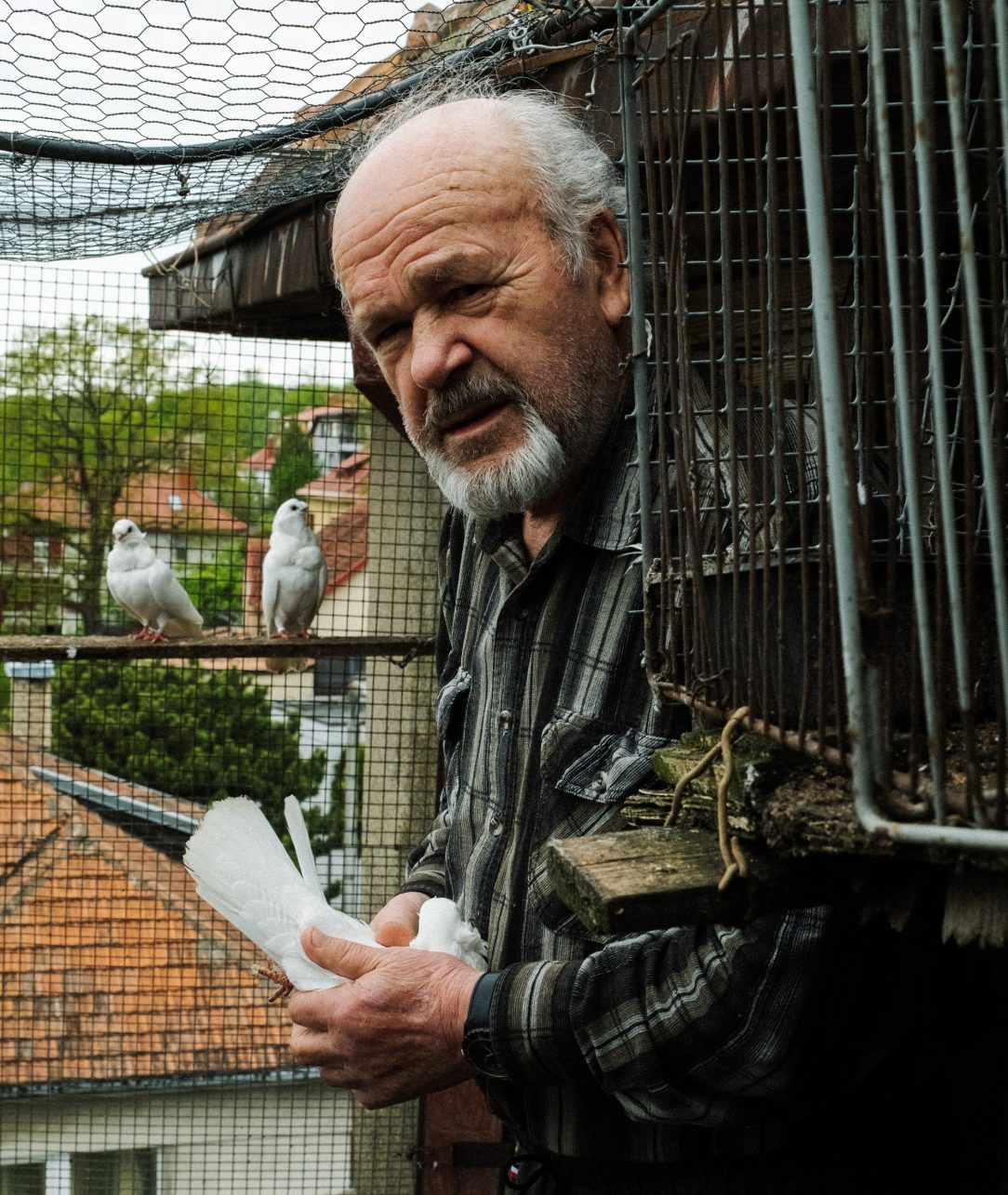
The third floor was never meant for pigeons. But somehow, it became theirs.
– These used to be storage rooms. Right where we’re standing now, there was a toilet. On top of it stood a metal stove, with a chimney running up through the wall. My wife and I got permission from the executive committee to build here. We raised the roof with sheet metal.
– So you already had a vision for the pigeon house?
– Once I started building, of course, I did. The stairwell was high, so why would I need all that height otherwise?
Neighbor Karosas gave him his first racing pigeons, the gonzas. Stasys raised a chick and released it into the sky. It was gone for a week. Then, after seven days, it returned. From that moment on, it was his. Stasys recalls it with a tenderness that is becoming increasingly rare to hear in a city.
Racing pigeons, Moscow, Paris, and Daktaras
Stasys speaks about racing pigeons as though they belonged to a kingdom that was never quite his own but existed alongside him.
– They’d take them to Moscow, to Paris, in special vehicles. They put a ring on the bird and call you and tell you the exact time it was released. Then you sit at home and wait. As soon as it returns, you call them back, and they record the time.
– And what about the ones that don’t come back?
– Almost all of them do. Sometimes there’s a storm, or a hawk. But they head straight home. Maybe they’ll stop at a lake for a drink along the way.
I found myself lingering on that image. A person sits in a small apartment – in Šilainiai, Žaliakalnis, or Aleksotas – and watches the sky. Somewhere above Poland, his pigeon is flying. Overtaking trains. Overtaking cars…
Stasys himself didn’t compete. He says it cost a lot of money. But he knew everyone who did. Racing pigeon owners had their own subculture, undocumented in any encyclopedia of Kaunas, complete with committees, competition prizes, and trips to Moscow. And, of course, it consisted of people from every part of the city.
There was Pauras, the table tennis player and prizewinner in the Soviet Union. Baika, the drummer from Aukštieji Šančiai. The chief engineer of Švara. Even Rimas Kurtinaitis in Panemunė. And Daktaras. Henrikas.
– I once sold one racing pigeon to Daktaras’s son, – Stasys says calmly, as if he were talking about a neighbor. – One like this, you know. It was fashionable then, too. He built a house, made a nice aviary, and bought a bunch of birds. He’d been raising them since childhood.
That Daktaras, whose name in Kaunas in the 90s meant completely different things than a perch full of pigeons in an attic, grew up in Vilijampolė, on J. Naujalio Street, and his family had a pigeon house in their yard. Growing up alongside him were Luras, Goga, Siauras, Mongolas – half the nicknames that would later become part of local history. They all kept pigeons. Children who lived in apartment buildings would build pigeon lofts in the attics above the top floors. The same way Stasys built his own in Žaliakalnis, on E. Frykas Street, a few kilometers to the east across the Oak Park.
In Jarmusch’s film, a mafia messenger keeps pigeons on a rooftop in New Jersey, and it feels like a poetic device. In Kaunas, no such device was necessary – it already existed. The same market in Šilainiai. The same day of the week. The same price for a racing pigeon. The same bird returning home, no matter who its owner happened to be.
Stasys doesn’t say that. He mentions, in a single sentence, that he once sold a racing pigeon, and then moves on to talking about Pauras, Baika, and the cemetery. But the sentence remains suspended in the air. Between a world in which a mafia figure raises pigeons and a world in which the very same birds are raised by a pensioner in Žaliakalnis. Somewhere between those worlds is a bird that could not care less.
Manure for Kertupis
It is Stasys himself who brings up his son, almost by accident, while talking about manure.
– My son died. So I am a bit busy these days. I went to the summer house once. When I visit it again, I’ll take the manure with me.
The summer house is in Kertupys. Manure is the most valuable thing the pigeon keeper passes on to earth. The son was 41. On July 6, it will be a year.
The conversation then moves on to other topics. Stasys does not dramatize things. I do not try to pry for details. His son trained dogs. His wife especially liked the Belgian Shepherd, “You know, while walking, it looks only at you.”
The Šilainiai Market, the Poles, and thirty rubles
This hobby does not bring any money now. Stasys emphasizes that several times.
– There’s no profit in this. For a pensioner like me, it’s a big loss. Back in the day, you’d take one to market, get twenty-five rubles, you know, you could live, you could support yourself. Now? Ten euros. And three of those go to the market fee. It’s crap.
The Šilainiai market is still there. They say it’s the biggest. People come from Ryga, from Tallinn. The market in Vilnius is small, and in Alytus, he says, it’s mostly geese. Kaunas people keep less, but they sell more.
– Do you belong to any societies?
– No. You have to pay membership fees. That stage of my life is over.
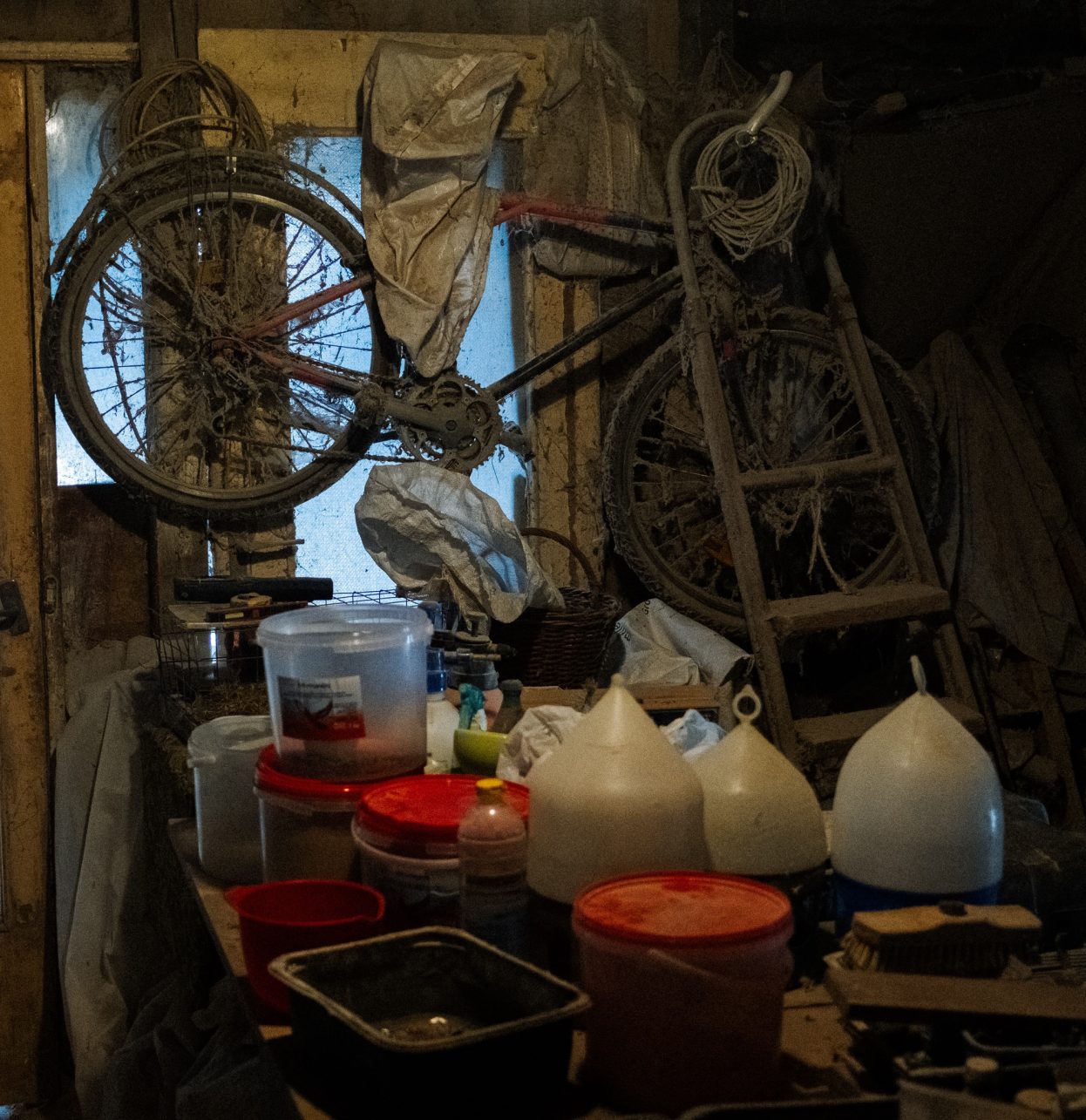
And yet, despite not belonging to any association, Stasys maintains five times more discipline than many club members would show in their own lofts. There is simply no institution hanging over him. No society, no committee, no imposed rules. Only an internal schedule, two buckets of water, twenty-five kilograms of feed, yeast as a vitamin supplement, and the Šilainiai market on Friday mornings, which he still faithfully attends.
All pigeon keepers know each other, he says. They’re all older people now. If not friends, then acquaintances. Someone calls from Marijampolė asking whether he has this breed or that one. Stasys does. But he never sells his best birds. He parts with the lesser ones. The best stay here.
Hawks from Ąžuolynas
– No, I don’t let these out. If I release them, the hawks will carry them off, you know, kill them.
There are animals in the city that are mentioned only in passing in accounts of Kaunas’s wildlife. The hawks of Ąžuolynas are among them. They are perched on the oak branches, look at the buildings and wait.
– These are powerful birds, big ones, – Stasys says about mėsačiūbas breed. – They go straight up, and the hawk dives down. It won’t catch it. But if there’s a weaker one, the hawk will carry it away.
Another aggressor in the city is a crow. They spot an opening and – bang. Broken eggs, tiny chicks, feathers everywhere. These days, Stasys hardly opens that hatch at all. Mėsačiūbas pigeons remain closed. Only šėrikai and the brown-sided ones are allowed into the air – they fly around a bit and then return. Gone are the dedicated flying sessions of the past, when he would come home from work, release the birds, and watch them rise above the utility poles, “to a point high in the sky.”
– I don’t make them fly anymore. They go out on their own, stretch their wings, and that’s that.
Stasys says that pigeons are “like a disease” to him. Just as some people feel the need to have a drink, he feels the need to climb up to the third floor.
– Whether I want to or not – I feel the pull.
– So how did you come up with it? What brought birds into your life?
– Well, beauty, pleasure, what else? And they’re clever, too.
Fifty years in the same place, with the same birds. I realize that it is actually the most samurai thing ever. It isn’t just a hobby.
We took the stairs down, said goodbye to the photographer and crossed Ramybės Park. I looked down and saw a pigeon pecking at the ground nearby. Definitely not a wild one. One of Stasys’s.