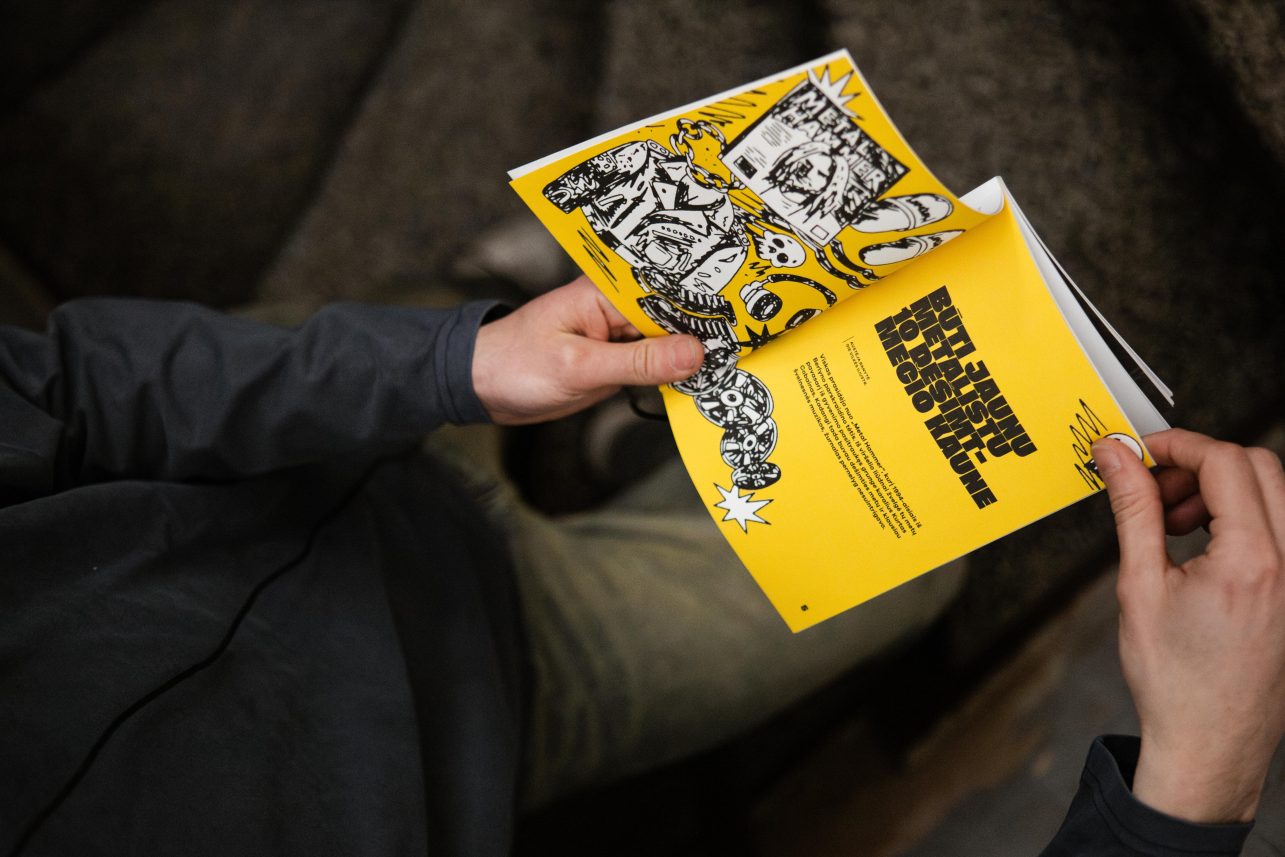
It all started with Metal Hammer, which my dad brought from Berlin in 1994. On the cover, looking sorrowful, was the grunge king Kurt Cobain, who had taken his own life that spring. Since I was ten years old at the time and listened to softer music, the magazine didn’t intrigue me all that much.
Fast forward, and I’m thirteen. At her sixteenth birthday party, my cousin plays Nirvana’s “Rape Me” – her younger sister is swaying to the beat with her stuffed toys. None of us fully understands what he’s singing about here, but the song goes straight to the heart, and later, I find out who he is – it is the same knight of the sorrowful face staring at me from the cover of that imported magazine.
(Text published in the April 2026 issue of the magazine “Kaunas Full of Culture”, “Metal”)
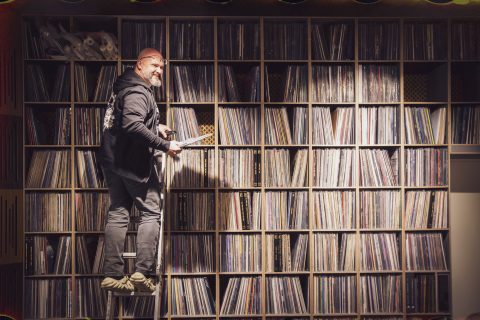
Soon, grunge is not enough; I want something heavier. I head to Laisvės Avenue. Somewhere there, on the corner of Laisvės Ave. and Mickevičius Street, in a small record shop, I buy Metallica’s Reload. It’s not an original recording. The original records were sold in “Bomba” near the municipality. But, as one of its employees and soul, Vaidas, once mentioned in an interview for this magazine, the prices of original recordings were astronomical for teenagers back then.
It is important to remember that the internet was still in its infancy and was accessible to very few, while the desire to discover and hear more – and heavier – music, especially when you’re fourteen, was huge. This is where the Kaunas radio station named “Tau” and two enterprising metalheads, Nerijus and Aleksandras, did a great service for fans of heavier music. The two of them hosted a show called “Sunkusis pirmadienis” (Heavy Monday). It was broadcast late at night and, even though I had to get up for school the next morning, I eagerly awaited its start with a blank cassette ready in my small boombox in case I wanted to record a track. Nerijus and Aleksandras greatly broadened listeners’ musical horizons and helped, especially those with fewer resources, to get acquainted with a wide variety of metal bands. Thanks to them, after listening to many tracks, I was able to plan further investments of my pocket money. Even pirated recordings cost something! Buying blindly would have been a luxury.
One such place where you could browse the catalogue and order a recording of your preferred band existed at the now-defunct “Merkurijus” shopping center. There, you could also ask the man selling cassette tapes for recommendations. Once, when my angelic-looking friend chose what she described as “some kind of satanic metal,” the responsible salesman tried to talk her out of it and suggested something softer.
“Merkurijus” attracted not only young metalheads, and not just because of the godfather-like figure fulfilling musical wishes. If you passed through the “little tunnel” on the right, you would end up in a courtyard with kiosks selling single cigarettes. That inner courtyard was also a hangout spot for dance music fans, away from the judgmental eyes of adults. What could be more convenient than a sometimes deliberately visually impaired saleswoman and a cigarette costing mere cents when you’re fifteen and you don’t have the money for the whole pack?
Still, metalheads and punks at the time mostly gathered in the Old Town. The best place for hanging out, talking, and writing wishes in each other’s notebooks was by the Nemunas River, or more specifically, by the budkė (booth). Strangely, even today, I don’t know exactly what that booth was that we gathered around. Maybe a water-level monitoring station for the Nemunas? But most of all, it was probably a metaphysical phenomenon – a symbol, a parallel world where you could spend time with like-minded people.
Unfortunately, these hangouts were sometimes disrupted by forsai, also known as urlaganai or later marozai. These were tracksuit-wearing youths with shaved heads who felt the need to harass long-haired boys who clearly didn’t fit their standards of masculinity. Girls were targeted less often, but more than one girl wearing combat boots, jangling chains, and a leather coat or jacket had heard the question, “Hey, rat, have you seen any girls around?”
The 1990s – the formation of Lithuania after regaining independence – was vibrant, aggressive, and rapidly changing. Not everyone managed sense, to understand, and jump on that freedom train. Some wanted to maintain “order”. Today, leather biker jackets are sold in all popular clothing stores. Combat boots of all kinds of colors and shapes have been in fashion for a good ten years. Wearing a leather coat on the street won’t surprise anyone anymore, and no one will throw stones at you for that (and in 1999 they would have).
Back then, alternative style treasures could be found in second-hand clothing stores, “Armijai ir civiliams” shop, or by rummaging through your parents’ closet, so if you wanted to create a good look, you had to be inventive and often rely on a DIY approach. Once, a friend opened her apartment door wearing white slippers on which she had carefully written MANOWAR in neat lettering.
You could find T-shirts or hoodies with the image of your favorite band or artist at the open-air market, but it was mostly dominated by the bands that were already considered too mainstream – Nirvana and Metallica, although occasionally you could come across classics like Entombed. I saved money for an entire year and, when I went to the capital – if I remember correctly, to a shop called “Zarazza” – I bought a Cradle of Filth hoodie. Together with a long brown leather coat borrowed from a friend and a pair of second-hand Martens, it made me feel invincible. The insults from marozai on the street just bounced off my real metal armor.
Besides the “booth,” which worked perfectly as a hangout spot during the warmer months, metalheads also gathered in the legendary Kaunas bars, which unfortunately no longer exist. As expected, all of them were located in the Old Town. Well known to many millennials were B.O., or “Boškė,” located on Muitinės Street, the bar of the former Small Theatre – “Suflerio būdelė” on M. Daukšos Street, and “Galera” on Kumelių Street. A children’s photography school was established in the long wooden house during the Soviet era, and a café operated in the basement, dating back to the end of the 16th century, which later turned into “Galera” – a bar favored by metalheads and punks. Gothic arches, darkness, and mold were just the thing for metalheads and punks, but more sensitive people couldn’t last long in the smoke-filled dungeon. Because of that, I rarely attended the concerts held there – there was simply no air to breathe.
And although back then we often had to hitchhike to Vilnius for concerts, sometimes they did happen in Kaunas as well. One venue, unfortunately very short-lived, was “Terra X”. In a bar that resembled a brick labyrinth, both heavy and avant-garde music concerts took place. In the autumn of 1998, we went to “Baltic Thunder” – a pagan Baltic metal festival in Kaunas, at “Kreizas”. “Kreizas” was a bar and a small club in one of the KTU student dormitories. I think one of my first metal concerts took place there, and I’ll remember it forever because of a broken nose. It was accidentally dislocated by a guy in front of me, who was headbanging as enthusiastically as I was. But I’m a metalhead – and this is just a battle scar. Of course, I didn’t go to the doctor.
Kaunas has changed a lot since the 1990s. Not only have the kiosks selling cigarettes to children and the educators of pirated heavy music disappeared, but also those more secluded spots where teenagers could be alone and gather with members of their subculture. Although all the aforementioned bars have closed, Kaunas has a heavy music club called “Lemmy”, and it’s already ten years old! As a music lover, I find this place incredibly important. And that teenage metalhead version of me wouldn’t believe her ears if she heard that Kaunas finally has a place like that.