It is no coincidence that 2026 has been declared the Year of Kanklės – 120 years ago, the first kanklės ensemble in Lithuania was founded in Skriaudžiai. On this occasion, I interviewed kanklės builder Skalmantas Barkauskas, who has been contributing to the preservation of kanklės as a living piece of history for two decades. Skalmantas builds kanklės, restores them, and teaches others how to do the same.
During our conversation, we joked that just as many people hoard gold, the builder of kanklės hoards wood – he already has enough stored for the next five years. The most valuable thing, however, is not the material or texture, but the meaning and tradition hidden in kanklės. I invite you to a conversation about the miraculous transformation of trees.
(Text by Agnė Sadauskaitė. Photos by Arvydas Čiukšys)
Skalmantas, I would like to introduce you as a one-man band. You are a builder and restorer of kanklės and many other instruments, a musician, an artisan, and a sculptor. How did these activities come together?
Everything developed naturally. When I was little, I carved household items from wood, trying to get to know and “tame” the material, and I never imagined that I would become a maker of musical instruments. Once I became familiar with this craft, I had the opportunity along the way to meet masters Algimantas Sakalauskas and Jonas Bugailiškis. As I was finishing school, I visited their workshops, showed them my carvings, and asked for advice. They encouraged me to apply to the Art Academy.
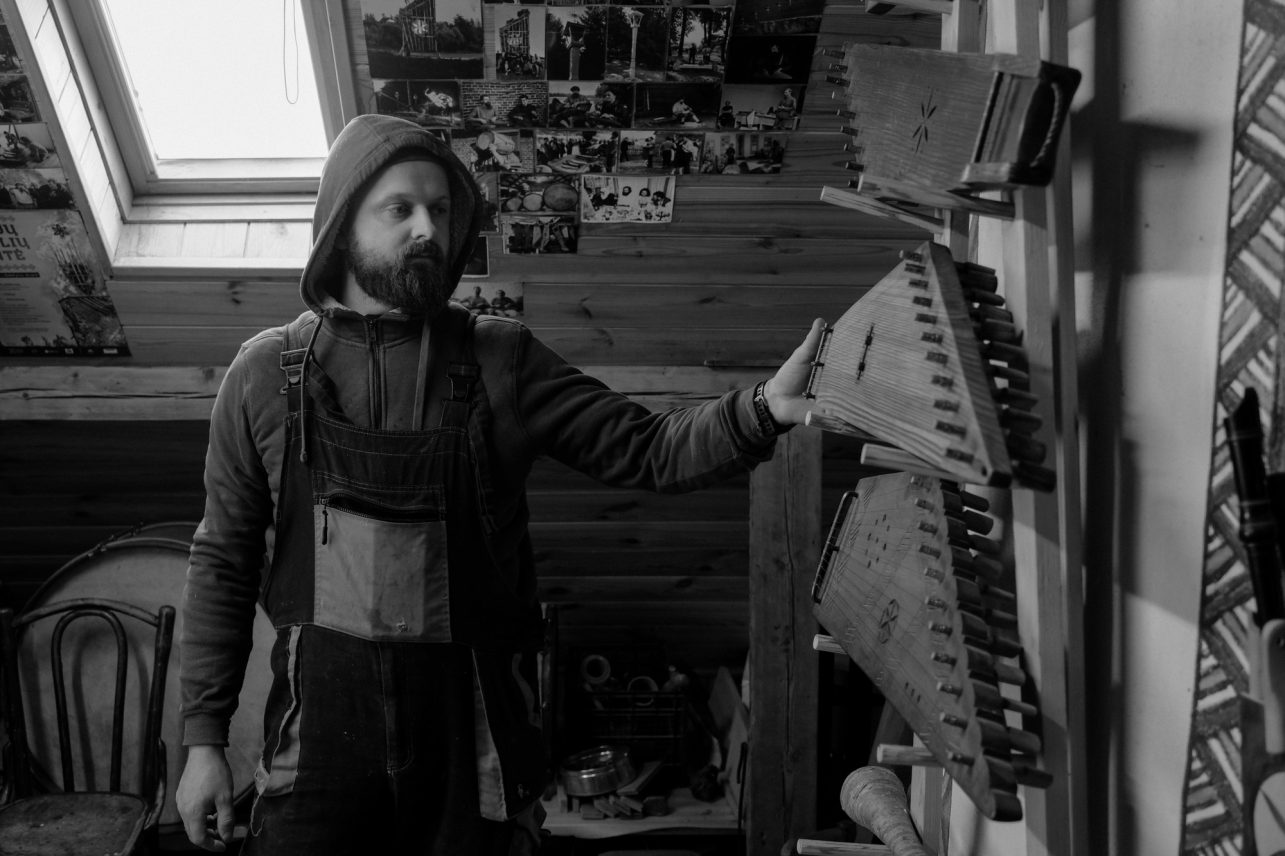
I studied sculpture. In my third year, I wanted to quit, but Professor Stasys Žirgulis encouraged me to stay, stating that sculpture and the production of musical instruments are interconnected. After graduating, I made several wayside shrines, burning straw sculptures, but in the end, I stayed with the musical instruments. Restoration came naturally, studying museum exhibits and wanting to resurrect them, have replicas, and show people through education how they might have sounded in the past.
Do you agree with Professor S. Žirgulis’s ideas about the connection between instruments and sculpture?
Yes. Master Albertas Martinaitis noticed that it was no coincidence that I had completed my studies and that my own distinctive style is visible. For example, I use elements of blacksmithing and metalworking that others apply less often.
I taught myself to play music. When I made my first kanklės, I didn’t know the musical scale well, I had no theoretical knowledge, and no trained ear. I attended one lesson, but I didn’t understand anything. When I returned home, I began learning on my own: I hummed and searched for those sounds, trying to play them on the kanklės, and little by little, I began to understand the basic principles.
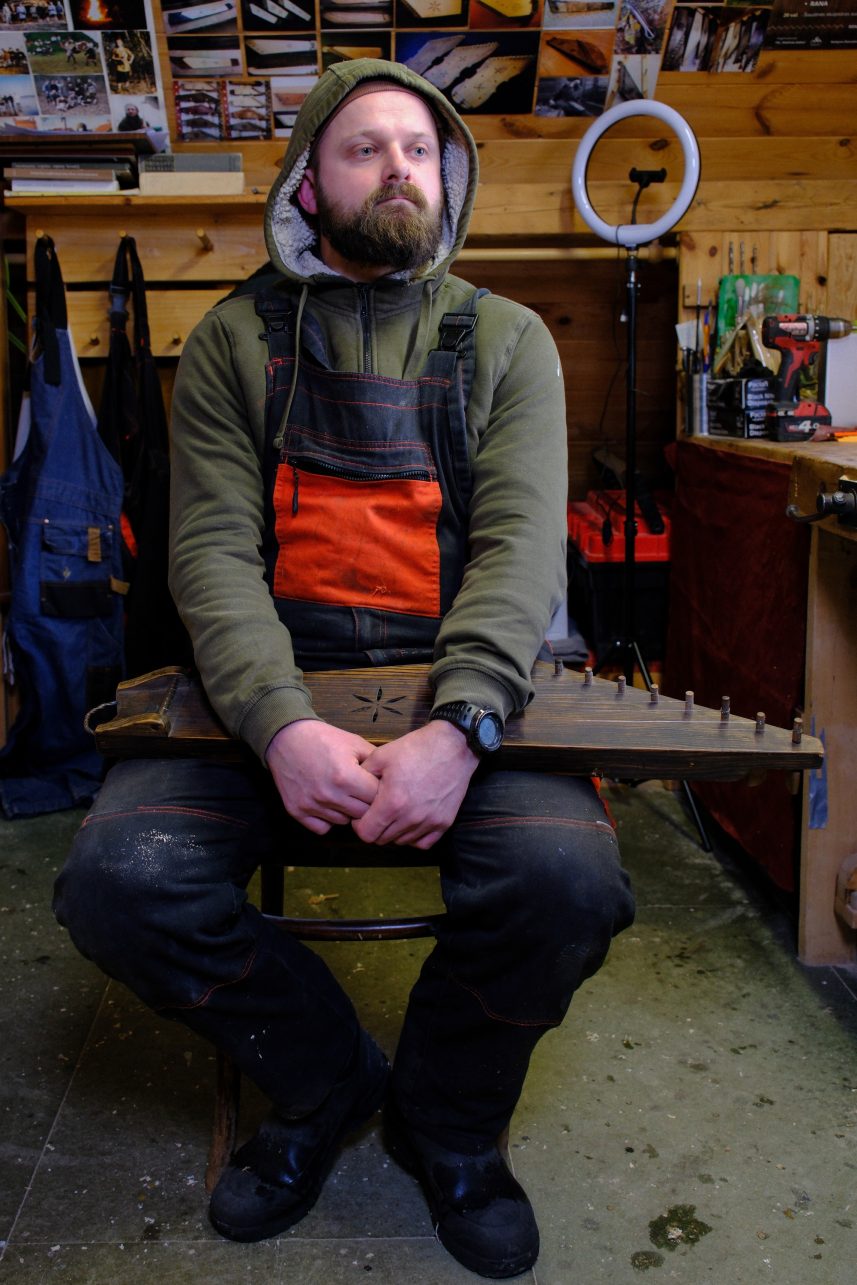
You have been playing the kanklės for more than twenty years; you made your first instrument when you were fourteen. What inspired the teenager you were at the time to become interested in it?
My mother was a member of the Babtai Cultural Center folklore ensemble. At that time, I was still just a child, and I’d go with her to festivals and events. My grandfather was a shoemaker and a self-taught musician; he played the accordion at various celebrations. My great-grandfather was a wheelwright who made wooden carts. I certainly inherited some things from my family.
One day, my sister brought home A. Martinaitis’s kanklės. I was about 12–13 years old then and had already started carving wood. Looking at those kanklės, a question came to mind: there’s a wooden box with wires stretched across it – why and how does it produce sound? So I began making one myself from a piece of firewood. At the same time, I was very interested in Lithuanian history. I became the youngest historical reenactor and joined a club dedicated to ancient Baltic combat traditions. There I saw men playing the kanklės and singing folk songs, and it made a strong impression on me. I thought this might be my field, where I can find myself.
It seems that when choosing wood for making kanklės, the most important thing is not so much the type of wood as its preparation. Could you tell us about the process of preparing and making kanklės?
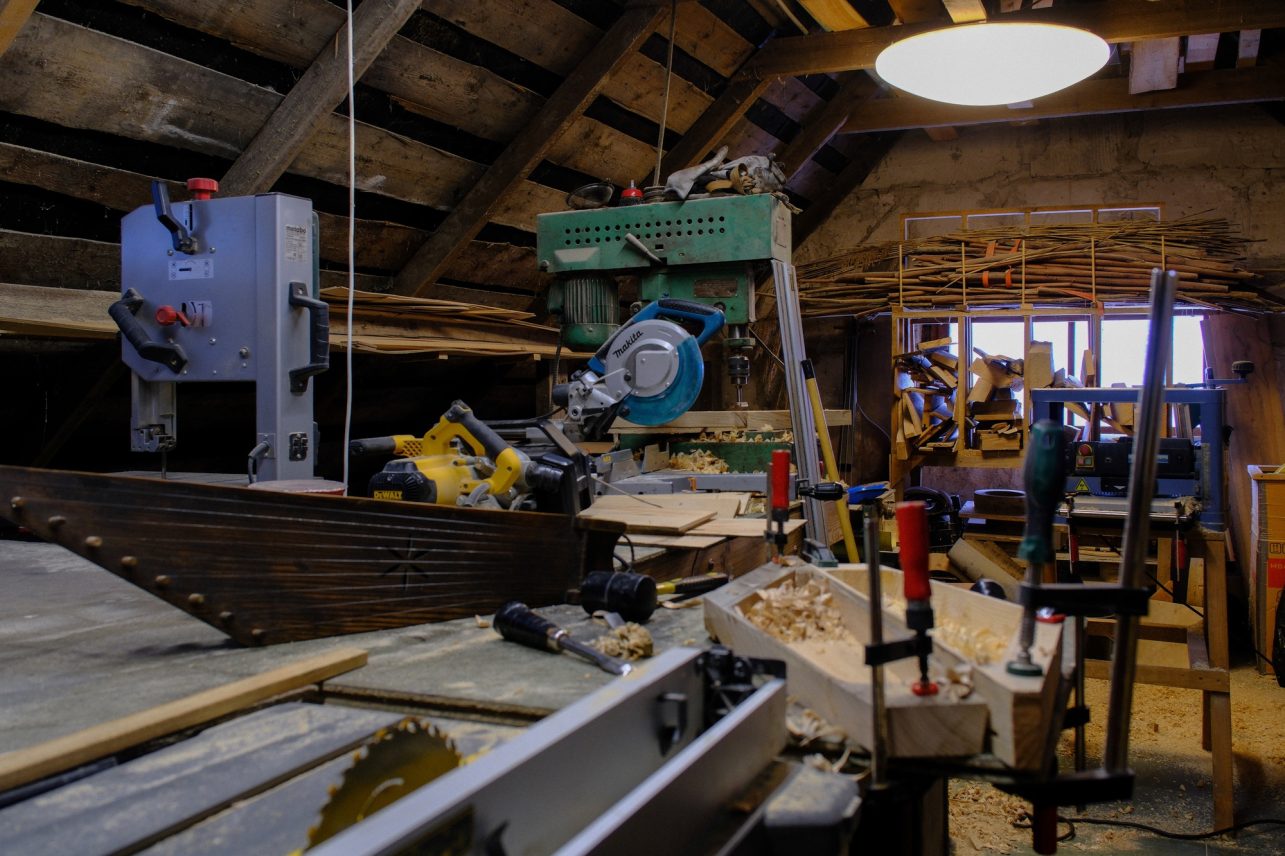
There is a lot of preparation. The box with strings experiences tension, and to withstand it, it must have certain properties. Harder wood can be made thinner, and it will not bend or break, while softer wood must be left thicker. When the strings are plucked, they produce vibrations, and the acoustics are better when the kanklės are thinner. The search for suitable wood begins with people who have their father’s or grandfather’s wood lying around that has never been used. Such wood is minimally sensitive to climate change, humidity, or drought – it has already endured a lot.
I imagine that such wood is not always easy to come by. Do you store it for the future?
I always store wood, and currently I have enough for about five years ahead. But if someone wanted to make kanklės, there are manufactories in Europe that specialize in selling wood specifically intended for musical instruments. I’ve experimented with this myself and tested the properties of different types of wood that way.
Many people hoard gold, but the builder of kanklės hoards wood. You mentioned that anyone can simply make kanklės if they want to, and you teach the craft yourself during plein airs and workshops. It’s hard to believe that it can be done so quickly. What does such a learning and production process look like?
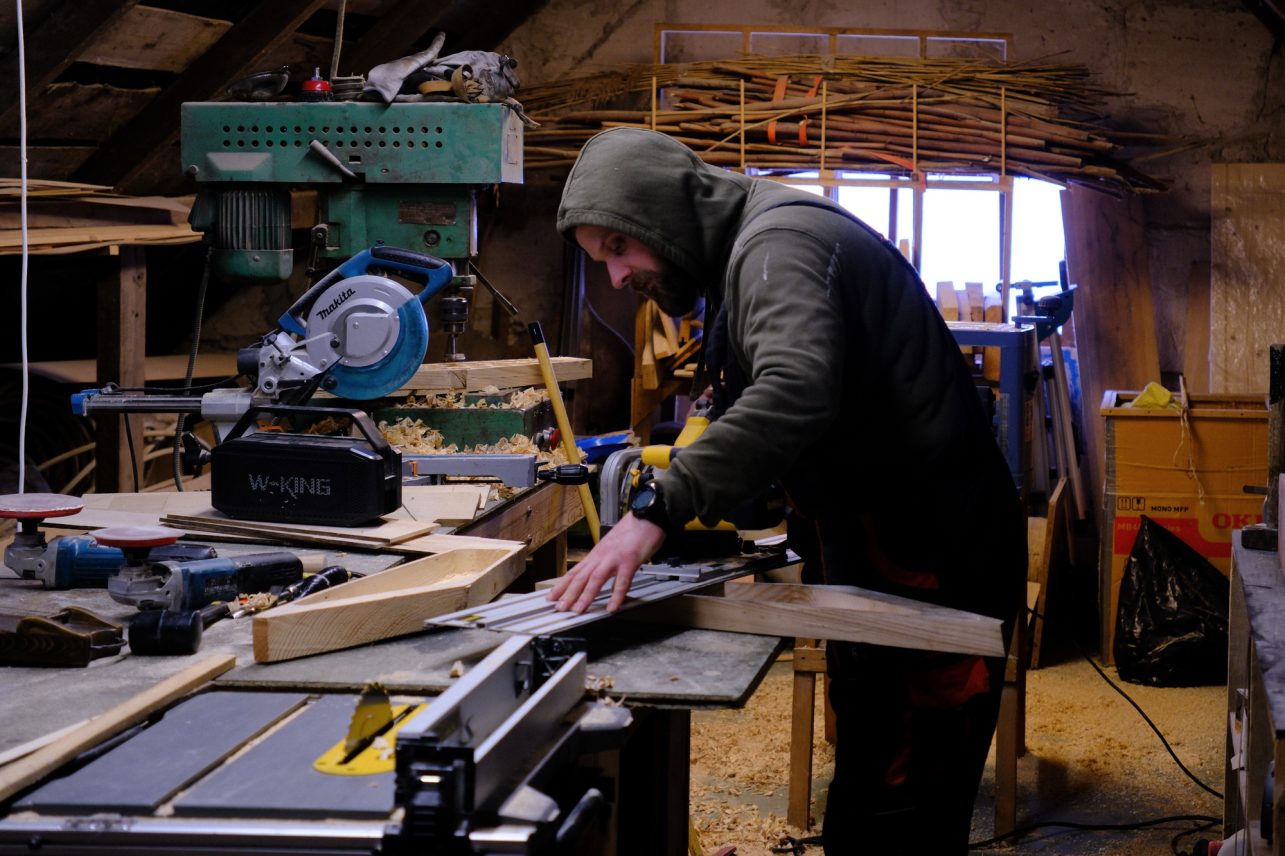
It is a long process. If you worked completely independently and consistently, it would take more than one or two days. For workshops and open-air sessions, I bring prepared blanks and matched pegs, which significantly shortens the process. While people decorate their kanklės, I prepare the parts for the next step so that everything moves along faster.
I have also had people come to my studio who managed to make their own kanklės in a day or a day and a half. Young people also come. One person made kanklės and then came back to make a second one. In the summer, the traditional open-air workshop will again take place at the Horse Museum, where we will be making kanklės, so I invite everyone to come and try it.
What is the decoration of the kanklės based on?
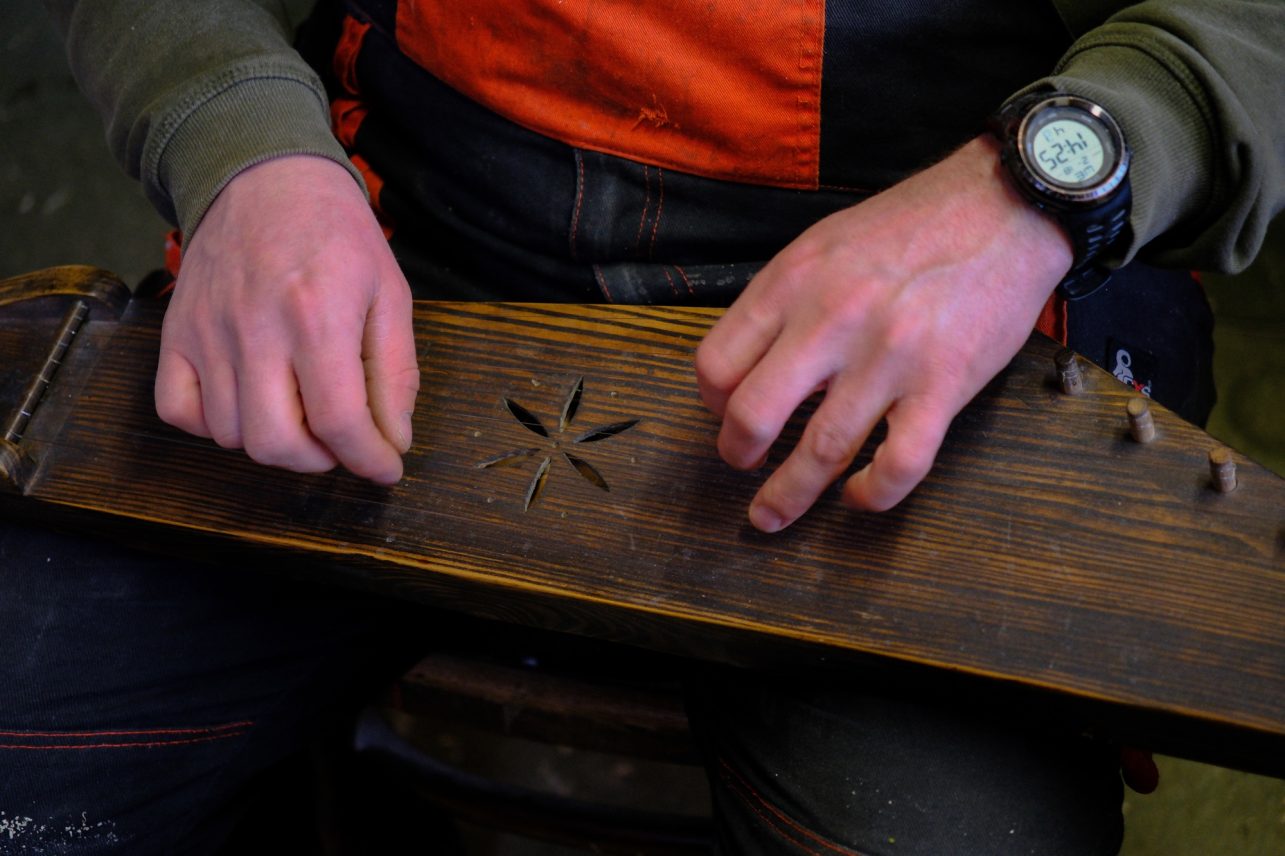
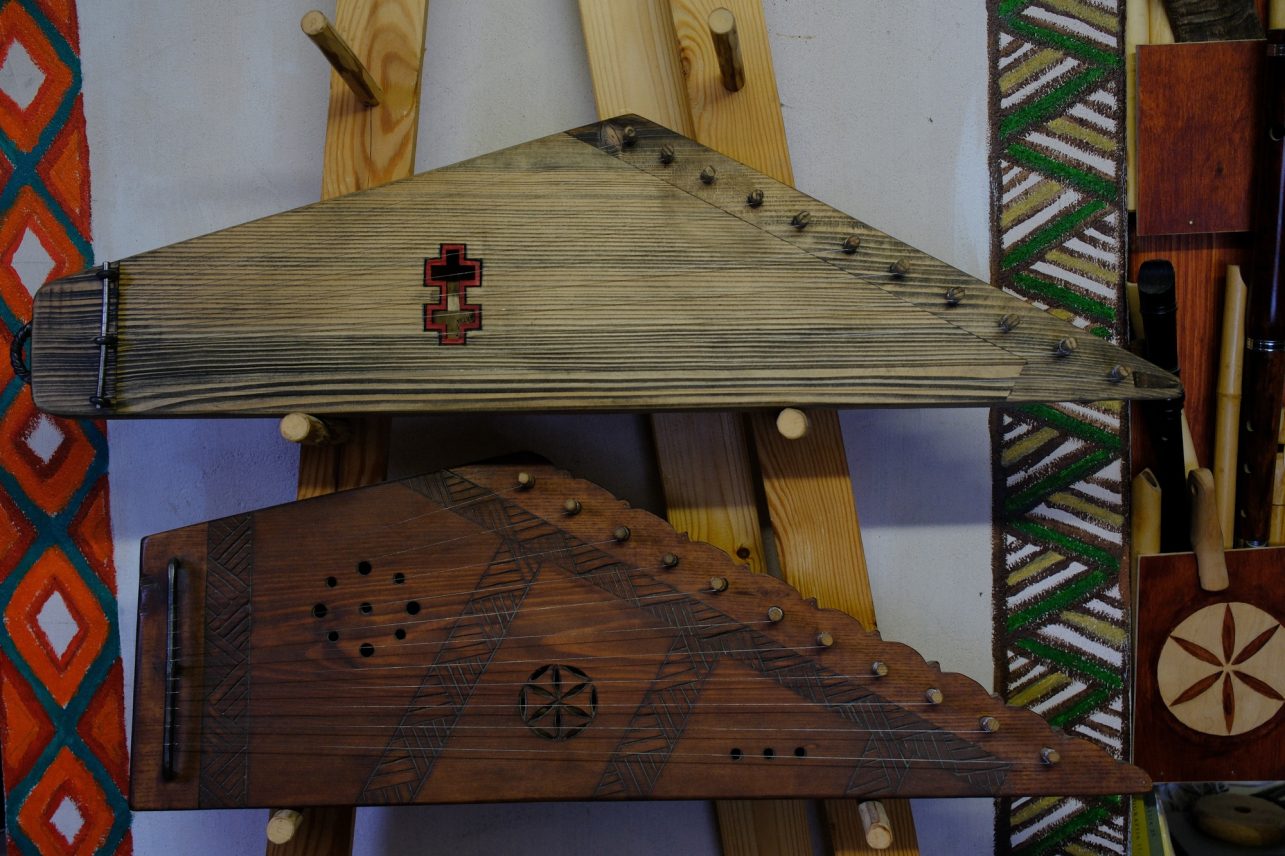
Each region has its own traditional symbols, shapes of the kanklės, and number of strings. If the instrument is traditionally made and will be used in folk ensembles to represent a particular region, it is decorated with traditional symbols. The Flower of Life is the main symbol used on kanklės; other elements include circular and triangular shapes, small leaves, and different arrangements of these motifs.
Do decorative details affect the sound?
If the soundboard had many decorative details, there would be many sound holes, and the instrument would have a smaller resonance chamber. Therefore, I try not to overload the instrument with decorative elements so that the kanklės can have more resonance. It is difficult to determine whether certain patterns make it sound better or worse. However, it has been observed that leaf-shaped petals produce a clearer sound, while round shapes create a more muted tone.
How do you choose the wood for different kanklės?
Kanklės can be made from many types of wood, and each provides a different sound. People have different preferences for tone: some want a brighter sound; others prefer something more resonant. With clients, we first communicate to understand what kind of sound they want, and I ask them for a recording if they have one. Sometimes it takes making the right kanklės on the second or third attempt, although of course it also works on the first try when everything matches. There is always some level of uncertainty about whether the sound will turn out well; it’s a very delicate matter.
My own kanklės are made of spruce, and I am an enthusiast of this wood. Their sound is plaintive, and if we look at it from a mythological perspective, the kanklės connect our world with the afterlife. Their timbre strongly reflects this mythological meaning. I mostly play them; they are also easy to carve. Ash, elm, or birch, on the other hand, are much more difficult to hollow out.
Do you select different strings for each kanklės, or do you use standard ones?
The strings are made of steel and must be so hard that if you took them and bent them at a 90-degree angle, they would break. If the string were soft, the sound would be low, and the kanklės would not sound nice. The drawback is that the instrument then becomes limited to a single tuning. Guitars use copper-wound strings, which are softer and more suitable for different sound tuning. I order the strings from Germany; now it is possible to choose different diameters, from very thin to thicker ones. In the past, people even used cables or tendons. I have also seen electrical wires used instead of strings.
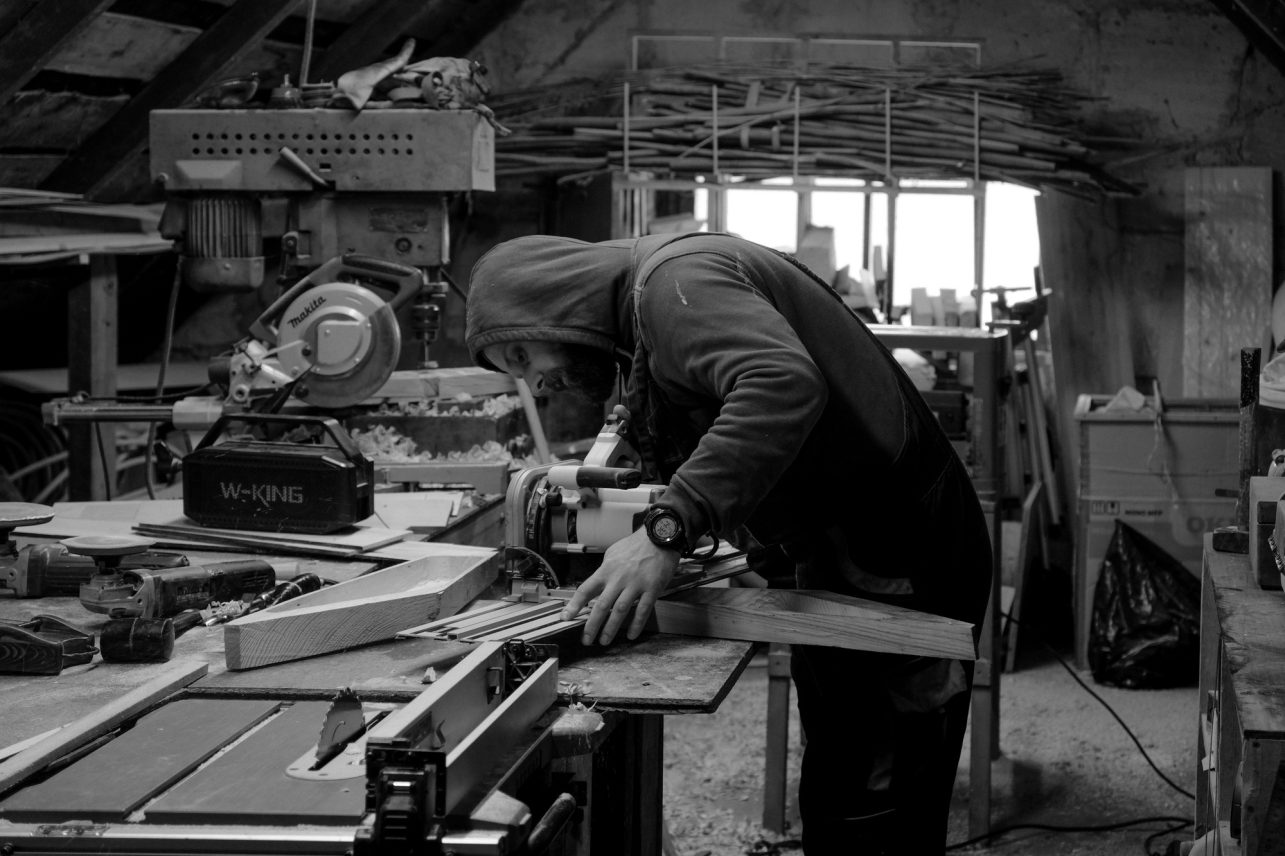
Impressive! The important thing is that they’re disconnected from electricity. How many strings are usually used?
In the Aukštaitija region, the oldest kanklės had five strings and were used to accompany sutartinės (traditional multipart songs). They do not have a full scale; the player tunes them according to the pitch of the song and how they can accompany it. Nine-string kanklės are also widespread. With them, you can play both songs and dances. Later, 12-string kanklės appeared, allowing more variation in sound and the possibility to adjust notes.
In the Suvalkija region, kanklės with 12, 14, or even 16 strings were used. When ensemble traditions developed, and groups of kanklės players began to form, the range expanded, and more strings were added. Kanklės with 29 strings are called concert kanklės – an achievement of the second half of the 20th century, when Lithuanian instrument makers tried to make it possible to play classical pieces on the kanklės. And they succeeded. The large kanklės have levers that allow slight changes in pitch. Nowadays, in music schools, students begin by playing traditional kanklės and finish with concert kanklės.
How important is this activity to you, along with folklore and history?
I feel that the most important thing in my life is to follow a straight path. Just as a monk enters a monastery and does not wander around but understands what he is doing and why, in the same way, the kanklės and their making have brought peace to my life. I know this is my path. I understand that I will not make a huge amount of money in this field, but I go to the workshop as if I were going to school to learn, and sometimes as if I were going to a celebration. I know that someone will come to visit, and I will have made wonderfully sounding kanklės. For me, the most important thing is to see that person’s eyes. Little by little, grain by grain, I feel that I am contributing to Lithuania’s national cultural education. Kanklės leave, but they speak. Sometimes I see them in events, in the hands of children who are just starting to learn how to play. I am very happy to be able to make such a contribution to our culture.
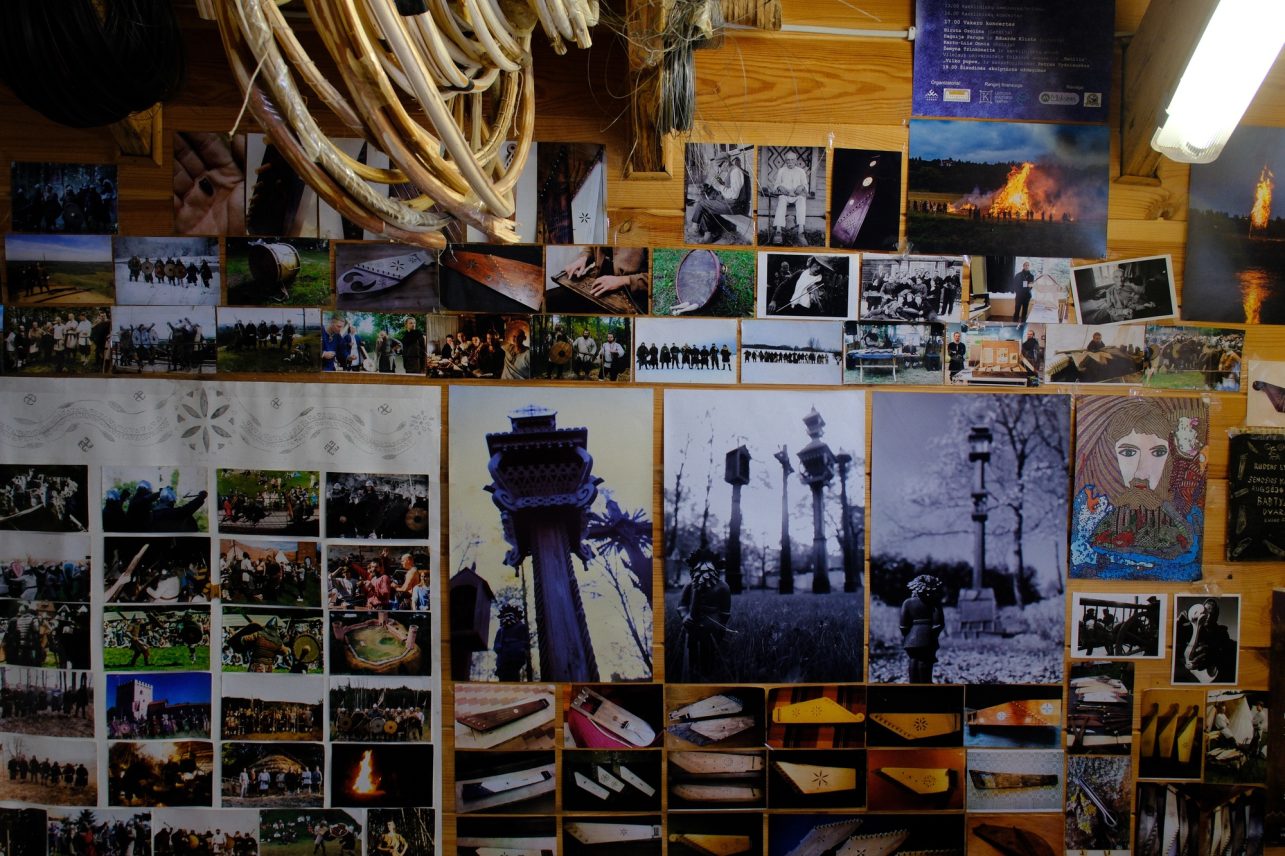
If we asked what Lithuania is in musical terms, the kanklės would most often come to mind. It is a unique instrument that represents our country. Each traditional instrument has its own genetic code; it carries the timbre of those songs and dances. If the instrument could not be tuned properly, we simply couldn’t play it. So we carry a message about our country. Not with words, but with sound.
You have created two kanklės from fallen branches of Raganų (witches) spruce, which is a protected natural monument, and you have also carved kanklės from stone. Do you plan to do more experiments in the future?
In Lithuania, we do not have university programs that you could graduate from to become a musical instrument maker. So that also motivates me to take time off to study wood, experiment, and search for new sounds. There are not many teachers, and not every craftsman wants to reveal their secrets. I try to constantly expand the list of instruments I make, and I also travel to international fairs. It’s necessary to keep improving all the time.
The stone kanklės were like bringing together my studies and musical instruments into a single origin. I still have those kanklės, they weigh about 70 kilograms. The stone does not resonate in them, only the strings that emit a low sound. I have many projects related to instrument restoration. I discovered that in Lithuania, drums were once made from sheet metal, so we are trying to trace whether there was a craftsman who specialized in making them. There is an impressive violin at the Museum of Ethnocosmology – a traditional one decorated with traditional patterns – and I would like to make one like it.
Sound is everywhere around us. You can cut a plumbing pipe and, by blowing into it, produce a sound similar to that of a horn. You just need to discover it, observe your surroundings with a sharp eye, and listen.