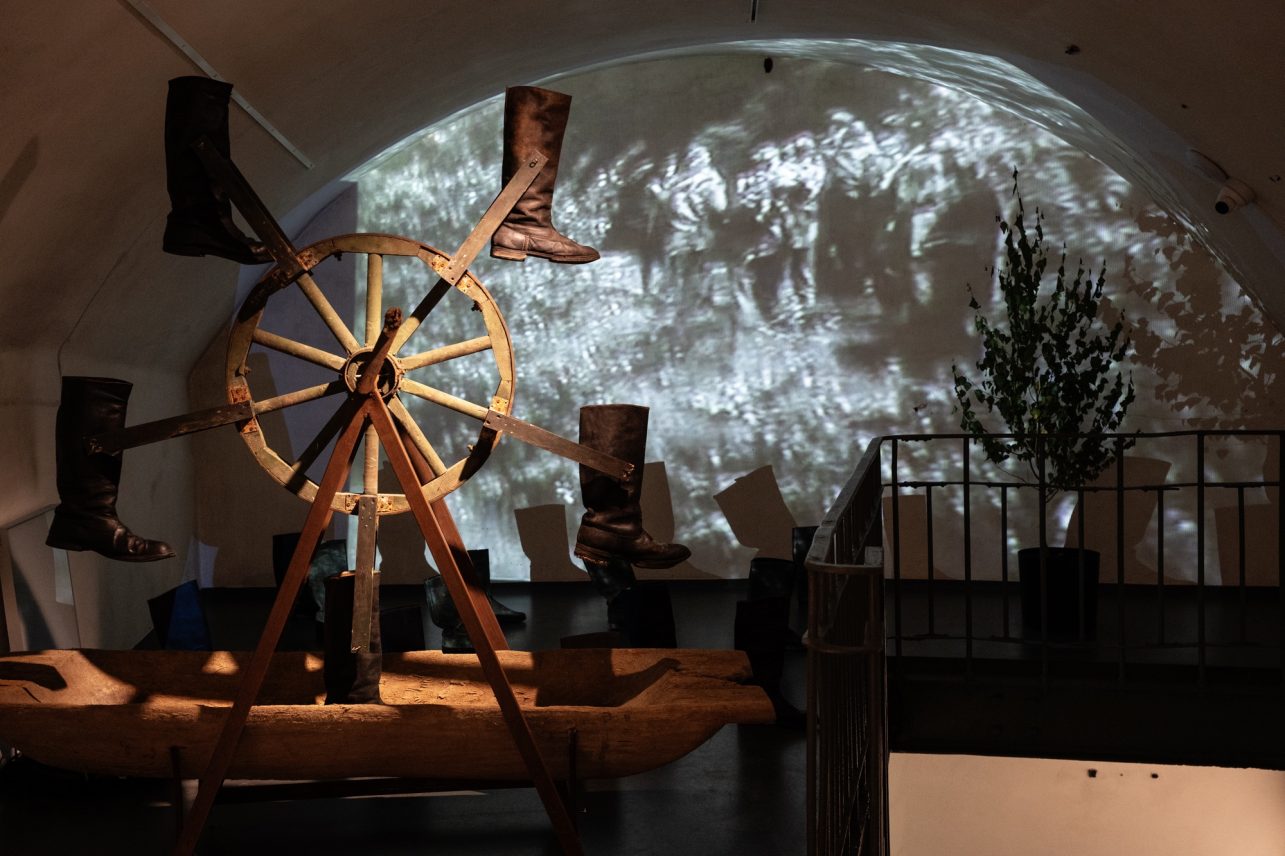
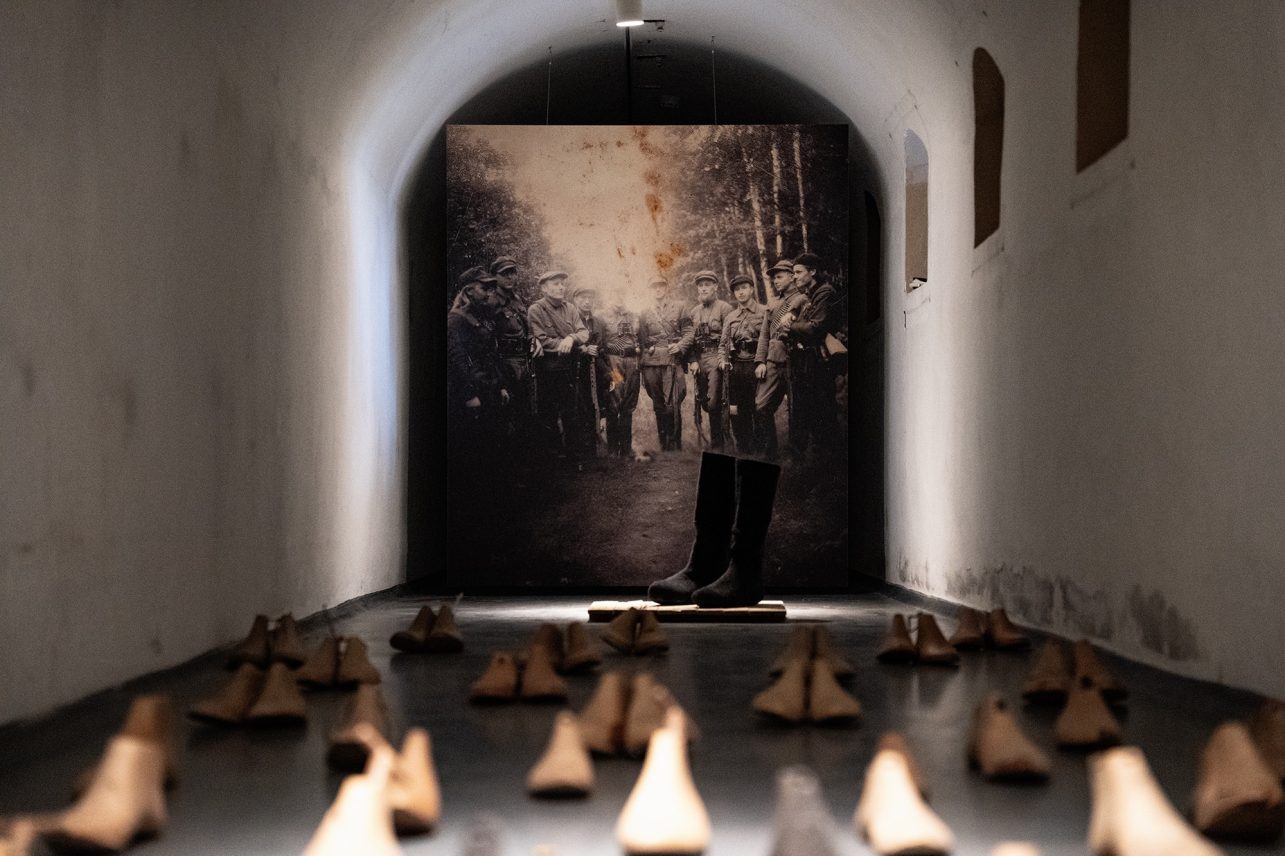
The exhibition “In the Shoes of Lithuanian Partisans…” is open at the Kaunas Ninth Fort Museum until 1 February. It is a unique visual archive that opens up the history of the resistance through specific people: their faces, relationships, daily lives, and fates. It also features installations of partisan boots created by Rūta Rimšelienė and Gedimina Šalkauskaitė, which speak to the themes of movement, footprints, and survival.
(The text was published in the January 2026 “Networks” issue of the “Kaunas Full of Culture” magazine)
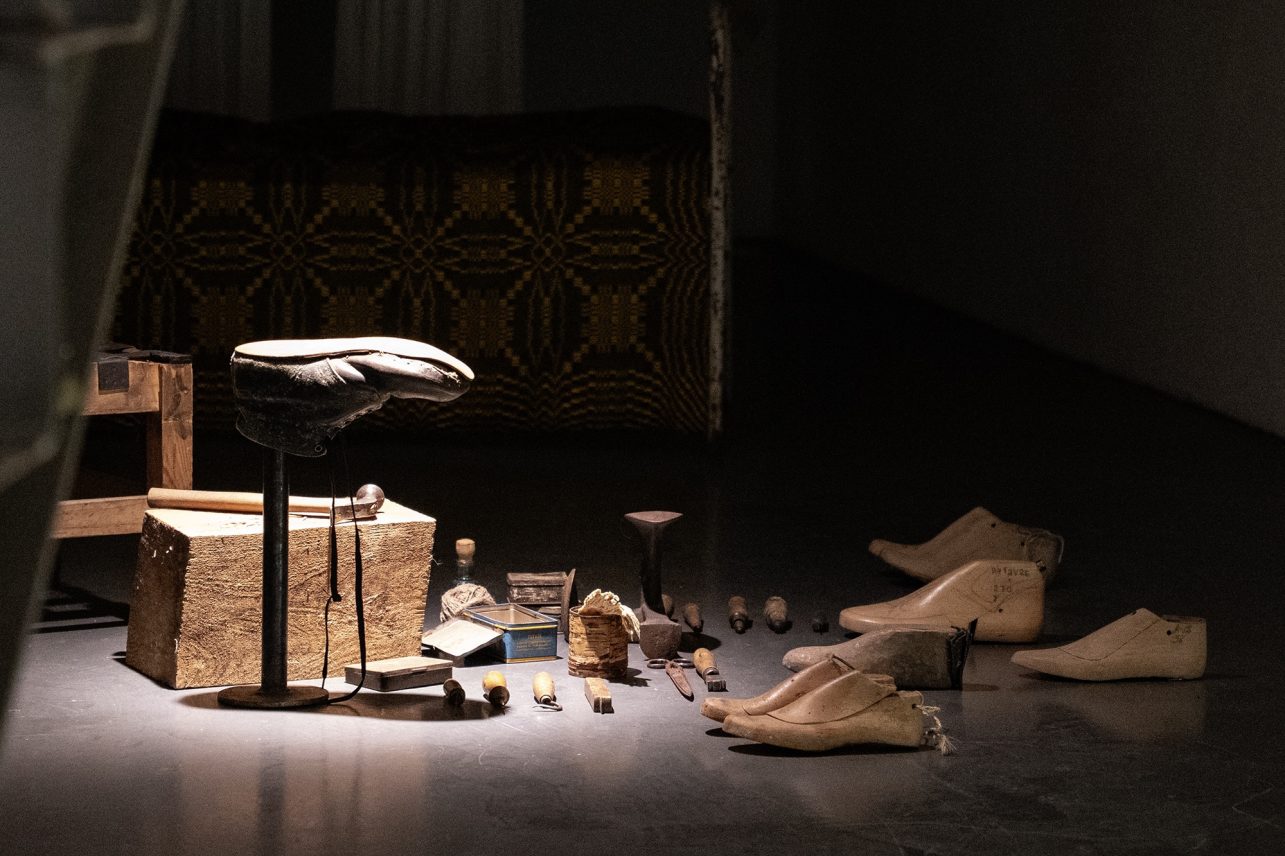
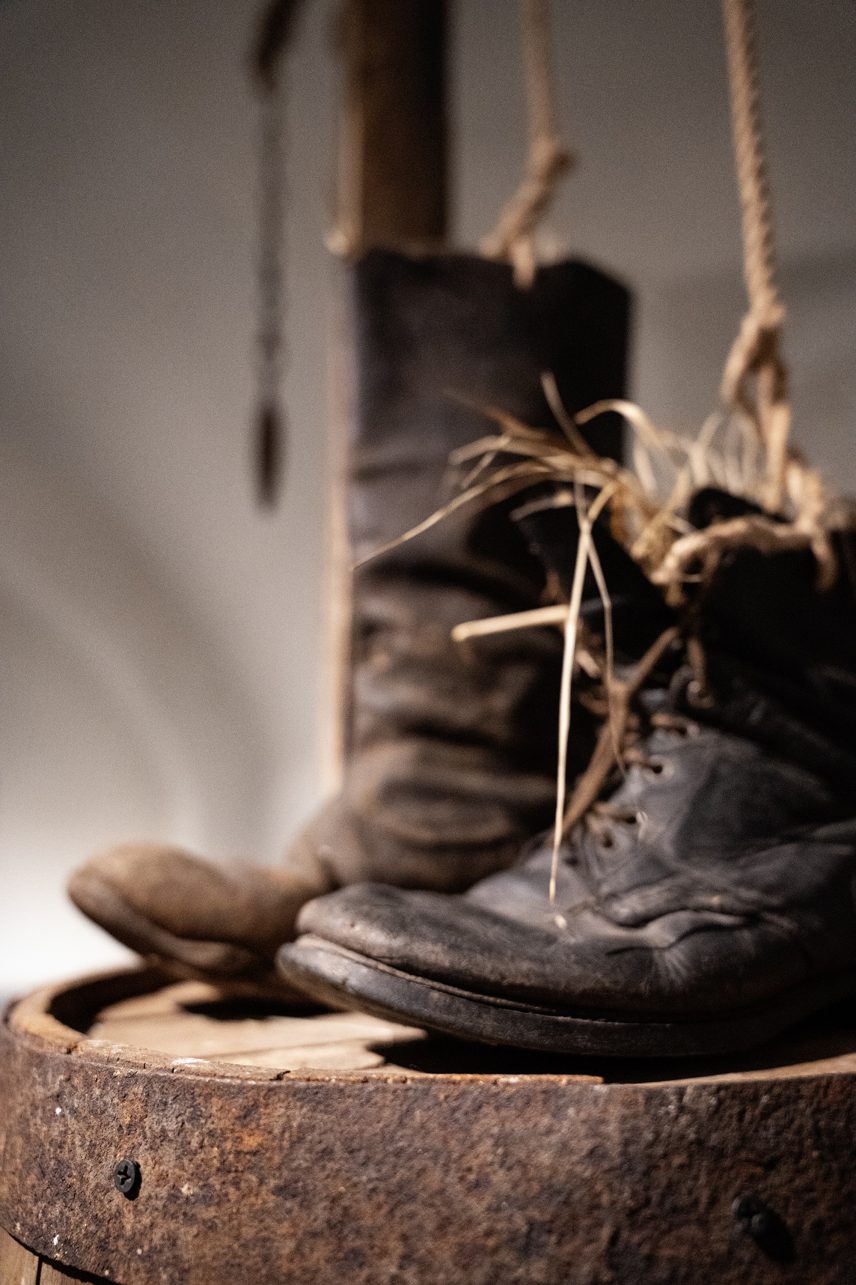
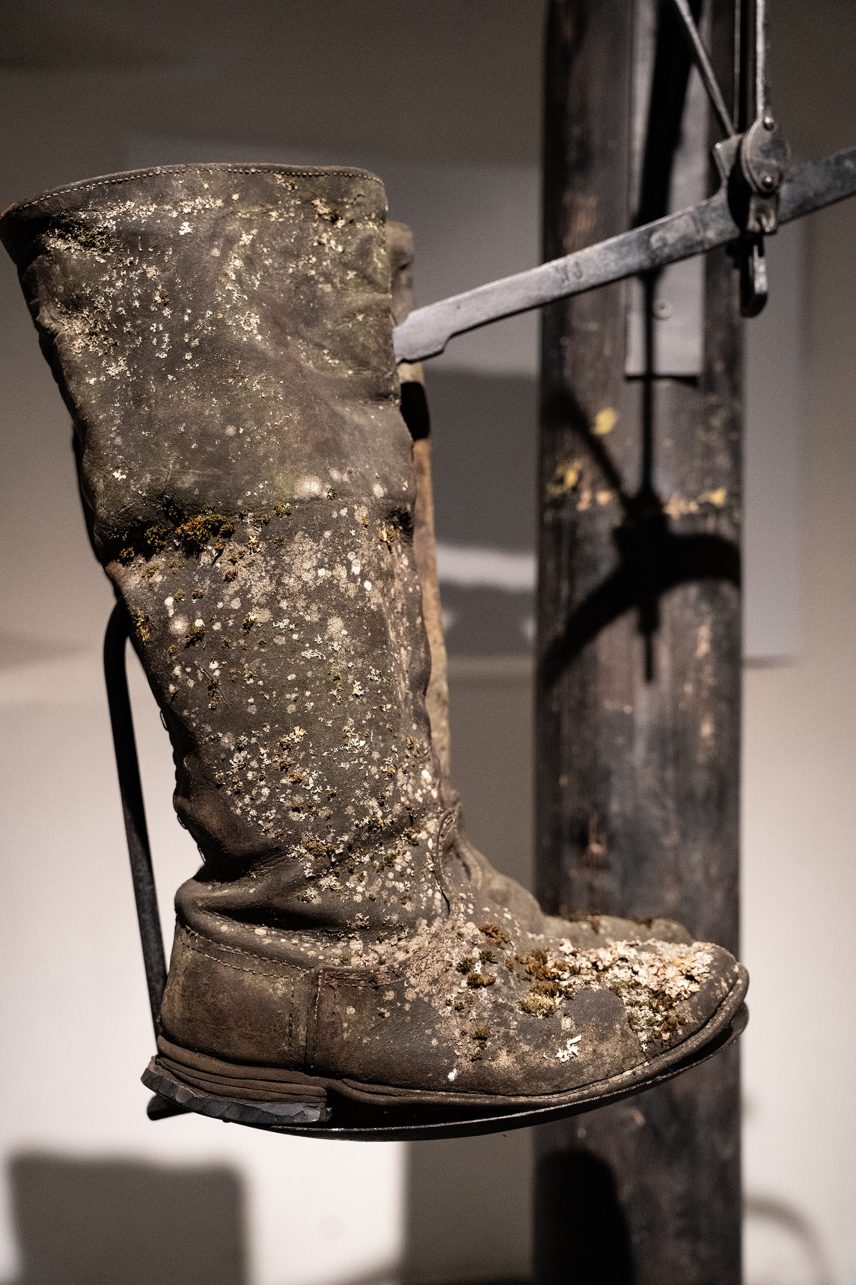
“The boot becomes a representation of the partisan’s path: a step through forests, villages, and secret trails. The space created by the installations allows one to feel the rhythm of their marches or the daily fatigue inscribed in every step of the fight”, says the exhibition’s curator, Eglė Pietarytė. The narrative she created with exhibition designer Renata Vinckevičiūtė-Kazlauskienė can be presented from various relevant angles, including the important aspect of communication and networking. What happens in an instant today and is taken for granted was complicated and… dangerous in post-war Lithuania.
The exhibition tells a very specific, yet universal, story of the partisans. Why did you choose to focus on the partisans of the Aras unit of the Briedis team of the Vytis military district?
The photographs that became the exhibition’s focal point could have been taken by couriers or the partisans themselves and were likely given to Jadvyga Kundratavičiūtė-Sakavičienė by one of the fighters. At the time, Jadvyga was sixteen or seventeen years old. She delivered messages, carried food, hid partisans, and later, for her entire life, she hid their photographs in the frame of her bed, between the boards. Her son, Kęstutis Sakavičius, found them there after his mother’s death. The publicised photos opened up new stories: people recognised their relatives in them. This is how we learned about the partisan struggle of brothers Mykolas and Juozas Šemežys and their comrades.
The narrative of the exhibition at the Kaunas Ninth Fort Museum is based on this authentic archive and the written memoirs of partisans, allowing us to get very close to the history.
Why is it important to exhibit a legacy like old photographs?
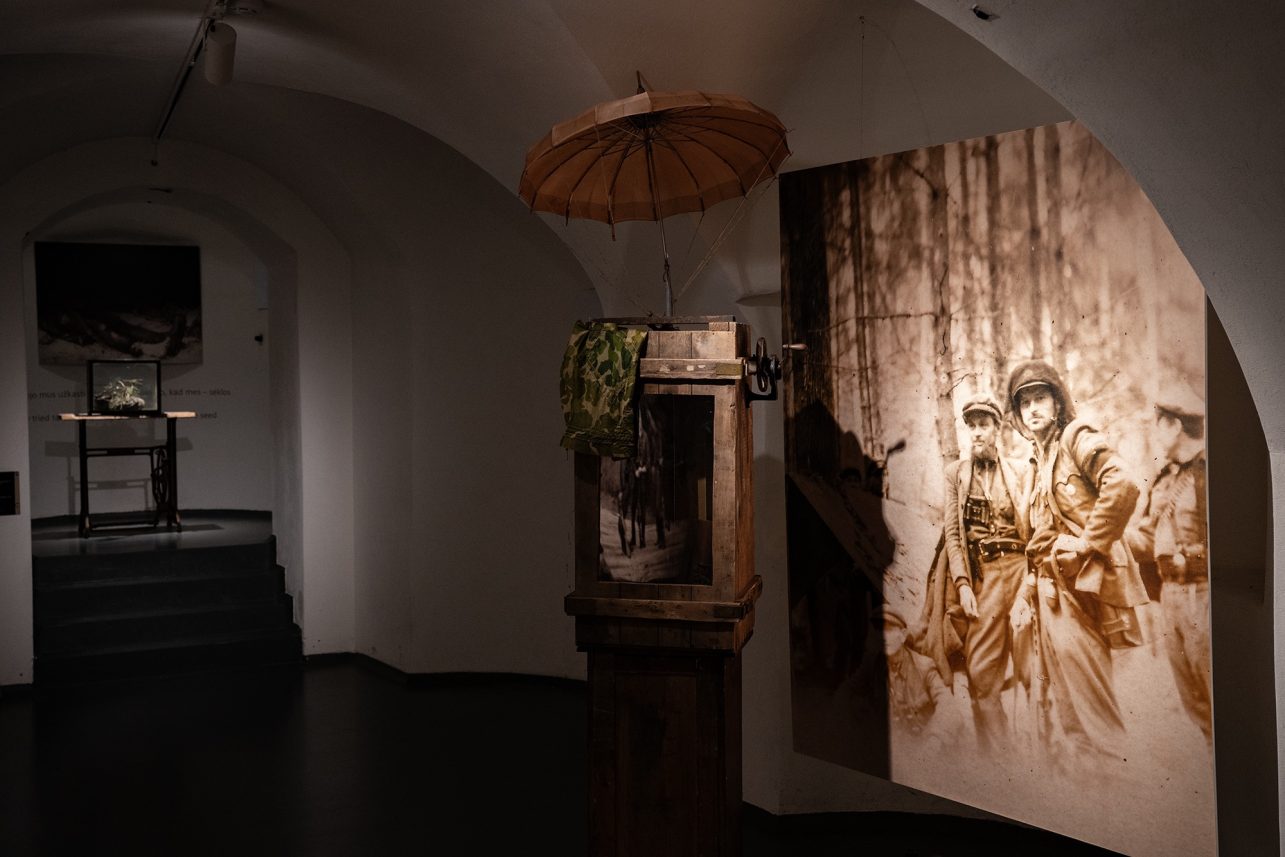
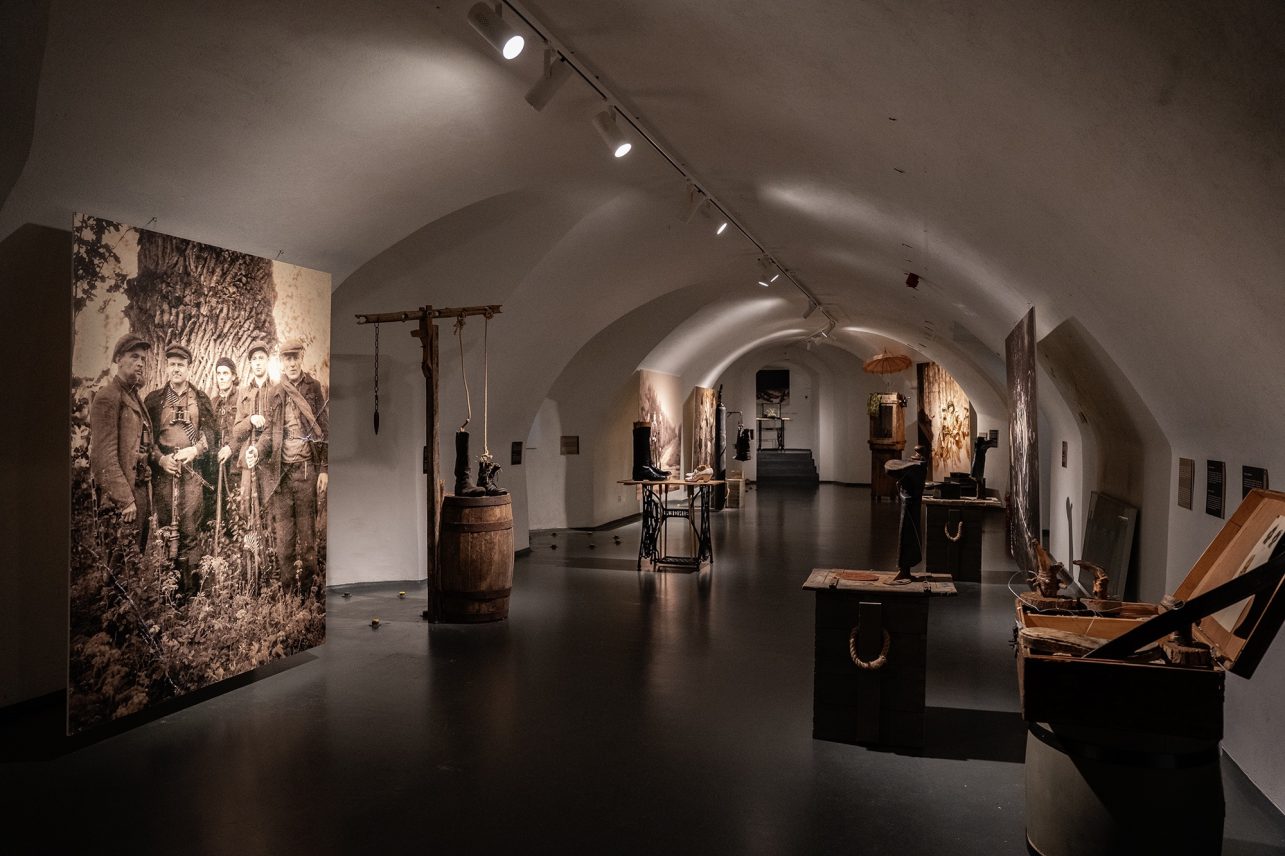
In the exhibition, the enlarged images have become a visual document, a form of memory that preserves people’s identities, their posture, fragments of their daily lives, and the entire structure of the unit. The photographs allow the viewer to get to know the partisans as individuals, to understand their activities, their relationships, and the environment in which they lived and operated.
The photos of the Aras unit capture the daily life of the Briedis team of the Vytis military district in 1948–1949. They feature the team and later district commander Mykolas Šemežys, known as “Aras”; his brother Juozas, known as “Tikras Brolis”; Vaclovas and Albinas Burbuliai; Jonas Stasiukaitis, known as “Ąžuolas”; Antanas and Vladas Dargužiai; Kazys Kirdonis; Juozas Grybas; Jonas Kimštas; and Bronius Baneckas, among others. They operated in the areas around Lake Lėnas, in the Pauslajys and Užuraiščiai forests, on the edges of the Šimoniai woods, and in the Pagiriai-Ramygala region.
Their clothing shows signs of the war years and uniform details typical of the partisans in the Aukštaitija region at the time. Some shots capture their daily life: resting on a fallen log, drying their boots, preparing for tasks, and their close bond with one another.
The partisans themselves used such photographs as documents of their membership in the unit. An image next to the commander or the core of the unit became a sign of recognition, helping to pass on information and establish themselves at the contact points of other fighter groups.
It was dangerous for partisans to be photographed together. If such photographs fell into the hands of the Soviet security system, they became a death sentence. They would be marked with blue ink, and numbers would be written on the faces, turning them into official records of wanted persons.
In the exhibition’s interactive installations, objects reveal the secret functions of the boots: transmitting information, concealing tracks, or using them as a tool for tactical manoeuvres. All this helped them to move secretly, to survive, and to resist. But if so many actions were carried out in secret, how did the partisans communicate with each other?
Within the unit, communication took place in a close-knit environment. Tasks were assigned verbally, and routes, guard posts, and reconnaissance points were established. A wider network of contacts connected the Aras unit with the Vytis military district command, neighbouring teams, and local communities. It involved the men of the unit, couriers, and people from the villages.
The villages of Užuraiščiai, Pauslajys, Lėnas, Pandėlys, Šimoniai, and Ramygala acted as intermediaries. The villagers provided food, clothing, hiding places, and information. News about the movements of Soviet collaborator battalions, raids, ambushes, and checkpoints on the roads came from them. Information also moved between the fighters of the Šarūnas and Žalioji teams, and between the guards and scouts of neighbouring units. Such reports helped to identify dangerous areas, patrol rhythms, and safe crossing zones.
And, of course, the internal structure of the unit was very important. Disciplined daily actions like shared guard duty, preparations for marches, tactical planning, and food preparation meant that everyone knew their place and their duties. We can also feel this close bond in the photos of the Aras unit, which show the men preparing for a march, posing for a group shot in the woods, or during a moment of rest.
The partisan movement in Lithuania relied on a broad network of people and places. How was this network woven between different areas and among the population?
We begin the exhibition’s narrative in a shoemaker’s workshop. Here, the boots become a symbol, marking the path taken by the freedom fighters who created one of the most organised resistance movements against the Soviet occupation in Europe.
Couriers were crucial for the fighter units. Secretly transmitted information made it possible to organise a coherent resistance. Through the hands of the teenage courier Jadvyga Kundratavičiūtė-Sakavičienė, short orders, warnings about raids, meeting instructions, food, and clothing travelled through the areas of Užuraiščiai and Pauslajys. It is likely that the photos of the Aras unit were also entrusted to her. The story of the Šemežys family helps us understand that there was a constant pulse of communication between the forest and the village, maintained by specific people, clearly agreed-upon farmsteads, and consistent routes that ensured information safely reached the right hands.
The surviving accounts of couriers from that time suggest that Jadvyga’s work was likely similar to that of other liaisons in the Užuraiščiai and Pauslajys areas. Historical testimonies show that such couriers often carried food, clothing, newspapers, and short messages, stopping at designated farmsteads where supplies for the partisans were waiting. We recognise this common operating model in the stories of many women and teenagers from various regions of Lithuania.
The second layer of this network was the farmstead “stops”. The accounts of Stasė Šemežytė-Stragauskienė mention places where documents, newspapers, messages, and delivered items were hidden. A courier would come to such a farmstead and leave or pick up a bundle. The hosts knew on which day and at what time to expect a guest.
The third layer was the united local community. They watched the roads, counted the Soviet collaborators’ vehicles, and noted the direction the soldiers were heading, what they were asking, and what they were taking from the yards. Such knowledge would later be turned into short fragments in messages: “combing from the forest”, “standing by the bridge”, “farm is occupied”.
All the members of the Šemežys family presented in the exhibition suffered repression. While the two brothers were fighting, the others were either exiled or sent to labour camps. In such common life situations at the time, what sparked their motivation, both for the fighting partisans and for those who extended a helping hand to them?
The Šemežys family of freedom fighters raised five children in Steponava, living off the land. The German army burned down their home, and the Soviet occupation exiled part of the family to camps. Two brothers, Mykolas and Juozas, took up arms to fight for Lithuania’s freedom. The youngest sister, Stasė, testifies in her memoirs to the constant injustice, humiliation, and brutal force of the occupying authorities, which fostered a firm resolve not to yield, even in the face of exile or death.
The partisans fought for the continuity of Lithuanian statehood, seeing themselves as defenders of the state. This was also characteristic of Mykolas Šemežys’s personality: a capable, disciplined man, close to the military system, who based his activities on the principle of the state and responsibility for its future.
The courier Jadvyga Kundratavičiūtė-Sakavičienė never got over the fear that the bad times could return and the occupiers could come again. It seems that in today’s context, this is particularly sensitive and relatable. When talking about networking and community building, can we find parallels between the political realities of that time and today?
Jadvyga Kundratavičiūtė-Sakavičienė’s experience, preserved in the stories of her friends and passed on to her son, fundamentally changes a person’s relationship with memory. The constant fear and tension Jadvyga experienced while living under occupation followed her throughout her life and were passed on to her children and loved ones. I would call it a wall of silence, a sense of caution.
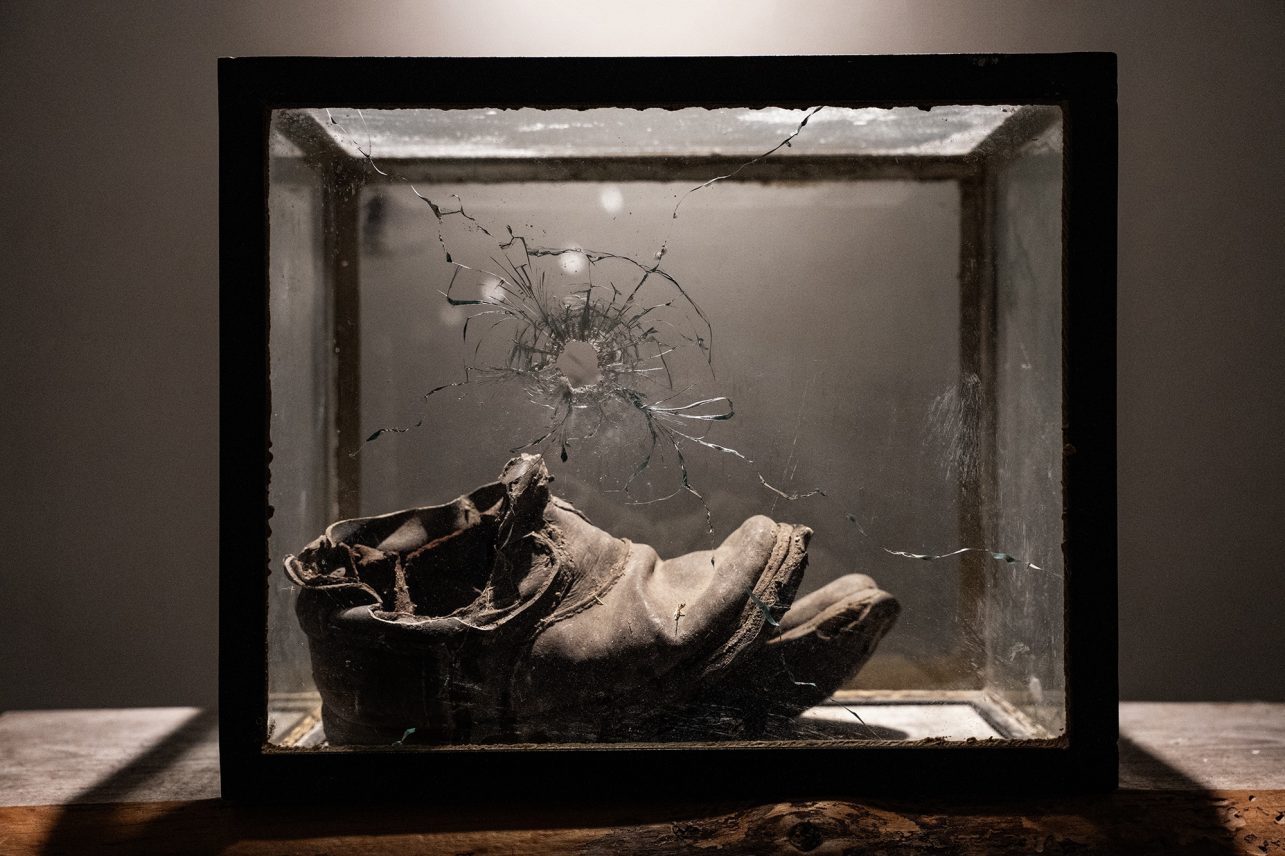
When creating the exhibition, it was important for us to reveal the metaphorical meaning of the shoe last: it is the foundational form of human posture. From the shoe last comes the boot, and from the boot, the path. The fighters of the Aras unit walked this path, the female couriers walked this path, and we walk the same path today.
Today’s society protects freedom through different practices. People in the cultural field, journalists, members of the academic community, and creators of civic initiatives protect the public space just as communities protected it in the post-war period by letting in a courier who came at night. In Lithuania, we see a strong tradition of cultural protest: peace protests, artistic and civic actions that defend freedom of speech and human dignity. This is not a random phenomenon; it is the heritage of our historical struggle. We have inherited an inner understanding that freedom must be protected with our dignified stance, our bodies, our voices, and our creativity.
In this exhibition, we wanted to show that the partisans’ path is not a finished historical fact. The shoe last, the boot, the photograph, the name, the quietly passed message from the forest: all of these form a fundamental line of freedom that connects the post-war courier Jadvyga, the men of the Aras unit, and the people of today who defend the right to speak, create, and be free. Freedom in Lithuania has always had, and will always have, its defenders.