Lithuanian women’s football has been undergoing a period of significant growth in recent years: clubs are strengthening, attention is increasing, and stadiums are increasingly filled with spectators. Behind these changes, however, are people who care about the growth of sports culture both on and off the field.
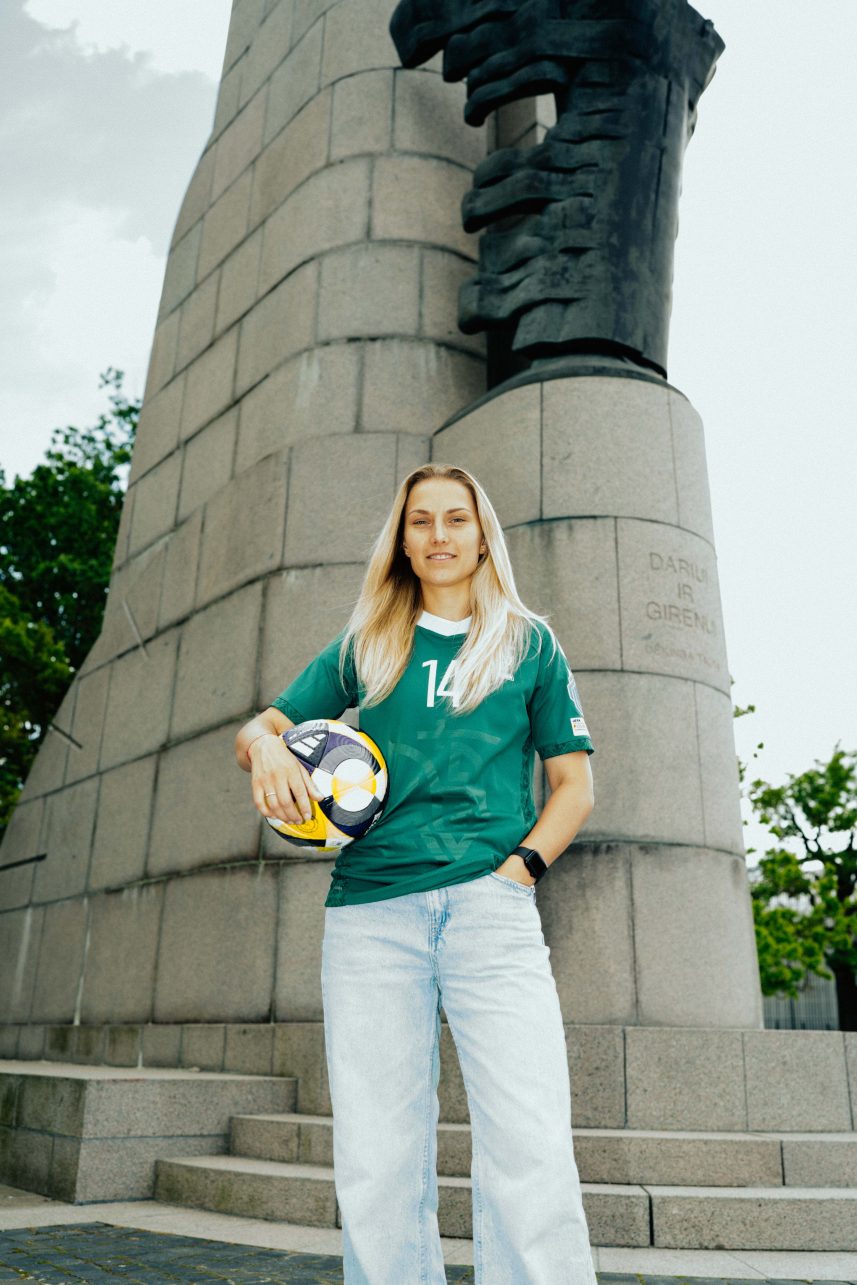
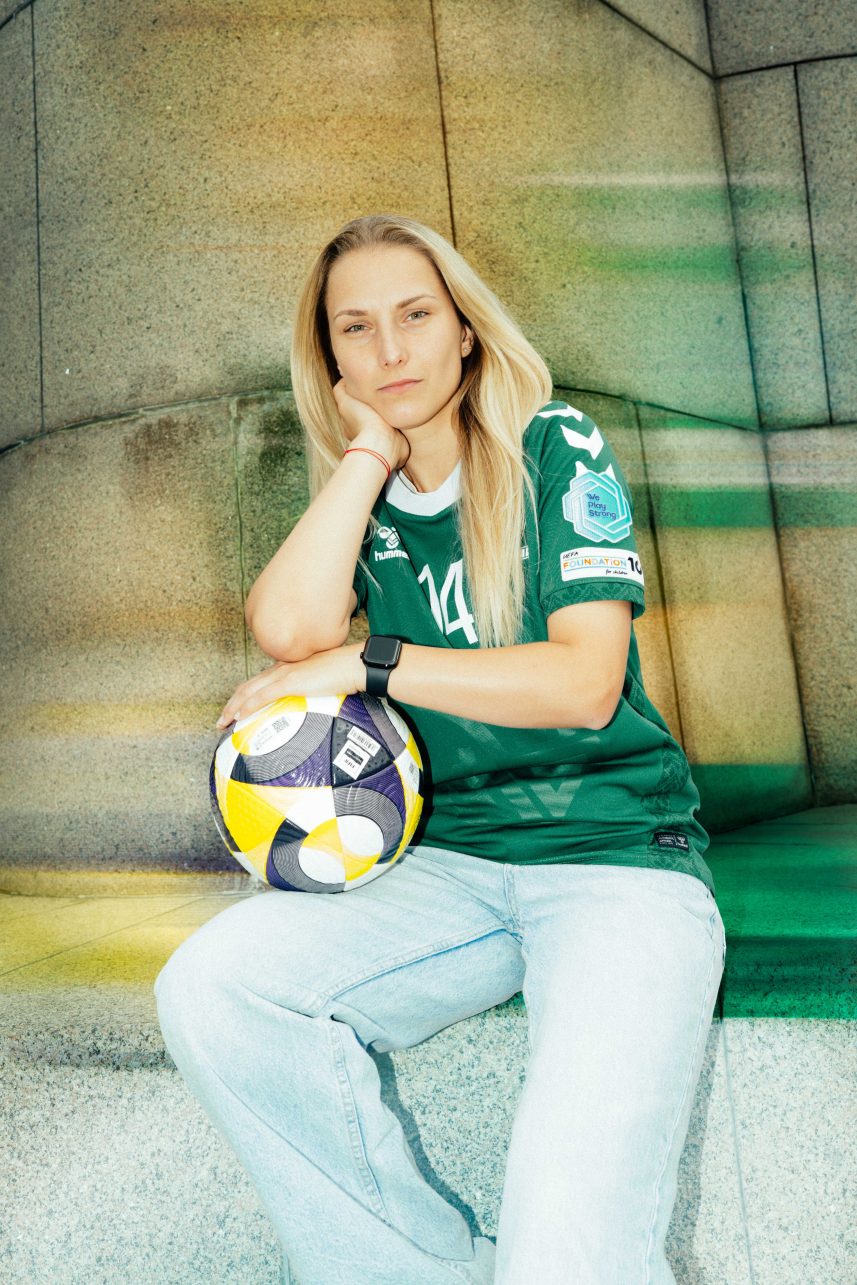
Among them is Milda Liužinaitė, captain of the Lithuanian women’s national team, which successfully passed the first stage of the World Cup qualifiers in June, was promoted to Division B, and will face the Swedes in October. One of the country’s most experienced female football players, she balances multiple roles daily: she represents the Vilnius-based MFK “Žalgiris,” heads the Lithuanian Women’s Football Association, works at the Lithuanian Football Federation, and actively contributes to the development of women’s football in Lithuania. We met Milda near the Darius and Girėnas Stadium and talked about her journey in football, the stereotypes that are still alive, the changes, and the new stage of her career in the capital.
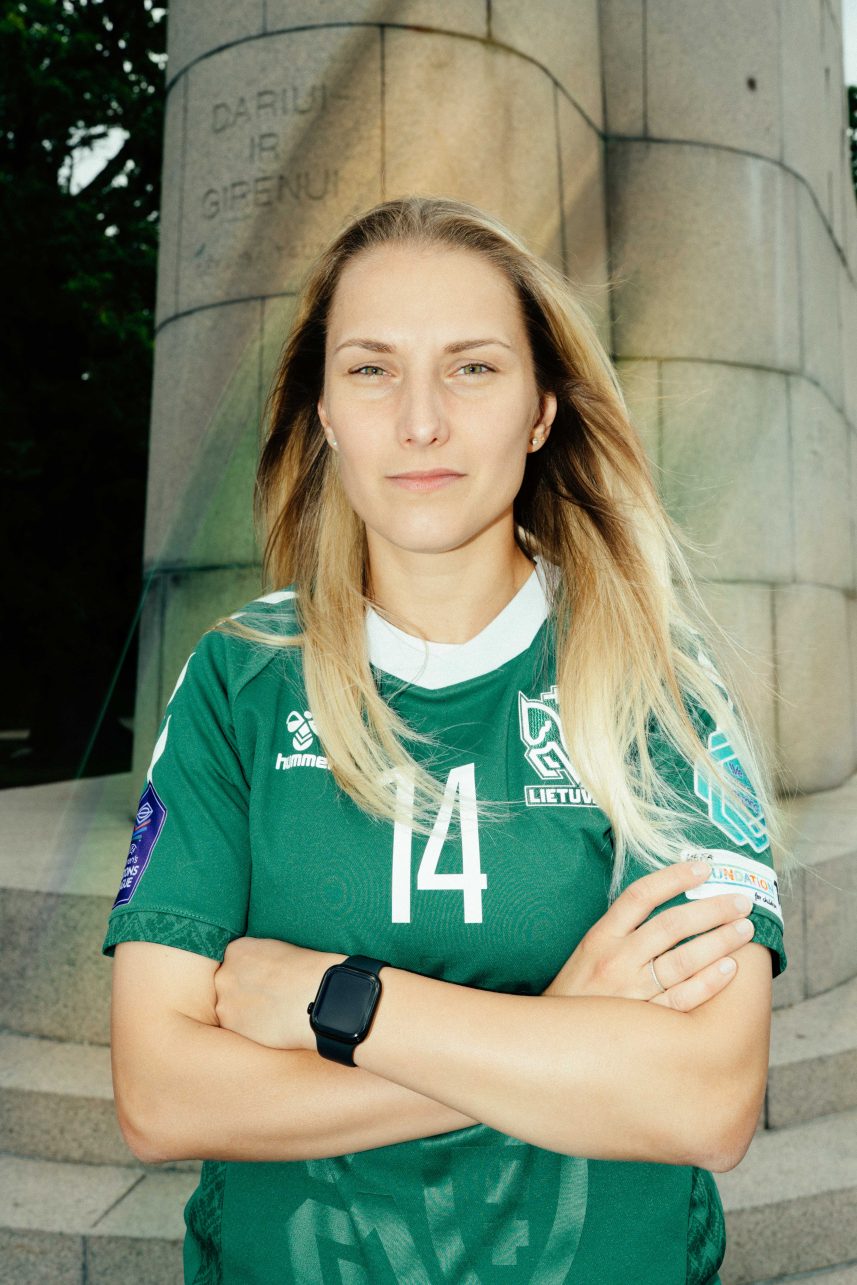
Milda, I read that you have been representing the Lithuanian national team since 2013 and have played almost 70 matches since then. But how many in total?
This number only refers to playing for the women’s national team, and it is approximate because some match reports are missing; besides, the reporting system has changed during that time. The total number, including the U-17 and U-19 national teams and clubs, is definitely much higher. After all, I have been playing for 19 years. In the A Lyga alone, there are about 20 matches per season.
I will venture a guess that you have heard more than once that this sport is “for men.” I am very curious about how you started.
All rules, words, and descriptions are created by people themselves. And the idea that football is a “men’s sport” was also conceived by people. Yes, perhaps men were the first to play football because they have been more physically active since ancient times, while women’s attention was directed elsewhere. But that is not a rule.
Since childhood, I have had more boy friends than girl friends; I preferred spending my time being active rather than playing with Barbies, doing hair, or putting on makeup. And I also have an older brother: we have always been best friends and spent time together. That is how I ended up in football, and I never felt it was a men’s sport; there were always more boys, but I had a group of girl friends as well.
What has helped you maintain your motivation most throughout all these years?
Everything is much simpler when you do what you really love and are surrounded by a good environment and supportive friends. And those who didn’t support me simply faded in my eyes. It only fostered a determination to do what I wanted and prove that it is possible to earn a living and achieve something.
As I got older, I realized that the stereotype of football as a men’s sport actively follows us, but I believe that it is just football, just sport; let’s talk about it that way. I have to be a bit of a feminist sometimes and fight for women’s rights, but that should be relevant not only in the environment of my chosen sport but also at work, in culture, everywhere.
Women’s football has changed significantly over the last decade. Which changes seem most important to you?
Definitely; the most striking change is the results. This was largely influenced by the environment created for women to play sports: clubs are strengthening, conditions for players are improving, the coaches themselves are becoming better, and their qualifications are rising. Women’s football is growing very rapidly worldwide, and the trends are reaching us as well.
Over the last decade, even the way people talk about women’s football has changed, as has the perception, competitiveness, and sponsorship. There are far fewer stereotypes now; for example, it is no longer believed that your legs will become crooked if you play football. More and more girls are joining; people see that it is not so scary to let their child play.
You spent the majority of your career in Kaunas. What did you take away from that stage?
I played for the same team, just under different names. Ingrida Siliūnė had created a legal entity – the Kaunas team FK “Žara” – but licensing in men’s football requires having a women’s team in its structure, so after that, we were under the wings of “Stumbras” and “Inkaras.” Then came FK “Kauno Žalgiris” and “FK Hegelmann,” and now it is the Kaunas District Football Academy.
It is truly very difficult for a separate women’s club to survive; even now, few people are interested in or support women’s football. If the men’s budget is one and a half million, then women are allocated about 100 thousand. And that is only as part of a joint club. But there is also something to be happy about: we have women’s teams and academies in the top leagues, such as “Gintra” and MFK “Žalgiris.”
How important is the connection off the pitch for football players?
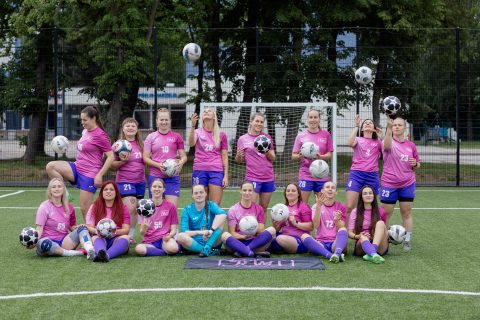
Women’s football is not our main job but a hobby, as we cannot make a living from it; however, the team truly becomes like a family. In the Kaunas team, we all became very close friends; we traveled together and celebrated holidays together. Traditions interweave with the desire to spend time together off the pitch; meeting at a bar after a match or training and talking about everything, not just football.
The sense of collectivism is truly very useful: you play not only for yourself but also for that friend beside you, for the team. Creating such a connection over many years meant forgetting about birthdays, holidays, and even vacations, because you are always going to a match. You plan all the extra things in life around football – and it is not that difficult when you know that every member of the team is doing the same.
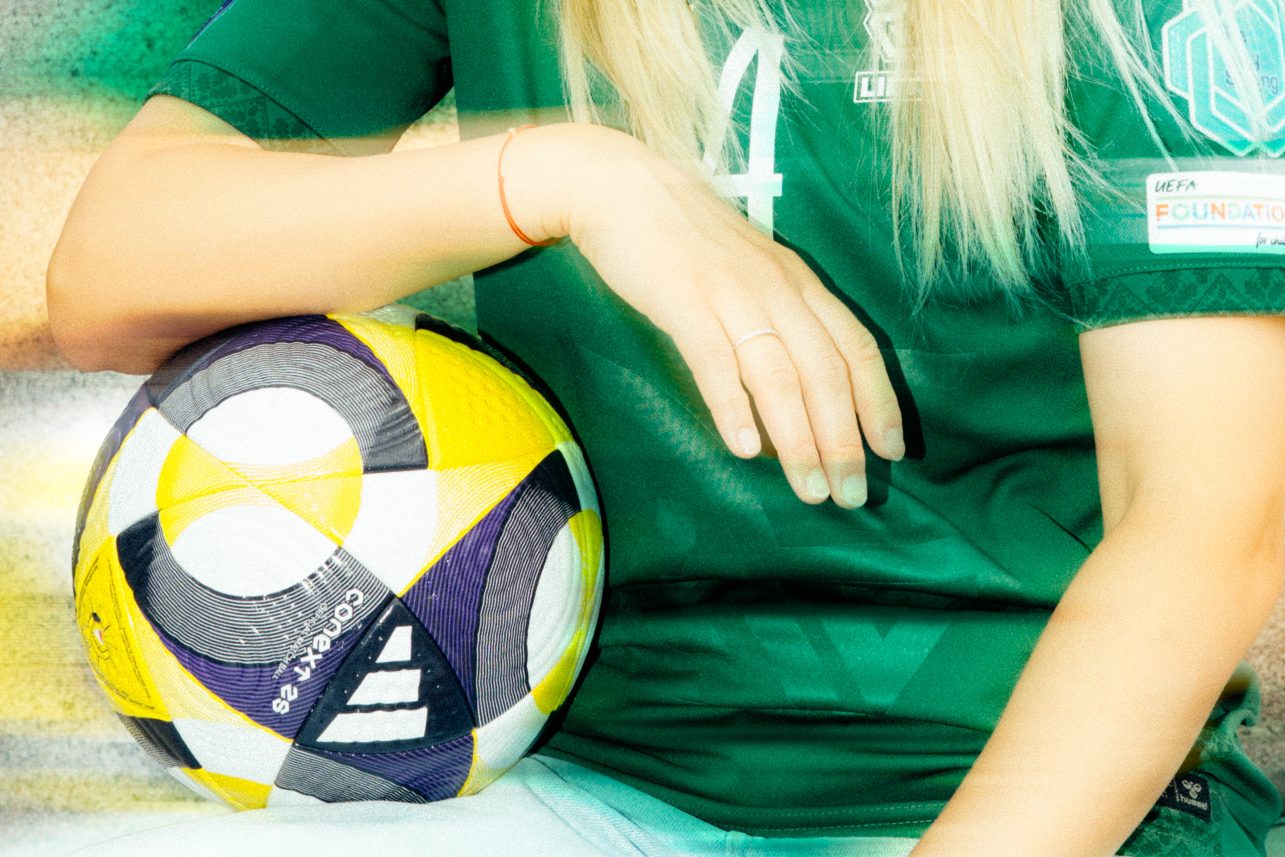
Does the greatest joy of victory come from the result or the people you share it with?
In individual sports, you celebrate alone. Of course, there is the coach and the family, but that joy – I don’t know if it equals the joy of a 30-person team. It feels as if the emotions simply double.
The same goes for defeat: when you lose alone, you only blame yourself. But in a team… you might also blame yourself and think about what went wrong, but you still lose together; you can discuss what happened with everyone, and you receive support and a hug. It is much easier to experience all emotions that way, both good and bad. Emotionally, team sports give me much more happiness.
You are one of the country’s most experienced female footballers and the captain of the Lithuanian national team. What does this role mean to you?
First of all, I didn’t have a goal to become the captain. I am no longer the manager of women’s national teams, although I did that for maybe 6 years. During that time, I was both a manager and a player. I knew what conditions my colleagues needed, what the plan, catering, and so on should be. Besides, I always sincerely cared for my team and had contact with coaches and players; that is probably how I was elected captain.
As a captain, you have to be open to everything, be ready to help, set an example, and be able to motivate others and, of course, yourself. A captain is not the best player on the pitch but the one you can always approach and ask for advice. I believe that everything must happen naturally, because you cannot create a connection artificially; therefore, there is no manual on how to become a captain.
What does a captain’s day look like?
Being a captain, especially in the national team, is not a duty with very specific responsibilities. Of course, when I was the captain of the Kaunas team, I would always intervene if problems arose; I would be at the epicenter and think about how to solve the situations. But there is no set plan. I think all my activities complement each other: I work for women’s football from morning to night, organizing championships and planning national teams and calendars, as well as contacting coaches. Sometimes I joke that I work in a “market of troubles,” because I am almost always solving problems so that things will eventually be better.
And later, after difficult seasons, positive feelings visit the body when you arrive to present awards to players and see how happy they all are; then you understand why you sit in that office and listen to other people’s problems. It seems I listen to complaints all day, and in the evening, I go to training and completely vent, letting go of those heavy emotions.
In March, you officially joined the women’s team of the Vilnius club “Žalgiris.” I read that one of the most important reasons for choosing the club was the changed attitude toward women’s football and a clearer long-term direction.
Yes, the general attitude has changed, but there were other reasons as well. One of them is that I am a starting player in the national team, and I need results; I want to be pushed, I want demands to be made of me, and I want good training sessions. In Kaunas, it is not completely clear what will happen next with the club: finances were decreasing, and the conditions did not motivate us to strive for top places. To be honest, I had been thinking about it for more than a year, but I was attached to my team; eventually, the desire to improve won out.
I believed in Vilnius “Žalgiris” because new people came into management who can be a good support. MFK “Žalgiris” and FK “Gintra” are, in my eyes, good examples of how men’s clubs should promote women’s football as well, so that it becomes one joint pyramid.
“FK Gintra,” which was the champion for more than 20 years, used to have legionnaires and so on. Others even wanted to overthrow the club to create competition, but eventually they just took on legionnaires themselves and started looking for stronger team members. I think this is a very good model that other clubs have begun to follow. “MFK Žalgiris” shows an excellent result, being able to gather almost 2000 spectators for women’s matches. Both as an athlete and as an employee, I will strive to do even more to make women’s football grow.
We say that women’s football needs money – then we will be able to do something. If that is your attitude, then you need to be prepared to look for that money, and I believe that it will all happen through joint efforts. But if the prevailing attitude is that we should provide that money ourselves, then nothing will happen. We need growth and competitiveness – that is where more desire for change comes from.
Football takes up a huge part of your life. What happens when you step away from it, even for a short while?
I’ll admit: it’s difficult not to have anything to do with football even for one day. Although I like traveling, I often cannot do it; for example, I will only be free now after the season ends, but even then, I will already be preparing for the next one. It’s hard to balance. But basically, as much as possible, I travel; I like spending time in nature, eating good food, and watching movies. I have neglected it a bit, but I used to play the guitar and devote more time to art, culture, and music. I like things that allow me to think about nothing else. Not even football.
instagram.com/milda_liuzinaite