We agreed to meet on Laisvės Avenue, by the fountain. “Perhaps we will recognise each other,” joked the poet and prose writer Aldona Ruseckaitė. Waiting on a bench, I already held her book in my hands – I certainly wouldn’t miss the chance to get an autograph.
We didn’t miss each other, and for our conversation about creativity, Kaunas, and the upcoming Kaunas Book Fair, we chose a symbolic location – the Vincas Kudirka Public Library.
By the way, it is a coincidence – the writer’s latest book, which we will discuss shortly, will be presented this month both at the fair (September 18th) and at the library (September 29th).
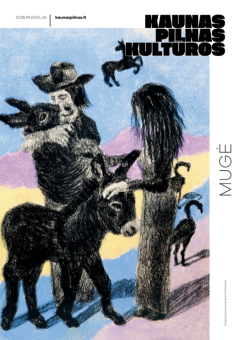
(This text was published in the September 2026 issue of the magazine “Kaunas Full of Culture”, titled “Marketplace”)
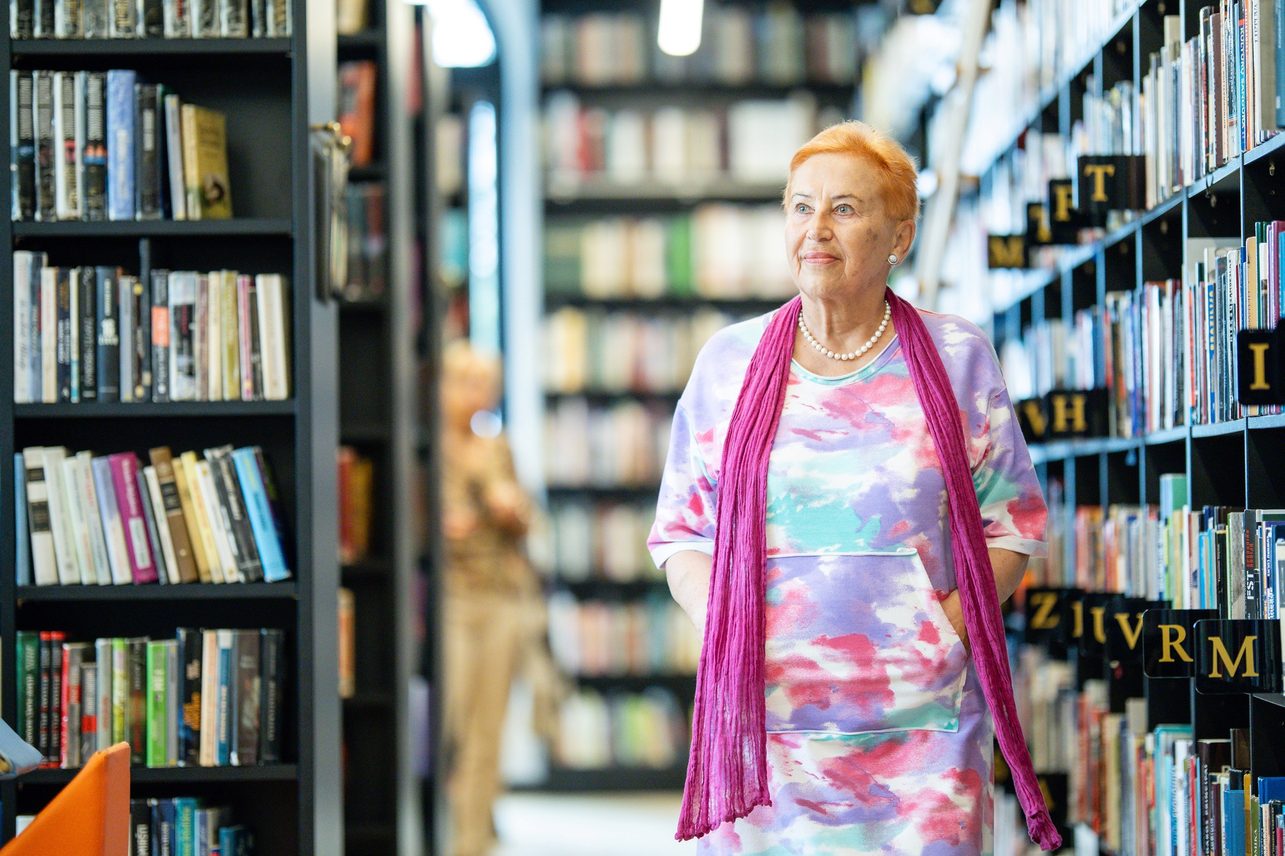
Your professional and creative life is closely linked to Kaunas – you worked for many years at the Maironis Lithuanian Literature Museum here, and many of your books were born in this city. Has Kaunas shaped you as a writer? Does it still manage to surprise and inspire you?
I don’t call myself a Kaunas native; I call myself a Kaunasite. In truth, I come from the Prienai district, but I have lived in Kaunas for very many years. My whole life, my friends, my fellow writers – everything is rooted in Kaunas. In my work, Kaunas is primarily not so much an inspirer as a character. There isn’t much of it in my poems – there, I return more to my birthplace, to roots and nature. Although there is some Kaunas: Town Hall Square, the Cathedral, and Maironis walking the city streets.
I have written books about Maironis, Žemaitė, Vytautas Mačernis, Salomėja Nėris, Ona Puidienė-Vaidilutė, and Vincas Mykolaitis-Putinas – all of whom lived in Kaunas for longer or shorter periods or were connected to it. Since these are biographical novels and I cannot simply make things up, I had to explore the places where they lived. I have scoured the whole of Kaunas – I walked the small streets, searched for houses, churches, cathedrals, and burial sites. I had to research the city itself very thoroughly.
When I published the novel “Shadow JMM”, people would come to my office at the Maironis Lithuanian Literature Museum for an autograph and tell me that they had come to Kaunas with a map they had created based on my book about Maironis, because they wanted to visit all the places associated with him.
So, Kaunas is a character in my work. It provides a certain foundation upon which the characters stand and live. I have tamed this city; I know a lot about it, and it is very close to me.
What is your favourite route in Kaunas?
My route is a bit of a funny one. I live in a house marked with the number 13, I used to take the number 13 bus to Maironis’s house, which was addressed as Town Hall Square 13. My daily route was between those thirteens. I would get off at the bottom of Savanorių Avenue, cross Vilniaus Street, and then Town Hall Square. This path is simply ingrained in my mind; I could see it in my dreams because I walked it for so many years.
Sometimes during my lunch break, we would go for a walk to Vytautas’s Church, along the embankment towards the Confluence. I miss walking along Laisvės Avenue as well. And, of course, I love Maironis’s garden. For many years, it was my spiritual space. During almost every lunch break, I would take a few photos: what had bloomed, how much it had snowed, what bird tracks had appeared. I no longer had my original childhood home, so Maironis’s garden became one of my most cherished little places.
Now that I am no longer working at the museum, I have discovered a different route. I live on Žukausko Street, and across the road is the Blessed Jurgis Matulaitis Church. Behind it is a former monastery and a park established next to it. As a person from the countryside, I am very drawn to nature. It is also very interesting to walk through Žaliakalnis, along Vaižganto Street – there is Vincas Mykolaitis-Putinas’s house and the Klimas villa where Vaižgantas lived.
Your biographical novels stand out for their meticulous archival research. How does the creative process for such a book begin, and what determines which personality you will write about?
Every novel of mine has its own beginning and a certain story. I never thought I would ever dare to write about Maironis – such a national symbol. However, one summer an elderly couple from the United States showed me some copies of letters – postcards from Maironis written to the man’s grandmother. They wanted to know more about her, to find something, and at that time I knew very little. Since I was a museum professional, many thoughts began to swirl in my head after reading those postcards. I felt there had been a great deal of affection and admiration for the woman – Ona Balčiūnienė. Even Maironis scholars didn’t know about these letters. Initially, I thought I should write a little novel about an elderly poet and a young muse, but then I thought – what’s new about that? The 150th anniversary of Maironis’s birth was approaching, and there was a lot of material in the archives, so I realised I could dive deeper into Maironis and show him as a person from various angles. So, the very beginning was those little letters, and then I began to research everything else.
With Vytautas Mačernis, it was a different story. As a museum professional, I knew his fiancée, Bronė Vildžiūnaitė. She had donated manuscripts and photos to the museum. I myself was a great admirer of Mačernis’s work. Once, on a museum expedition to the Telšiai region, we visited the Mačernis literary exhibition and met many people who had known him: his sister, brothers, and friends. We managed to collect a great deal of material. And, of course, there was Bronė. We would talk on the phone occasionally. She kept Mačernis’s love letters and their marriage permit for a very long time – she only gave the originals away when she reached the age of 96. If I hadn’t known Bronė and heard her story, I wouldn’t have written about Mačernis. I read many extracts from that book on Lithuanian Radio; after hearing them, Bronė said: “How interestingly that Ruseckaitė wrote, it feels as if she lived right beside us.” For me, that was the greatest compliment.
The story behind the book on V. Mykolaitis-Putinas was different again. While writing previous novels, Putinas kept appearing, so I had already accumulated a fair amount of material. As I mention in the book, his origins are close to me, as I am also from the Suvalkija region. The family structure is also familiar, especially the relationship with his mother.
Essentially, I chose the people I knew reasonably well and who interested me personally. Žemaitė fascinated me with the story of her late-life love. When writing about S. Nėris, I wanted to look at the most dangerous years of her life, to immerse myself in them and show both sides without hiding anything. In Ona Puidienė’s story, I was drawn to the world of women.
If I hadn’t worked at the museum, I wouldn’t have written a single one of these books – I can say that boldly. I didn’t even know I had an inclination for researching archives; I feel such joy when I discover something and can search patiently. There must also be a certain strange love for that author, for that character. Their life must interest me; I must know what I want to say about them and from what angle I want to look at them.
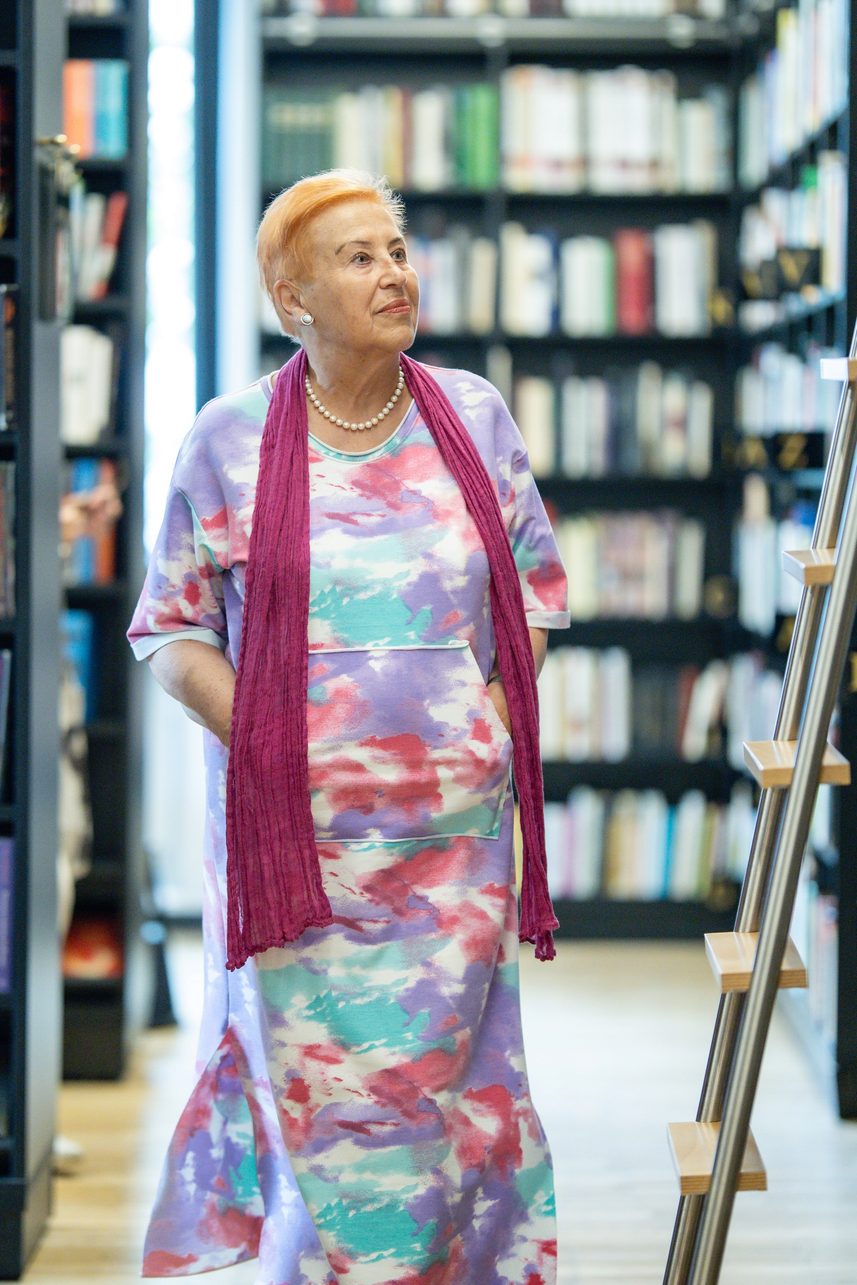
You have said that when writing about real personalities, you try not to cross ethical boundaries. How do you decide where the historical fact ends and your imagination as a writer begins?
It is an important boundary that always needs to be felt. Of course, you also have to consider the era. For example, when writing about Žemaitė and early 20th-century Vilnius, I read a lot about the events, incidents, and people’s behaviour of that time. When you know all that, you can imagine the environment and recreate it. However, you eventually realise that there are things you don’t know exactly; only rumours or gossip remain. Everything that is important in that person’s life must be based on documents. In many places, you simply must stop.
How long does your writing process usually take? Is it easy to let go of the personality you’ve written about once the book is finished?
First of all, you already know something about that person, though still quite abstractly. They interest you, and you feel you would like to write a book about them. Then the research begins, the work in the archives. If I had to calculate an average, roughly three years pass from the very beginning to the publication of the book.
And letting go is not easy, certainly not. When I write, I keep a photo of that writer beside me and sometimes talk to them. When I finish writing, I put the photo on the bookshelf among other portraits. Letting go is not easy, but you have to realise that it is a job. Sometimes, when I have written a book, even if it hasn’t been published yet, people already ask me: “What are you writing now?” I can’t write anything for a long time. I need a period of farewell. Usually, the farewell takes about six months.
Kaunas Book Fair
Let’s return to Kaunas. The city has had its own book fair for two years now. How do you view its emergence?
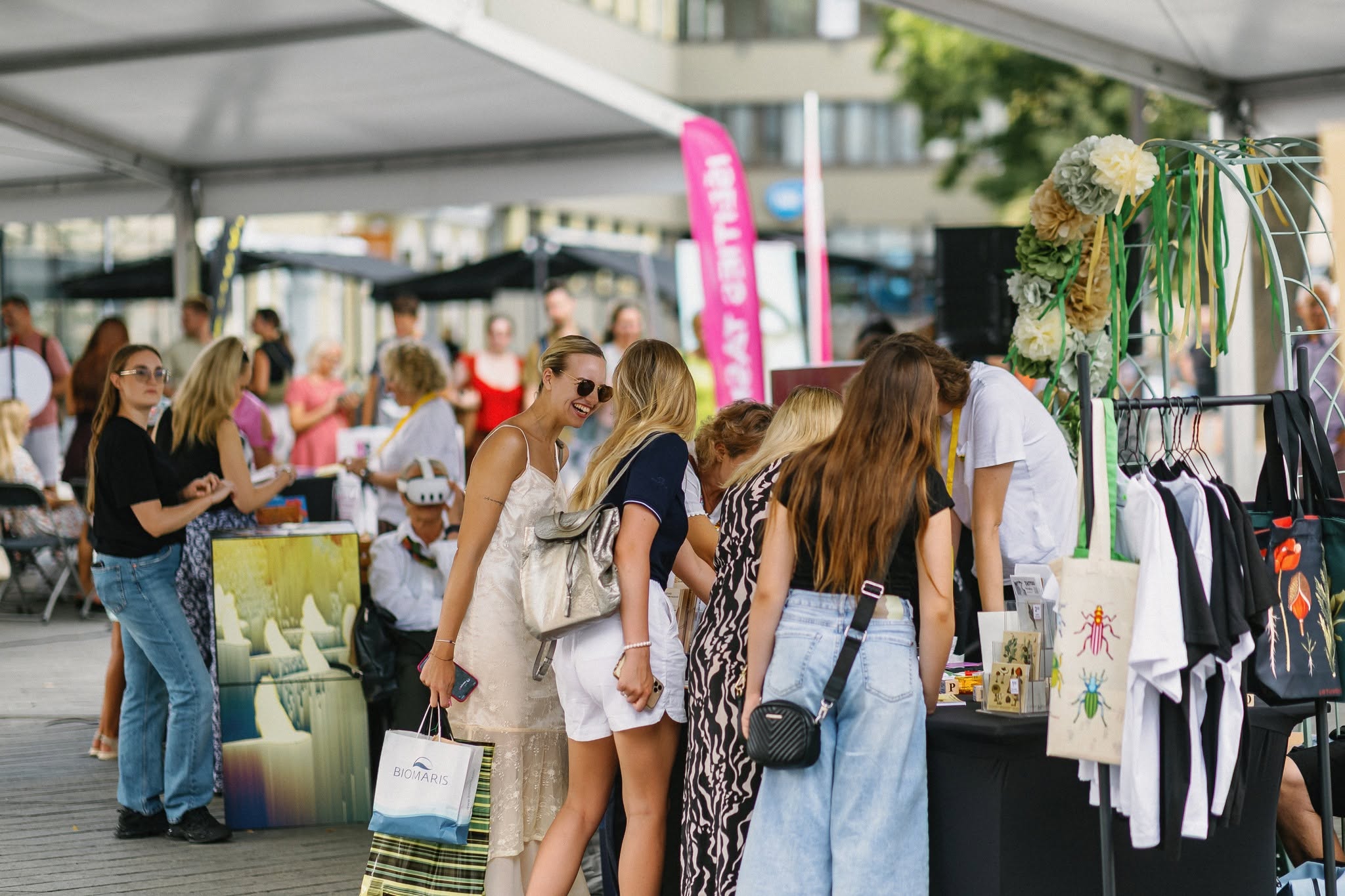
Kaunas is a large city, and last year showed that people definitely buy books and attend meetings. Admittedly, last year the meeting space was quite small – people couldn’t fit. As I understand it, it will be larger this year. I am in contact with the Lithuanian Writers’ Union publishing house; they said that participating was definitely worth it as they sold a lot of books. Many people come to the fair with children, simply to meet others and walk around. Such fairs cultivate a reading culture. I think it is a very commendable thing, and the fair will only improve. It is becoming increasingly difficult to get to the Vilnius fair; book fairs also take place in Šiauliai and Klaipėda. We cannot fall behind.
This year at the Kaunas Book Fair, you will present your latest novel, “Night Conversations”. How did the idea for it come about?
This book came about somewhat spontaneously. When people asked me: “Are you probably going to write about Vaižgantas now?”, I would say no. Then they would ask if I would write about Ričardas Mikutavičius, but I hadn’t thought about him either. However, one day I unexpectedly discovered that R. Mikutavičius and Vaižgantas lived for exactly the same amount of time – 63 years. Both served as priests at Vytautas’s Church, lived in the same flat across from the church, and both were popular, great orators and writers. So, I discovered more and more parallels. I realised I wouldn’t write about Vaižgantas alone, nor about R. Mikutavičius alone, but about them both – that was quite another matter.
One more thing was important – I knew R. Mikutavičius. I had interacted with him a lot on a professional, human, and creative level. I also felt a certain debt because he helped the museum a lot and donated his personal library. I decided to draw parallels between these two personalities, and at the same time introduce a female character through whom I could tell many of my own memories. Then I started thinking about the form. In my book, R. Mikutavičius is still alive, Easter sermons are heard, and Vaižgantas rests beneath Vytautas’s Church. Being such a curious soul, he goes to see who is living now in that flat across from the church. He knows that some priest has moved in. Vaižgantas enters the flat, R. Mikutavičius wakes up – and that is how those night conversations begin.