“When we can afford to go into the forest and bring nothing back, it shows a certain level of a country’s economic development,” claims Marius Karlonas. This is how he responds to my question about whether birdwatching is perhaps the new yoga; a trendy hobby for city dwellers.
This spring, Ornitostogos, founded by Marius, introduced precisely these kinds of urban birdwatching tours in Kaunas. Sitting in the Ąžuolynas library, where the ornithologist arrived together with “Sengirės kinas” to mark the centenary of the British naturalist Sir David Attenborough, we discussed Kaunas as a paradise for birdwatchers and the more philosophical aspects of this occupation.
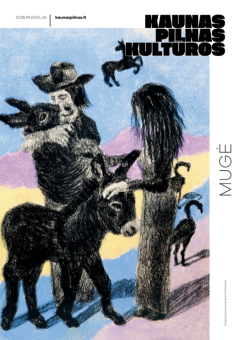
(This text was published in the June 2026 issue of the magazine Kaunas Full of Culture, titled Birds)
Those following the activities of Ornitostogos know: it involves birdwatching experiences in Lithuania and elsewhere in the world, waking up at dawn, and spending long hours in remote corners of nature. But a city tour? “We decided to debunk the stereotype that you cannot see anything interesting in urbanized areas, that you necessarily have to drive fifty kilometers,” says Marius, who grew up in the forests near Jonava. According to him, everything depends on how well we know nature, and an experienced guide is crucial here.
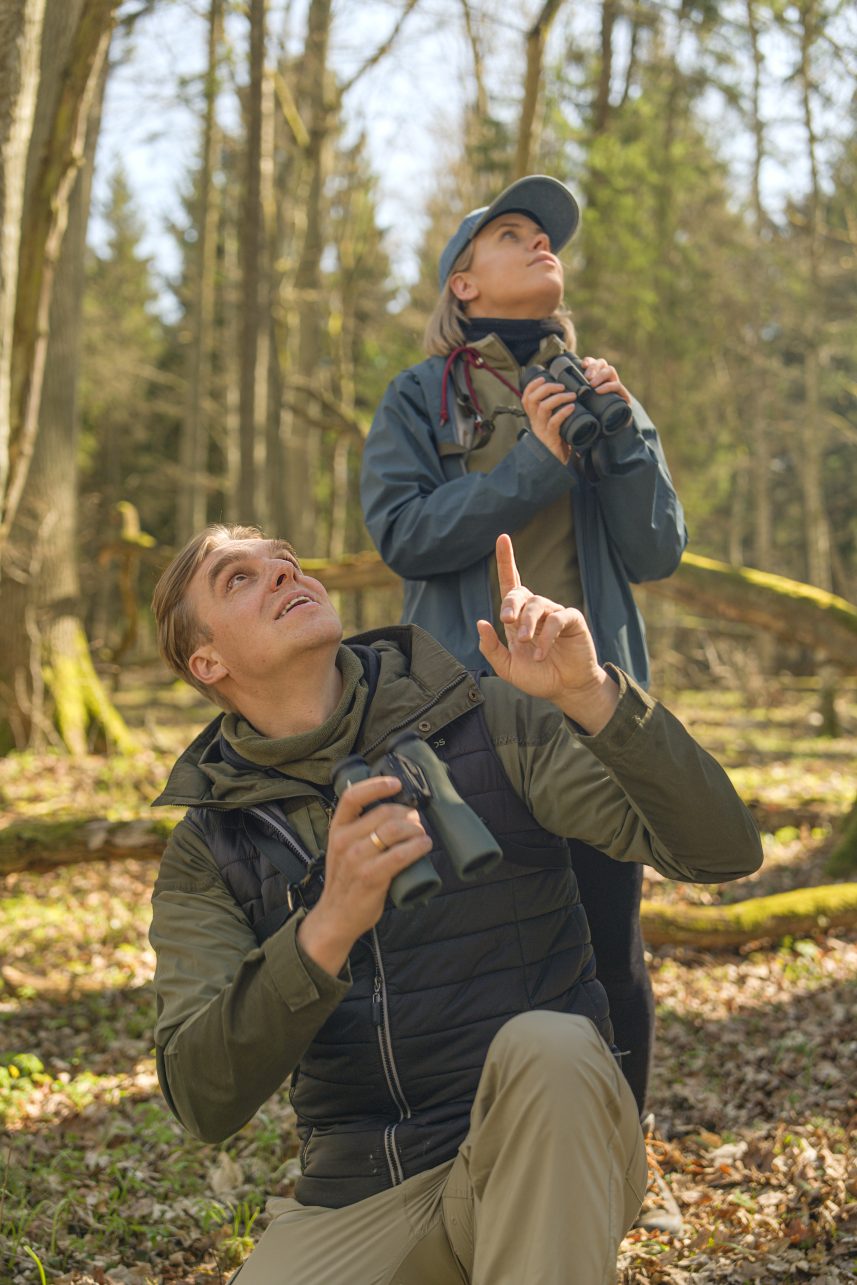
Urban birdwatching tours are 2-3 hour walks in small groups, held early in the morning. In Kaunas, these take place in Ąžuolynas and the Panemunė Forest. From a natural perspective, these are very different places. “The Panemunė Forest itself is not very diverse, but life there is enriched by the banks of the Nemunas; there we encounter not only forest birds but also those of the scrublands and settlements, not to mention the waterbirds. By the way, few Kaunas residents know that white-tailed eagles, the largest birds of prey in Lithuania with a wingspan of 2.5 meters, live right here in Kaunas. This bird is like Sabonis with his hands up,” Marius explains. During the winter, he and his colleagues count 7-8 of these “sky Sabonises.” He says others don’t believe him when he tells them to tilt their heads up while walking along Laisvės Avenue, as the eagles fly at an altitude of several hundred meters and look small from the ground.
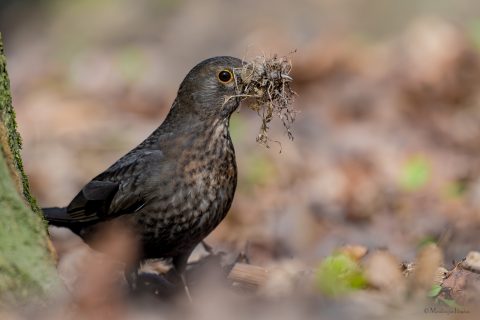
In late spring, one can “observe” about 35-40 species of birds in a couple of hours, and contrary to what many believe, the lush tree canopy does not interfere. What interesting things will we find in Ąžuolynas? “It was previously thought that middle spotted woodpeckers were very rare in Lithuania, but Ąžuolynas is simply teeming with them,” Marius assures. Among the hundred-year-old oaks, lindens, and maples, one can see black and grey woodpeckers, blackbirds, European pied flycatchers, and many other birds, as well as the common wood pigeons and house sparrows familiar to city dwellers.
When you see the beauty of nature, you become more sensitive to its problems.
And in winter, Kaunas becomes… a jacuzzi. The largest in the Baltic States, accommodating up to 22,000 waterbirds. “We count them every year and the numbers are simply staggering,” says Marius. After all, the Nemunas does not freeze due to the hydroelectric power plant. Of course, birds are abundant elsewhere too. Conditions in Kaunas are extremely favorable for them: the confluence of the Nemunas and Neris, the forests of Pažaislis and Kleboniškis… “In the middle of the city, you can encounter species listed in the Red Data Book; finding them elsewhere in Lithuania would be a major challenge. Kaunas residents certainly have something to be proud of,” the interviewee says, appealing to local pride.
So, about that yoga… The ornithologist agrees that birdwatching is rapidly gaining popularity in Lithuania, and his company contributes significantly to this. There is nothing wrong with it because, according to sociologists and economists, it is a hobby of developed countries. Of course, everyone likes to spend time in nature. Mushroom picking, fishing, and hunting are the classics of nature hobbies. But you bring something back from those, and sometimes you can even make money from it. Birdwatching, however, cannot be put in your pocket. “In exchange, you simply get wonderful emotions and clear your head. The joy of discovery that floods those trying this activity for the first time is my own motivation to continue. I feel that we are opening people’s eyes and they can no longer ‘unsee’ it. They ask: What have you done to us? Birds have appeared all around us; we didn’t see or hear them this much before.” Specialists agree here too: when you go out to watch birds, the senses dampened by screens become active; you start to hear, see, and smell better (perhaps even too well), and finally, you start to feel better. “You live for the chaffinch you just heard, not for your daily troubles,” Marius summarizes the benefits of the hobby.
I remember a recent meme saying that birdwatching works both ways: the birds are also watching us. And I think out loud: leaving the forest empty-handed is the best thing we humans can give to nature.
“Exactly. Birdwatching is a direct path to seeing how fragile and sensitive nature is, and how quickly it is changing and disappearing. Then you can no longer look at it merely as a place to grill shashlik,” Marius states. According to him, once you see the beauty of nature, you become more sensitive to its problems. You can only be indifferent as long as you lack the necessary knowledge.
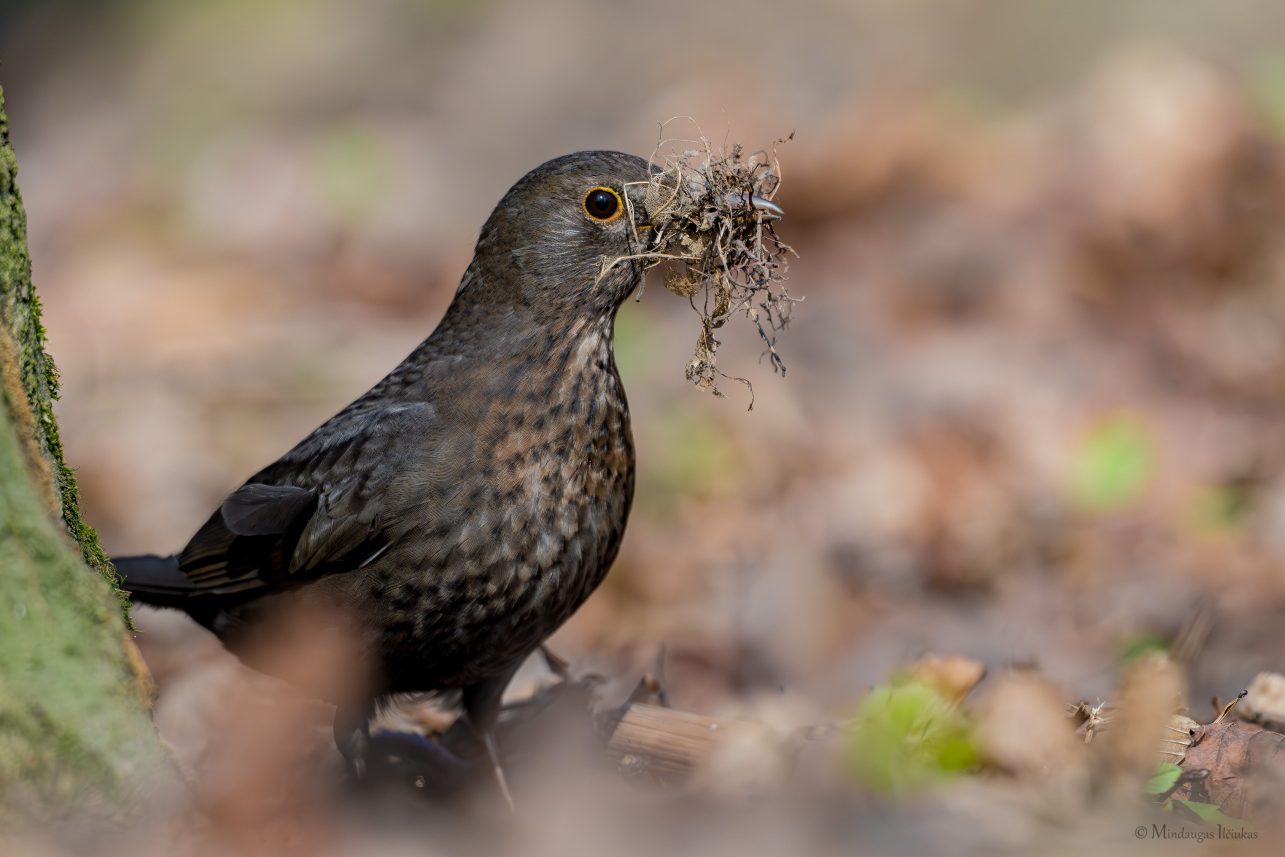
Interestingly, Lithuania is a popular destination for birdwatchers from other countries. It turns out we are exotic to them. “We have one of the highest bird diversities in Europe. Germans, Swiss, Belgians, and Brits come here. They are interested even in birds completely common to us, which have already become extinct in the West,” the interviewee surprises me. He invites me to remember the singing of the skylark; a seemingly ordinary attribute of a Lithuanian summer. “A Belgian who comes to Lithuania breaks into tears upon hearing a skylark, because he has not heard one in 40 years. Imagine, during one person’s lifetime in Belgium, skylarks, lapwings, and storks—all birds of the open agrarian landscape—have disappeared. It is all due to unsustainable agriculture and the use of insecticides, herbicides, and pesticides.”
Marius’s story sounds like an alarm: in Lithuania, the population of these birds has significantly decreased over the past twenty years. If this continues, the voices of the skylark and the lapwing will also remain only a childhood memory for us.
On the one hand, there are tens of thousands of ornithology enthusiasts in Lithuania; on the other hand, there are endangered species. What else, besides the sincere joy of first-timers, motivates Marius Karlonas not to give up? Here we remember the centenarian Sir David Attenborough, who has achieved so much throughout his career through his example, films, books, and calm voice. “He made the whole world look at nature differently, sparked curiosity, and drew attention to the fact that nature is not absolute or self-evident,” a spark lights up in Marius’s eyes again. According to him, the word is the strongest tool every specialist and enthusiast possesses. You can speak on television, or you can speak at the dinner table with your family at Christmas or at a party. With legal knowledge, you can try to change laws, or by using personal charisma, you can infect thousands with your idea.
I am finishing this text and rushing to count the blackbirds under my window. They are truly going wild in Žaliakalnis this year. Pass it on to others.