In the song “Žvakių šviesoje” (In the Candlelight) by Foje, the lyrics go, “Tiktai žvakių šviesoje / savo veidą aš randu” (Only in the candlelight / can I find my face). With Andrius Mamontovas’ slightly muffled voice playing in my headphones, these words guide me through the city.
I approach St. Gertrude’s Church and its Candle Sanctuary, accessible through an archway at the end of Laisvės Avenue or from J. Gruodis Street. The gentle sting of the early October chill slowly retreats as I gaze at dozens of flickering candles. “Can I find my face,” the song continues in my ears. Perhaps it really is easier to see the essence in the glow of candlelight?
This place is unique not only in Kaunas, but also in all of Lithuania. The sanctuary, located in the church crypt and in the adjacent building with large glass windows, belongs to the Unity of Prayer campaign. It is organized by the Marian monks – this is a global initiative that unites people in prayer for peace, loved ones, and personal desires. Here you can light a candle that burns for seven days and pray for your own and others’ intentions.

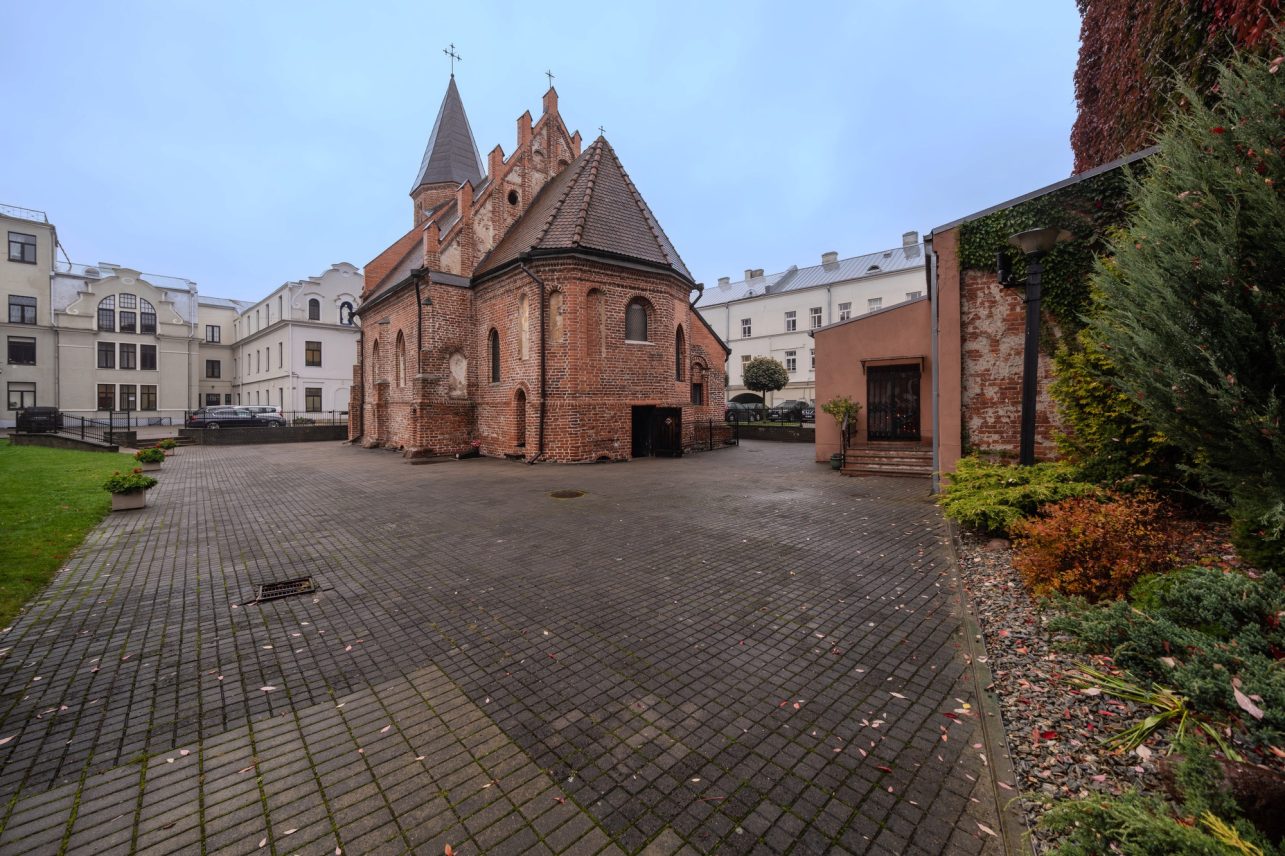
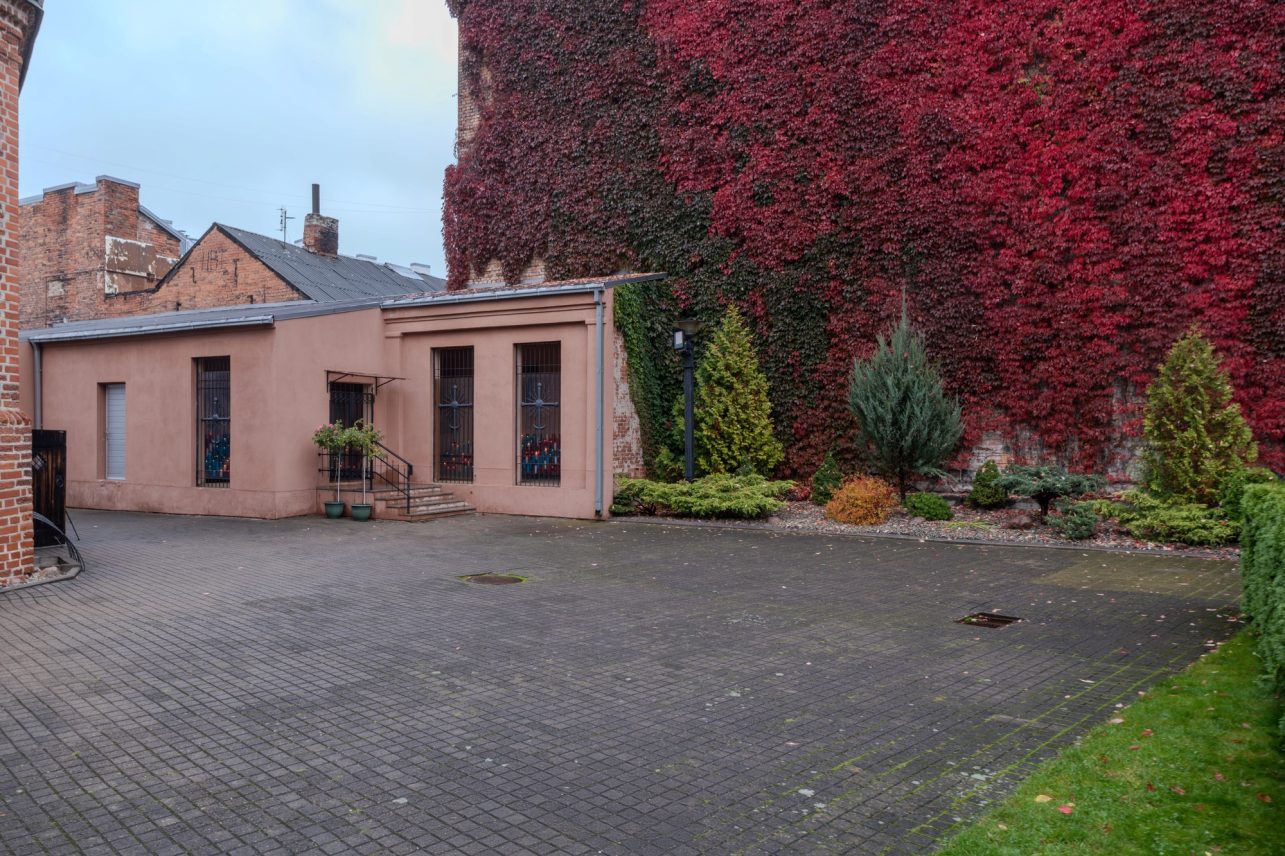
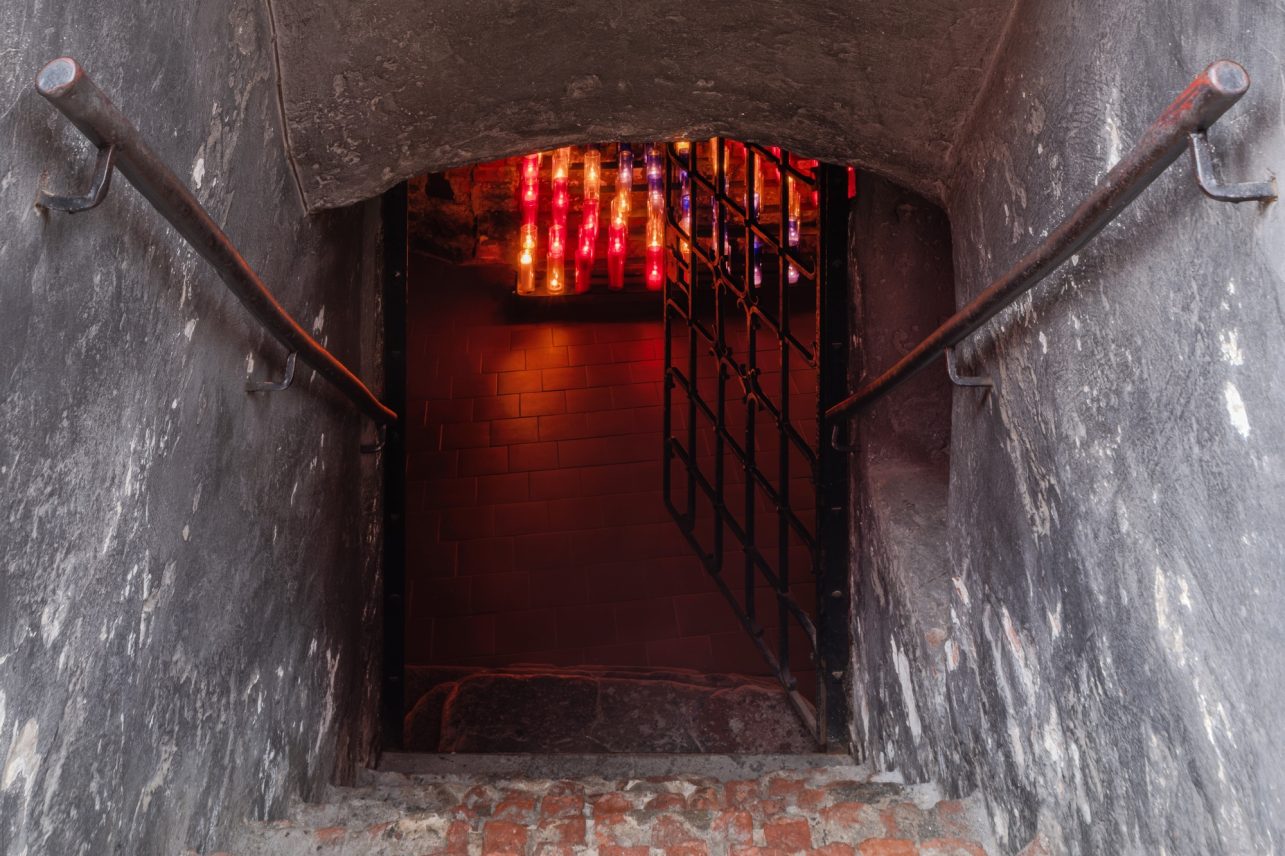
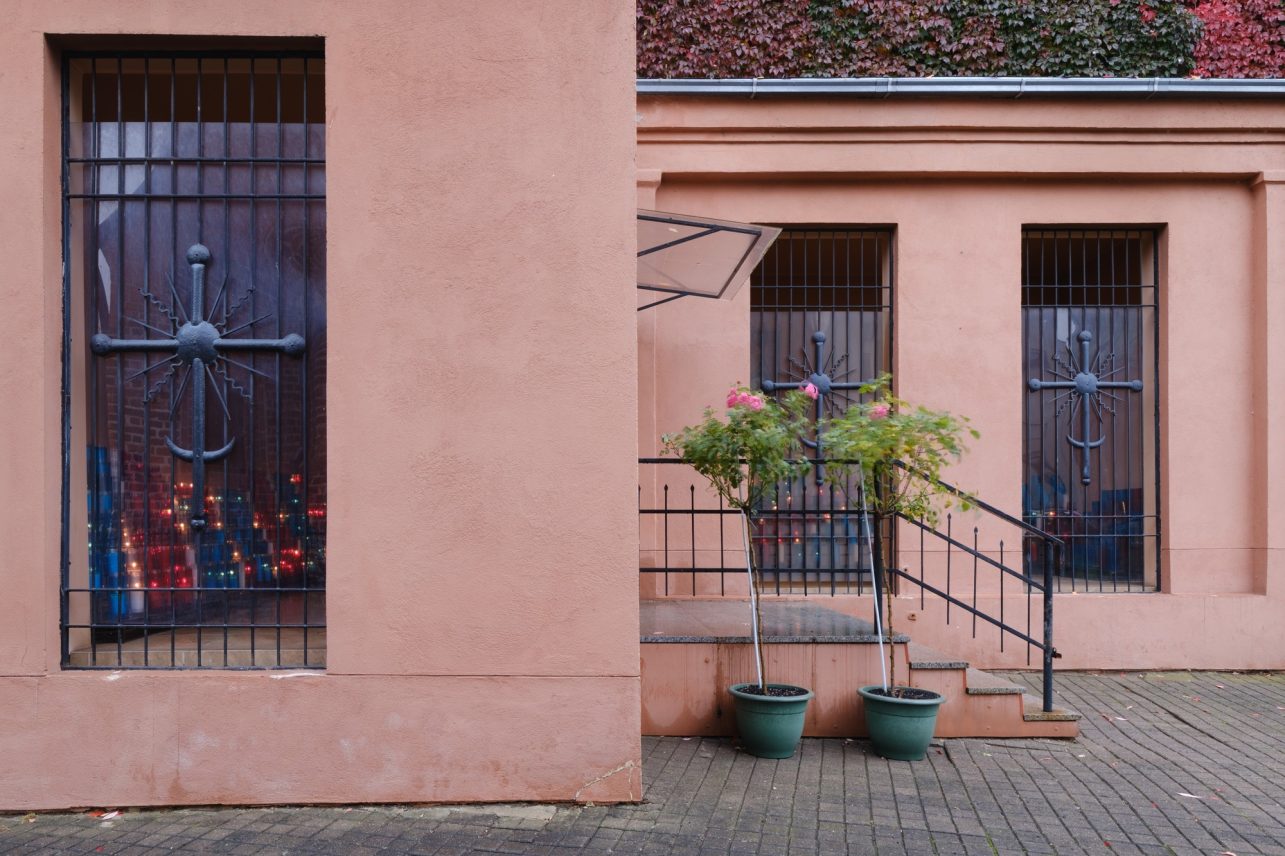
The sanctuary was created by the Marian Helpers Center, which operated alongside the Kaunas Marian Monastery. It was consecrated and opened to the community more than two decades ago, in 2002. At that time, the sanctuary occupied only one space – St. Gertrude’s crypt, located beneath the presbytery of the church. Part of the sanctuary still functions there today. This crypt is right under the sculpture of the crucifix, the greatest sacred treasure of the church. On the day the sanctuary was opened, 28 candles were lit to symbolize the intentions of the faithful. The sanctuary acquired its current form – the premises in the crypt and in the building next to the church – a bit later.
The decision to expand the sanctuary was made for two reasons. The small number of candles on the first day grew exponentially – the Candle Sanctuary became a place of attraction, and over time, there was no longer enough space in the small crypt for all the candles people wished to light. The expansion was also prompted by the difficulty of access for people with mobility issues, as the crypt is located in the church’s basement. A little later, as I descend the stairs into the crypt myself, I instinctively hunch over to avoid the Gothic stone blocks hanging just above 1.4 meters high. Sister Teresė, who accompanies me, remarks with a smile that these are truly “the gates of humility,” encouraging everyone to bow as they enter.

But I’m getting ahead of myself. First, I visit the Prayer Support Service located in the same courtyard, where prayer intentions are received. In the office, I’m greeted by Sister Teresė’s bright face. After I explain that I’m preparing an article but would also like to submit a prayer intention, she asks me a few practical questions. I give her my name and my intention; this information is entered into a computer document. I donate five euros. I confirm that I wish to pray for someone else’s intention and receive a small slip of paper with thoughts dedicated to Vaida’s family and the indicated period during which the prayer should be said. Sister Teresė explains that it doesn’t matter when or where I pray and suggests I recite the Lord’s Prayer or use the printed “Prayer to Divine Mercy at the Miraculous Cross of St. Gertrude – the Marian Church” provided by the Prayer Service.
Four people take care of the Candle Sanctuary and the prayer intentions, and the center is open on weekdays from 9:00 a.m. to 6:45 p.m., and on weekends from 10:00 a.m. to 1:45 p.m. There are several ways to submit an intention. One of them is in person, which is the option I chose. In other words, you need to visit the Prayer Support Service at Laisvės Avenue 101A, in the building opposite the entrance to St. Gertrude’s Church. You can also call by phone or send an email. If you submit your request remotely and wish to have a candle lit on your behalf, you must make a bank transfer, indicating the number of candles in the payment details. The offering for one candle is five euros.
Intentions submitted remotely are collected throughout the week and formally begin on Fridays. On that day, intention candles are lit, and a Holy Mass is celebrated in the church, during which prayers are offered for all the requests of the Candle Sanctuary’s visitors. The community of worshippers recites the rosary daily for all submitted intentions.
a candle is merely wax, the room merely brick – it does not perform miracles by itself.
Intentions can be submitted not only by Catholics but also by people of other faiths or even by non-believers. What matters most is a sincere desire and the intention to pray, not belonging to a specific denomination. As Sister Teresė explains, some people come to request an intention but do not pray themselves because they are non-believers. Still, we agree that this is already a small step toward faith.
Since I submitted my intention in person, we immediately headed to the Candle Sanctuary. I could see right away that this place is cherished and well-visited: the Prayer Support Service receives many intentions. As we descended into the crypt, I counted that more than half of the candles were lit. Sister Teresė explained that the greatest number of intentions are received before All Souls’ Day, Christmas, Easter, and Mother’s Day. Sometimes, there are so many intentions that extra candle stands have to be brought in, leaving only narrow spaces to walk through.
The donated amount is used to purchase special candles that burn for seven full days. For safety reasons, visitors are not allowed to light their own candles. The sanctuary uses only specially made ones placed in appropriate glass holders. What about those who cannot afford to donate for a candle? The staff member at the Prayer Support Service emphasizes that a candle is merely wax, the room merely brick – it does not perform miracles by itself. What truly matters is the intention and consistent prayer throughout the week. No financial donation is required for that. It is precisely these intentions and the shared prayer that the Marian Fathers, who established the sanctuary, value most. The Prayer Support Service ensures that believers can support one another and pray for others’ intentions just as fervently as for their own wishes and desires.
After choosing from blue, white, and red candleholders (although that doesn’t matter, really) I light a candle in the crypt. Sister Teresė prays for my intention. I feel a lump in my throat – although I’m not deeply religious, places like this always bring to mind the face of my beloved grandmother. There’s something profoundly moving about the intimacy of prayer while standing in the crypt and hearing the words that ask to be heard and the intention confirmed. After the prayer, we cross ourselves, and then Sister Teresė allows me to snap a few photos and look around. After that, we chat a bit more, and then I say my goodbyes and climb up through the gates of humility. Outside, I meet another woman waiting her turn to light a candle.
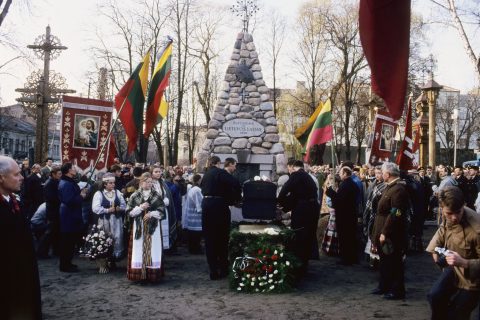
I linger a while longer on the ground floor of the Candle Sanctuary – I don’t yet want to get back into the world from this place which is located in the city center yet still feels remote. Whenever I’m here, I always feel irritated by the nearby parking lot, which could so much better serve as an extension of the churchyard, but this time, even that doesn’t bother me. I look around the sacred space: in autumn, one of the city’s most beautiful walls changes its attire from a vivid green to a calmly rippling sea of yellow and red vines. The church, though at the heart of the city’s hustle and bustle, offers shelter from the rush and the noise. Surrounded by buildings, this little church has created a crack in time. Its walls, by the way, were erected in the 15th century, when this place was just a suburb of Kaunas. The church itself has remained almost unchanged, although its owners have changed over the centuries, and once did its purpose. The Soviet occupation was the only period no services were held in the church – the building was converted into a warehouse for medical equipment. On June 25, 1988, it was right here, by this church, that the first Sąjūdis rally took place. Members of the cultural community, led by architects, gathered to protest against construction plans next to the church.

The symbol of the candle has undergone many transformations. In the book The Thresher, Andrus Kivirähk, describing the lives of wealthy landowners and poor villagers, mentions that “they there, in the palace, are unaware of the mortal danger. They continue to amuse themselves and burn countless candles, while at their gates the plague is already sharpening its scythe with a hungry gaze,” indicating that candles were both a necessity and a luxury item. Today, candles no longer have this meaning, but the symbolic aspect has remained. Their light symbolizes inner light, peace, concentration, and, in religious rituals, living faith. At the same time, it is a sign of silence, respect, and communion, inseparable from weddings, protests, birthdays, home comfort, lovers’ dinner tables, and funeral rites – so the candle accompanies a person through all life cycles.
The most beautiful thing for me is that this fragile, flickering flame always defeats the darkness and highlights what is truly important. So in the Candle Sanctuary, a candle is just a candle, but through intentions and prayer, it highlights what we need most, and who we are.