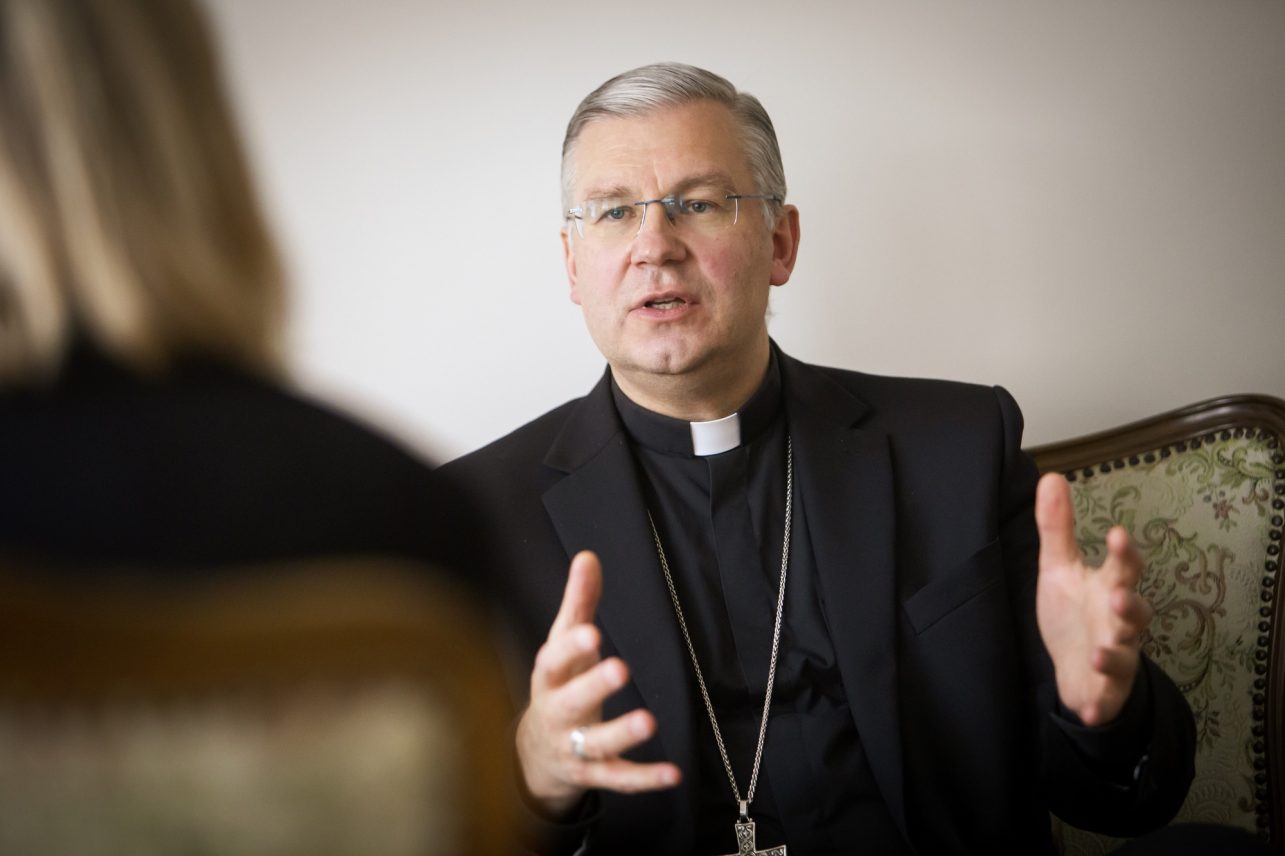
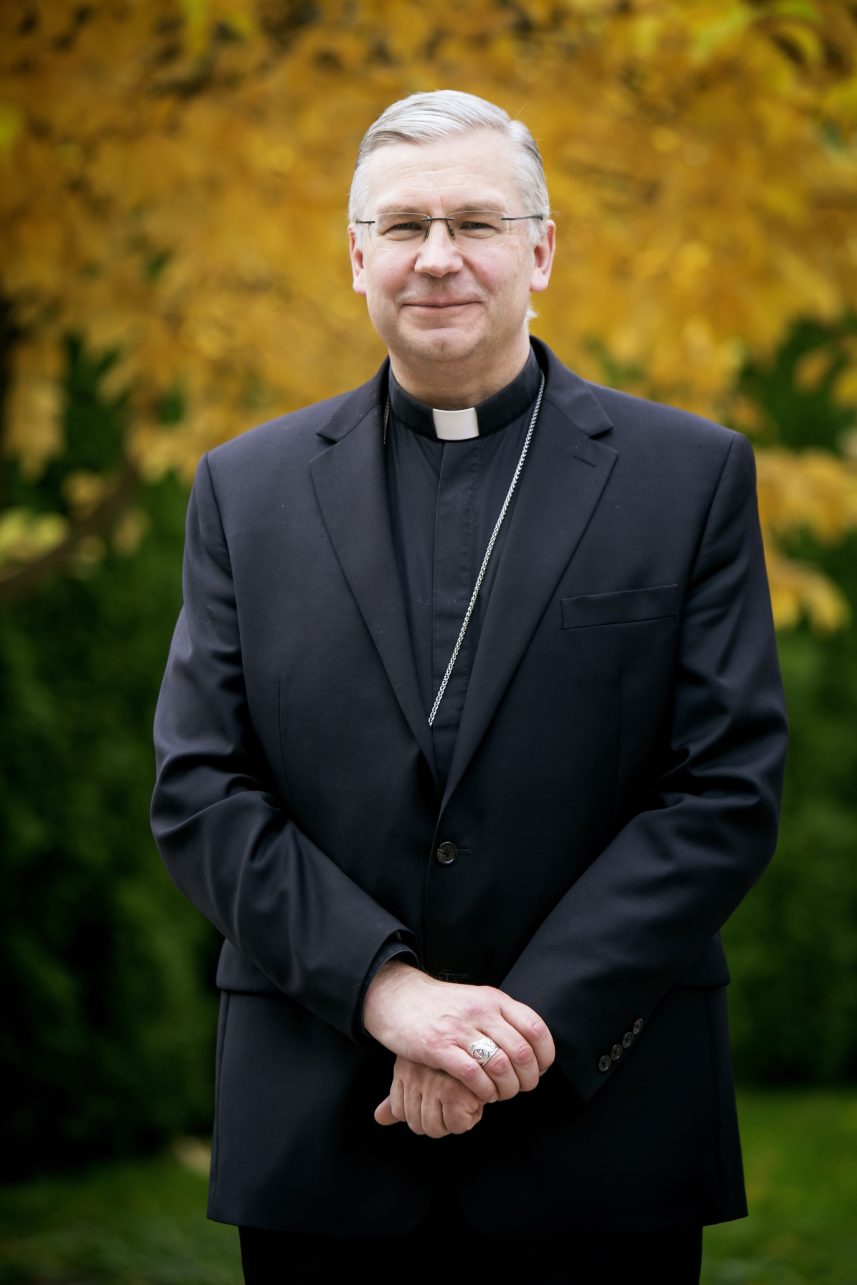
A few years ago, photographer Donatas Stankevičius and I went on a cultural tour of the clergy houses – you can visit three of them in Kaunas, which have been converted into museums, all at the same end of the Old Town. We ended up following a similar route this time, only the Archbishop of Kaunas, Kęstutis Kėvalas, received us not in his apartment, but in a hall one floor below.
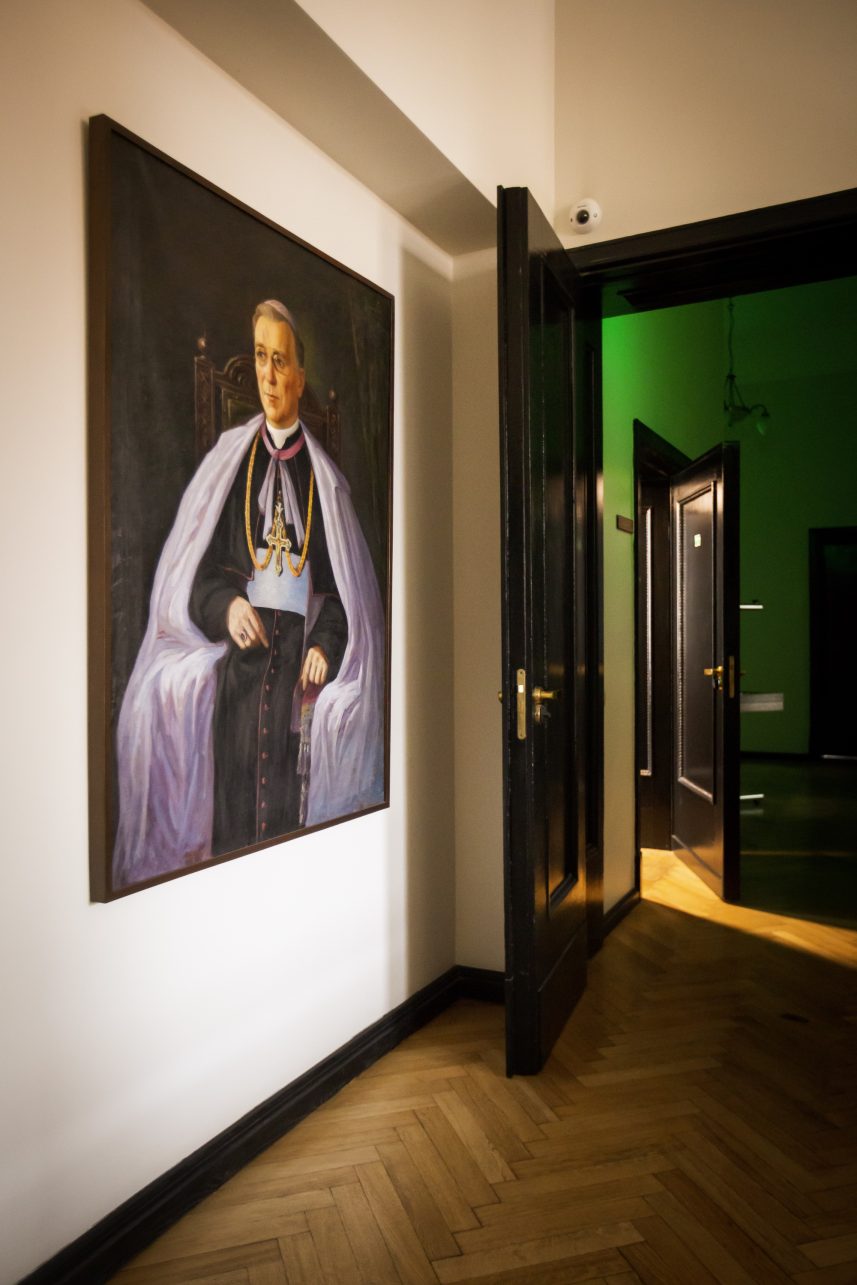
The Bishop’s Palace in Kaunas, designed by Karolis Reisonas during the interwar period, is a magnificent yet hidden gem tucked behind the Town Hall Square. During the years of occupation, it housed the Juozas Naujalis Music School, where many of today’s talents were nurtured. The cultured atmosphere helped preserve the building’s architectural details, for example, the black interior doors, which are unusual today but incredibly stylish. Donatas and I muse aloud that the curia could open its doors more widely to culture. We’re not pressing the archbishop against the wall, but he himself, showing us a hall that’s just being restored, voices a similar idea. Perhaps next year?
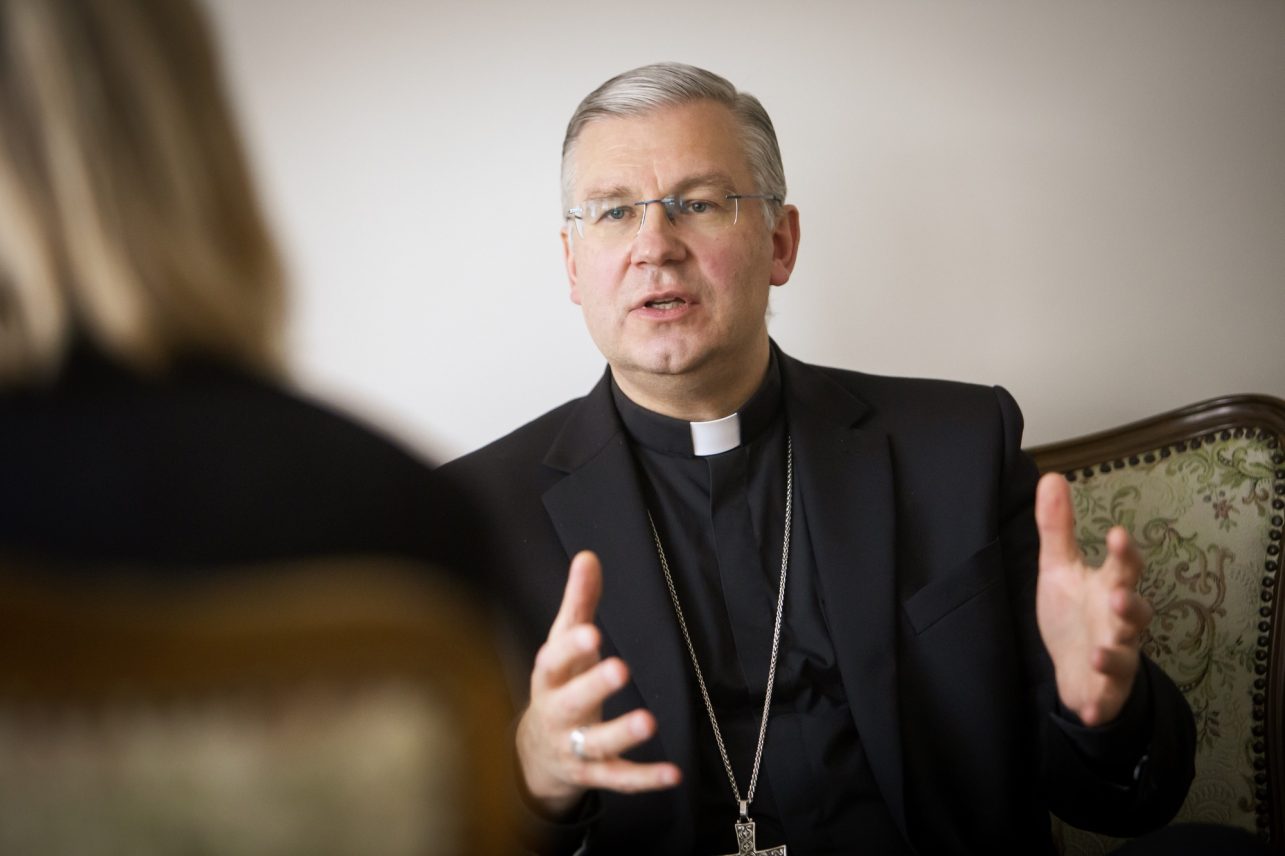
There’s not much left of this year – how has it been for the Archdiocese of Kaunas?
Since we are celebrating the Jubilee Year, there has been a great sense of uplift and many events. At the beginning of the year, we organized a large pilgrimage to Rome. Thousands of Lithuanians arrived by plane and bus; St. Peter’s Basilica literally trembled from our choirs and orchestras. Vatican officials said they rarely hear music of such high quality. It was an immense source of pride for a small nation to receive such praise in the central sanctuary of the world. A similar uplifting mood accompanied the recently concluded Šiluva indulgence feast, and in the summer, thousands of people gathered for the Feast of Hope in the Kaunas Sports Hall.
The Church is not only about celebrations, but it is also about everyday life. Sometimes that life is invisible, yet wonderful things happen in it. For example, the day center Ateik (Come) for people experiencing homelessness, where individuals can not only find a place to sleep but also someone to talk to. And in Vilijampolė, the organization Gerumo rankos (Hands of Kindness) implemented a unique project – they bought an entire apartment building. There, people in need of a fresh start – both young and old – can live for a year and receive social services. It’s not just a roof over their heads, but also the warmth of a home that inspires them to begin anew.
Is the Archdiocese more of a patron or a partner in such projects?
We collaborate in various ways. Some organizations, such as Caritas, were founded directly by the archdiocese. With others, including the city municipality, we act as partners. For example, we run a children’s day center together in the Old Town – a very cozy place that brings us joy because the children are happy there.
One of my own duties is coordination. Many initiatives come from the curia, which, within the Church’s structure, functions much like a municipality: it sets the tone and creates plans. Thus, the bishop is an initiator, a mover; he asks how things are going, what is missing, and what we can do better. Of course, there’s also the formal side: various boards, councils, and meetings are part of my daily work.
Sometimes, even we get tired of these meetings. But we attend them guided by the faith that the world will become a better place to live because of them. In the end, the most meaningful work does not remain on paper but in a person’s heart. It’s what is created through relationships, through emotional memory, through an outstretched helping hand. A person who has received kindness from strangers will never forget it.
Among your many responsibilities, do you still have time for personal reflection?
I have to schedule a reflection. If it isn’t placed in my agenda, it simply doesn’t happen because you get carried away by the wave of meetings and tasks. It’s not easy to carve out such time, but I comfort myself with the thought that this pause is a command – it’s my duty.
Reflection is an essential part of spiritual, psychological, and physical health, yet in today’s world, we greatly underestimate the importance of pausing. As Juozas Erlickas says, we just “run through the fields, our hair flowing in the wind.”
I call that time a “desert day”; I try to disconnect, to use my phone as little as possible. I usually go to Palendriai Monastery. I don’t have any duties or responsibilities there, and I really like it, because I am an equal, a member of the community, and the focus is on God, not on the person.
You mentioned that it’s important for you to ask people how they feel. So how do the people of Kaunas feel today?
Kaunas residents are special people – I like them very much. They are practical, down-to-earth, and have a great sense of humor, sometimes sharp-worded. But their practicality is admirable because it’s directed not only toward themselves or their families but toward the entire city.
The city is simply pulsing with life. I’m very happy to see how much is happening and how many new spaces are opening. Over the past couple of months, it seems we’ve attended at least six openings: a swimming pool, a bridge, an arena, a new building wing, a foundation… You can really feel that we’re experiencing a great material upswing – something people have long been striving for.
Of course, the greatest challenge is not to lose spiritual well-being while growing materially. But it seems that even in this area, things are moving forward. Try buying a ticket to the National Kaunas Drama Theatre – I’m still waiting in line to see the play When We Were Young. The Kaunas State Musical Theatre is also constantly full. Recently, the musical Aida performed by this theatre for teachers at the Žalgiris Arena was of the highest level. I’ve attended several Broadway shows, and I have to admit, what I saw here was just as good, if not better.
Is Lithuania today a religious or rather a secular country?
Compared to America, which I know better from my studies, church attendance in Lithuania is considerably lower. This is undoubtedly influenced by the generation that grew up under Soviet oppression, who were taught in school that the Church was made up of “obscurantists.” Because of that, they still approach all things religious with great caution today.
However, I have observed one interesting phenomenon. Although parents themselves tend to be cautious, they still allow their children to go to church. And often, it’s through the children that the parents become involved as well. This year, one couple shared a beautiful story. When preparing children for Confirmation, parents are also invited to the catechism classes so they can understand what their children are experiencing and communicate more effectively. At first, the mother got involved, and later, the father did too. Eventually, they told us, “We can’t believe what has happened to our family over the past year. Our relationship has warmed, we’ve rediscovered faith, and we were already on the brink of divorce.”
How do you view so-called “occasional” Catholics – those who come to church only for Christmas, Easter, or major life events? Is that better than nothing?
We view them very positively. They are members of our family, our people. They remind me of a brother or sister who has emigrated. We don’t see each other often, but that doesn’t make us love them any less – sometimes it even makes them dearer. We look to them with hope that one day they will more fully discover what we have. After all, this family has existed for 2,000 years. It is a treasure filled with countless reflections on how to live in a way that brings happiness and a sense of fulfillment.
From the outside, you seem like a very open and sociable person. Does the calling of the priesthood suit your nature?
To be honest, I didn’t find myself right away. I wanted to be a sound director, to connect my life with music, to work in theater or film. I played the accordion and even fulfilled a childhood dream – I played at weddings.
Everything was going great until I had an adventure called a priestly calling. It was a complete surprise because throughout my entire childhood and adolescence, I had never even considered such a thing. At first, it frightened me. I felt a great deal of stress. In my mind, a priest was like Liudas Vasaris – a man disillusioned with love, for whom the seminary was the only escape. How could I live such a strange life? After a year of intense reflection, I began to test myself: I attended camps and various meetings. And I realized that I actually enjoyed talking with people, building relationships, and making others smile. Eventually, I understood: “Hey, maybe I really could be a priest.”
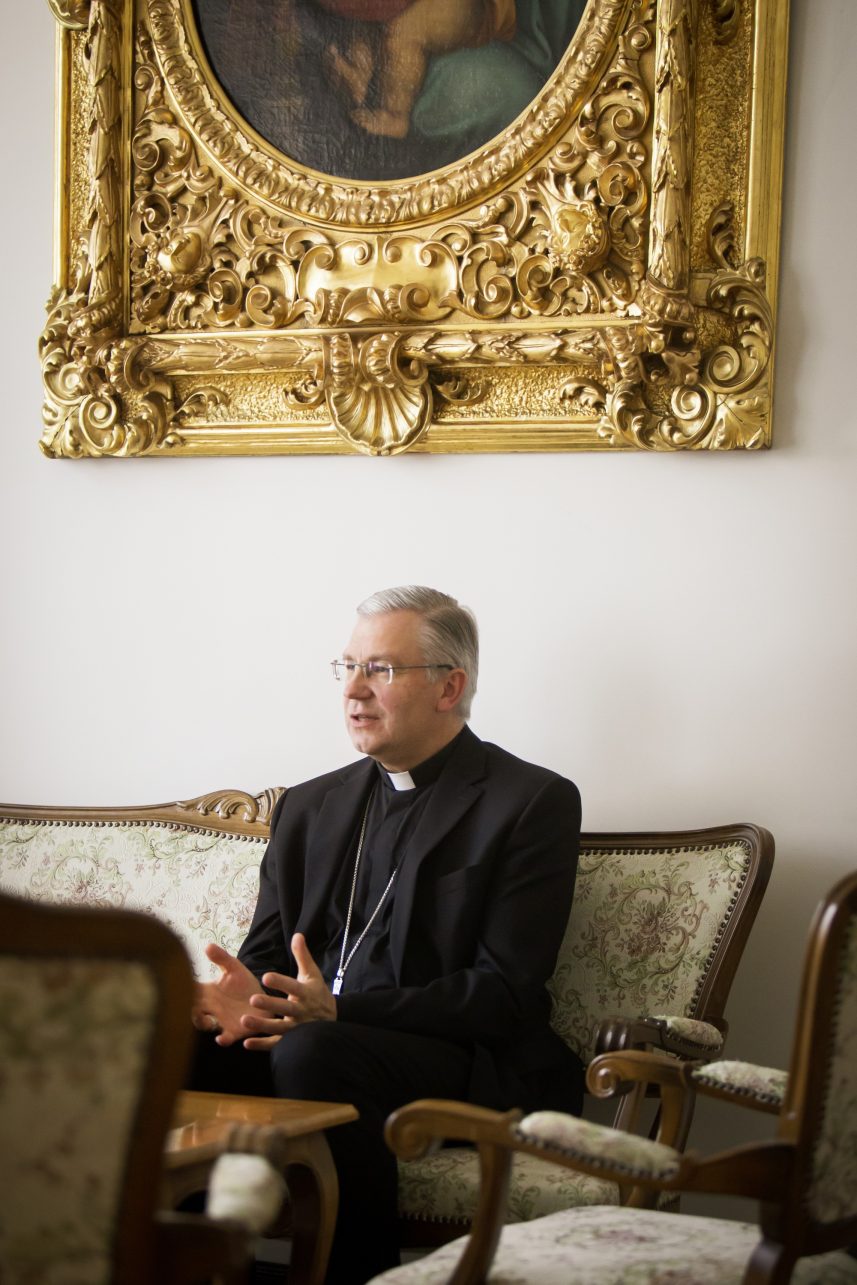
Later, I came to see that perhaps a longing for connection had always been within my nature. And priesthood, at its core, is precisely that – a constant relationship building.
Have you ever doubted your choice?
If there is no doubt, there is no faith because then you simply know everything. Faith requires constant reexamination. Doubt is a healthy process, a continual raising of the most important existential questions.
It all comes down to how we see the world. Worldview – how I think about the world – directly translates into emotional attitude – how I feel about it. And this affects everything, even physical health. After all, constant existential tension settles into our entire system. We treat high blood pressure with medication, but sometimes the real cause lies much deeper – in matters of worldview, in the fear that this world is not a safe place.
What practical, yet also spiritual advice would you give to people who find it increasingly difficult as the dark season approaches?
First of all, don’t lose the rhythm you had in the summer. In the summer, going for a walk at eight in the evening seems natural. In November, it already feels like midnight, and that thought no longer occurs – but it should. While people talk about sadness, I suggest first looking at the body. Take care of your physical needs, get enough sleep, return to a natural rhythm, and only then look at what comes next. We must regard our nature with great respect.
Secondly, consciously invest in relationships with your loved ones. Don’t let routine and daily life consume everything. Plan a date with your spouse and take time to read a book with your children. If necessary, consciously pause the flow of life so that it can regain a poetic or even romantic shade.
Thirdly, stay faithful to three essential things: work, prayer, and rest. Everything fits into prayer: self-education, reflection, meditation. The most important thing is to maintain the daily rhythm, keep your thoughts in order, and nurture the relationships that sustain us. Have not only professional or domestic relationships but also those in which we can be with another person differently than usual.
(Photographer Donatas asks) We often talk about the much-needed positivity. But shouldn’t we have a healthy balance instead?
It’s natural for a person to move through the seasons. We have summer – full of uplift and optimism. Then comes autumn – a time of doubt. Then winter strikes – a crisis when one must find a way to build their life anew. And then finally the spring returns again.
Trying to always stay in “summer,” in that constant positivity, is unhealthy. After all, it requires forcing yourself. Artificial optimism ultimately leads to deep pessimism or even depression.
The principle is simple, as everywhere else: everything in moderation. If you feel uplifted, you must allow yourself to come down as well; to sit down on the sofa and simply look at the wall.
When we see that someone’s life consists only of beautiful photos and posts with exclamations like, “My life is wonderful!”, it naturally causes suspicion. Either the person is trying to show off, masking pride, or they are simply artificially keeping themselves at that high point.
Inner warmth turns into an inner fire.
Exactly. And being next to such a “burning” person can prove difficult; the pace can simply be too intense.
Therefore, you need to be sensitive, both to yourself and to others. The most important thing is to walk together: with yourself, with your heart, and with the people around you. They may currently be in a different season, and I have no right to force them to stay in a constant state of uplift.
You mentioned the Palendriai Monastery as a place that helps you return to yourself. But it’s far away, in Samogitia. What about Kaunas? What places here are dearest to you, where one can pause and recharge?
First of all, Santaka, which is nearby. It’s a wonderful place for a walk. Also, the bank of the Nemunas with its new bicycle path and, of course, Kaunas Yacht Club. After the renovation, it looks like Monaco. It’s hard to believe we’re in Lithuania, remembering what a swamp it used to be.
There are also plenty of beautiful places around Kaunas: the Juniper Valley, the grounds of the Paštuva Monastery, and Raudondvaris Manor. Personally, I really like the new cycling paths, especially the one leading toward Kulautuva, the most stunning valleys open up along the way.
Having this nature right next to the city is a huge gift; in Lithuania, we are truly blessed. How many major cities in the world can boast that? In Paris or London, you have to drive for hours to see nature. But we can reach it in just a few minutes.
Do you like cycling?
Yes, I ride my bicycle, although I would like to do it more often. One of my favorite routes is along the Nemunas River through my native Žemieji Šančiai all the way to the Panemunė Bridge.
This route is very dear to me, because it reminds me of my childhood. I pass by my old school. It’s so wonderful to see how everything changes, how beautiful the now tidied-up riverside and Šančiai itself have become. The neighborhood has a strong community, like in Aleksotas, for example.
But Aleksotas is a different diocese!
Yes, indeed, after crossing the bridge, you find yourself in the Vilkaviškis diocese, in a different administrative territory. This once caused a funny misunderstanding. The municipality invited me to bless the construction site of the future pedestrian bridge that will lead to the new M. K. Čiurlionis Concert Hall. And only when I was standing there did I suddenly realize that I was already in a different diocese! What to do? I had to call the Bishop of Vilkaviškis, Rimantas Norvila, and apologize for stepping into his territory. He, of course, forgave me, but with a smile reminded me, “Stay vigilant.”