I belong to a generation that have a hard time imagining that the garden of the Vytautas the Great War Museum used to look completely different. Although just a couple of years before I was born, it was a center of public discussion, gathering, and civic initiatives. This time, based on testimonies and written sources, we are putting together a story. It will not be about the entire garden but about one of the key elements of its ensemble, one of the most famous monuments and memorials in Kaunas – the Tomb of the Unknown Soldier and the eternal flame of remembrance burning next to it.
(The text was published in the November 2025 issue of “Kaunas Full of Culture” magazine)
The War Museum Garden
The garden of the Vytautas the Great War Museum is among the most civically charged and memorable places in Kaunas. It has a high concentration of iconic stories and objects pertaining to the city’s fabric (and I am not even mentioning the ceremonies, the carillon, etc).
My generation could tell a lot about the interpretations and imitations of bohemian life here during adolescence. Where should we meet? In Karmūškė. The habit, it seems, was instilled by the museum’s guardian lions from Biržai, which 99% of the city’s children had to climb and immortalize themselves on.
In October 1988, a historical photo captured the raising of the tricolor on the carillon tower. It is also where one of the most memorable interdisciplinary works can be found – Bernardas Bučas’ sculpture The Sower, reinterpreted by Kaunas street artist Morfai.
We usually imagine a garden as a blooming, fragrant, relaxing village scene, but here, things are different. This garden is extremely monumental in its forms, content, materiality, and colors.
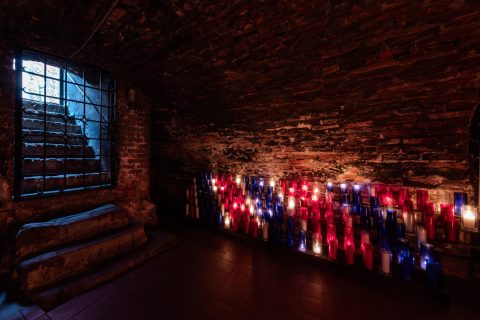
However, the Tomb of the Unknown Soldier, with the eternally fluttering flame, grounds you. It manages without the high pedestals, sharp corners, state megalomania, and coldness.
The idea is widespread
The Tomb of the Unknown Soldier is a memorial genre that became widespread after World War I. Due to the scale of the battles and new military technologies, thousands of soldiers remained unidentified. The first such tombs were erected in 1920 in the United Kingdom, at Westminster, and in France, under the Arc de Triomphe. Quite quickly, similar memorials were also erected in the United States, Portugal, Italy, Serbia, and elsewhere. Some countries, such as Canada and Japan, even have multiple monuments to honor different wars and their fallen soldiers.
One of the defining features of these tombs is the altar with an eternal flame, introduced following the French example. The flame never goes out, just as the nation never forgets its heroes. It is also the light of freedom, fought for in the darkness of uncertainty, evil, and tyranny.
One of the most impressive memorials to the Unknown Soldiers (and not only) was probably the one nearby – in Riga. Several thousand Latvians who died during the Independence Wars and the First World War are buried and commemorated on a 9-hectare territory about 5 km from the city center.
There are about 300 such soldiers’ graves here. All of them are marked with the inscription Nezināms (Unknown). The eternal flame dedicated to their memory is the central axis of the entire memorial. Various commemorations are held near it, at the end of the parade avenue. I recommend visiting this place for everyone going to Riga.
It took 12 years to build the largest memorial in the Baltic States, and its author is the Latvian sculptor Kalis Zalė, born in Mažeikiai. He also created the famous Freedom Monument in the center of Riga, which has become an integral part of the city’s identity and the site of the most important demonstrations, protests, and other historical events.
In 1921, the monument To Those Who Died for the Freedom of Lithuania was unveiled in Kaunas. It was the very first monument in this garden, beginning to shape the ensemble that is now so easily recognizable. Modest in appearance, it was created by two well-known masters of the First Republic of Lithuania: sculptor Juozas Zikaras and architect Vladimiras Dubeneckis.
The monument was consecrated by Jonas Mačiulis-Maironis himself. Another interesting detail: during the ceremony, a military orchestra performed a solemn military march composed for the occasion by Juozas Tallat-Kelpša, and a choir sang.
Perhaps the monument was best described by the then-President of Lithuania, Aleksandras Stulginskis: “The monument is remarkable for its originality: it does not shine with splendor or pride, but is simple and sorrowful, like our quiet, humble past.”
The body of the Unknown Soldier was buried here only after more than 10 years. When the altar-like Kaunas symbol was erected, this was not yet being considered. However, in the 1930s, the leadership of the War Museum began to consider the possibility of adding to the garden’s ensemble.
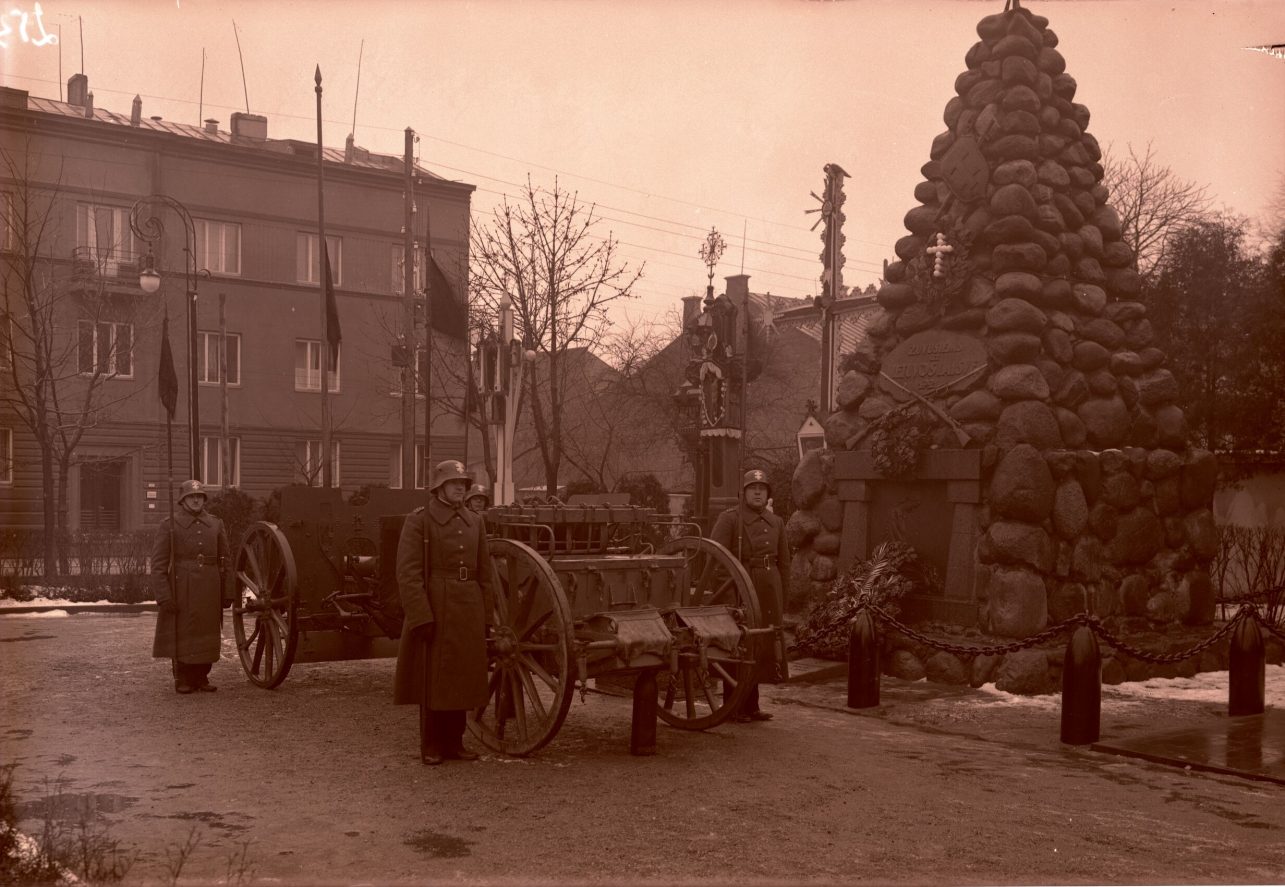
The remains of the soldier were first buried near the Lithuanian and Latvian border, in the Chervonka military cemetery, in the fields of Latvian farmers, at the sites of battles with Bolsheviks. The Unknown Soldier was brought to Lithuania in 1934 and solemnly reburied on November 23 in the museum garden in front of the monument.
President Antanas Smetona gave a speech at the ceremony. During the event, he awarded the Unknown Soldier with the Vytis Cross of the 3rd degree. Members of the government, military leadership, soldiers, volunteers, public organizations, and numerous citizens also attended the ceremony.
Leveled to the ground
When the second Soviet occupation began, communist functionaries took over administrative positions. One ideology replaced another, and the occupiers’ symbols replaced the Lithuanian ones. The remains of the Unknown Soldier were exhumed, and the work of two legendary creators was leveled to the ground.
Soon after, preparations began for a new pedestal dedicated to the red heroes. One of the most honorable sites – the grave of the Unknown Soldier and the monument To Those Who Died for the Freedom of Lithuania – was taken over by the statue of Feliks Dzerzhinsky, the son of a Polish noble, a criminal, and the founder of the Soviet security apparatus, who possessed no remarkable talents. This happened in 1951.
Revival gains momentum
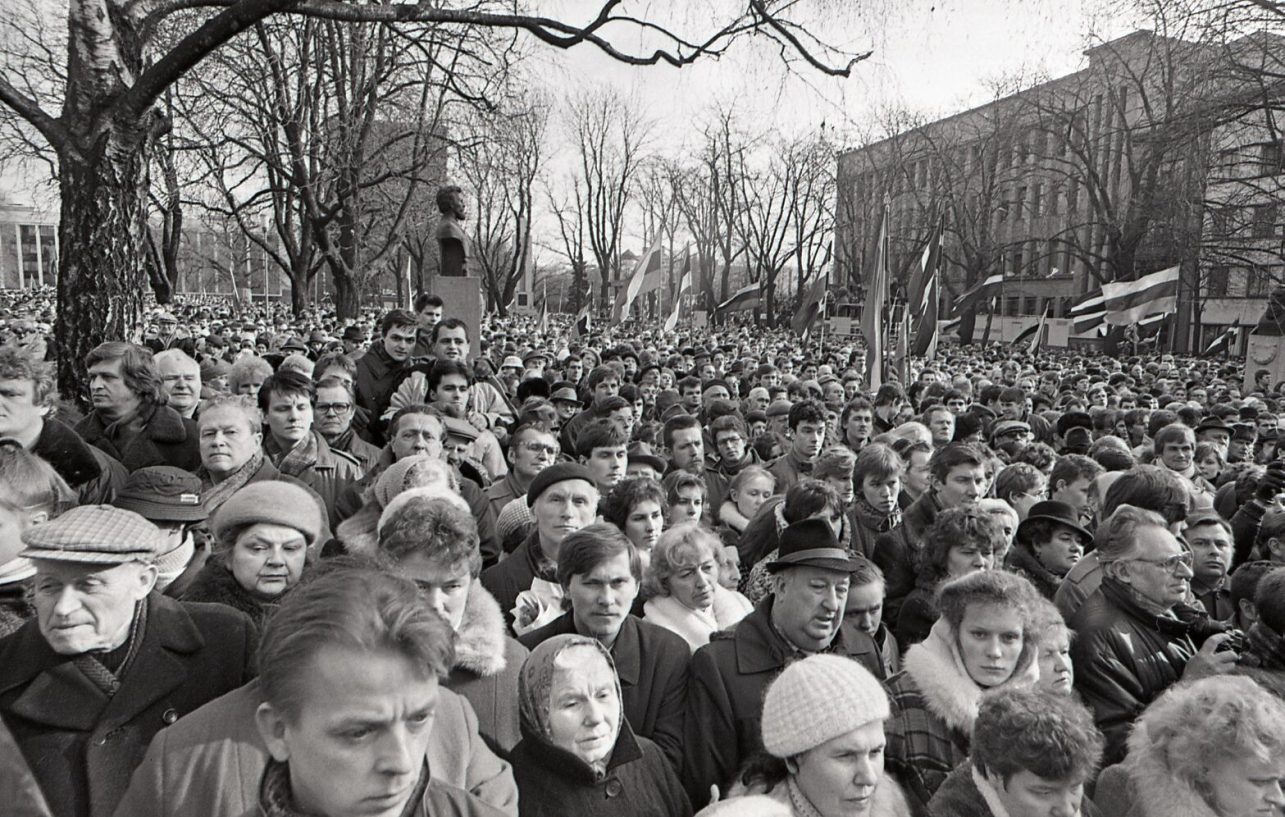
As national sentiments grew stronger, so did people’s attention to the destroyed values. Very soon, people turned their attention to the pantheon of the First Republic of Lithuania. The so-called Julius Janonis Square was due for a change.
The Lithuanian Cultural Foundation, established at the end of 1987 – more than half a year before the Sąjūdis – played the largest role here. In the summer of 1988, when its Kaunas branch was founded, Algimantas Sprindys, the former chief architect of Kaunas, who had designed the nearby Miestprojekas, was appointed chairman.
It was decided to rebuild the monument in the same way it had originally been constructed – by collecting stones from Lithuanian Independence War battle sites.
He becomes one of the initiators of the restoration of the Vytautas the Great War Museum’s garden and the reconstruction of former monuments, and later the author of the architectural part of the project. Alongside him, with the Lithuanian Cultural Foundation settling nearby at the Kaunas Artists’ House, my interlocutor, now the head of the Meno Parkas Gallery, Arvydas Žalpys, also becomes involved in the work.
The garden area itself had to be completely redesigned. First, Juozas Zikaras’ Liberty was restored. The busts of Martynas Jankus and Petras Vileišis were returned. Busts of Vladas Putvinskis, Povilas Lukšys, and Antanas Juozapavičius were also restored. The work proceeded quickly, voluntarily, with the concerted efforts of the community, institutions, and artists.
Finally, the time came to locate and precisely determine the former burial site of the Unknown Soldier and the original location of the monument To Those Who Died for Lithuania’s Freedom. Together with Česlovas Vytautas Stankevičius, the head of the Kaunas branch of the Sąjūdis movement, the old foundations were found and uncovered, along with several stones from the original monument bearing traces of mortar.
Groups are being organized
“Lithuanian Cultural Foundation was established in the Kaunas Artists’ House, but I didn’t contribute much to the artistic side of its activities. From the very beginning, my direct work was the restoration of that monument,” artist and curator Arvydas Žalpys recalls.
Vytautas the Great War History Museum and its then employee, now Lieutenant General Vytautas Jonas Žukas, got actively involved soon after. As A. Žalpys recalled, the future Commander of the Lithuanian Armed Forces radiated patriotism and organizational skill; it seemed that “this kind of work was exactly what he was meant for.”
It was decided to rebuild the monument in the same way it had originally been constructed – by collecting stones from Lithuanian Independence War battle sites. In September 1989, sixteen groups of stone collectors were mobilized to visit as many as fifty battle locations, including three in Latvia and four in Poland. Up to 200 volunteers took part in the campaign.
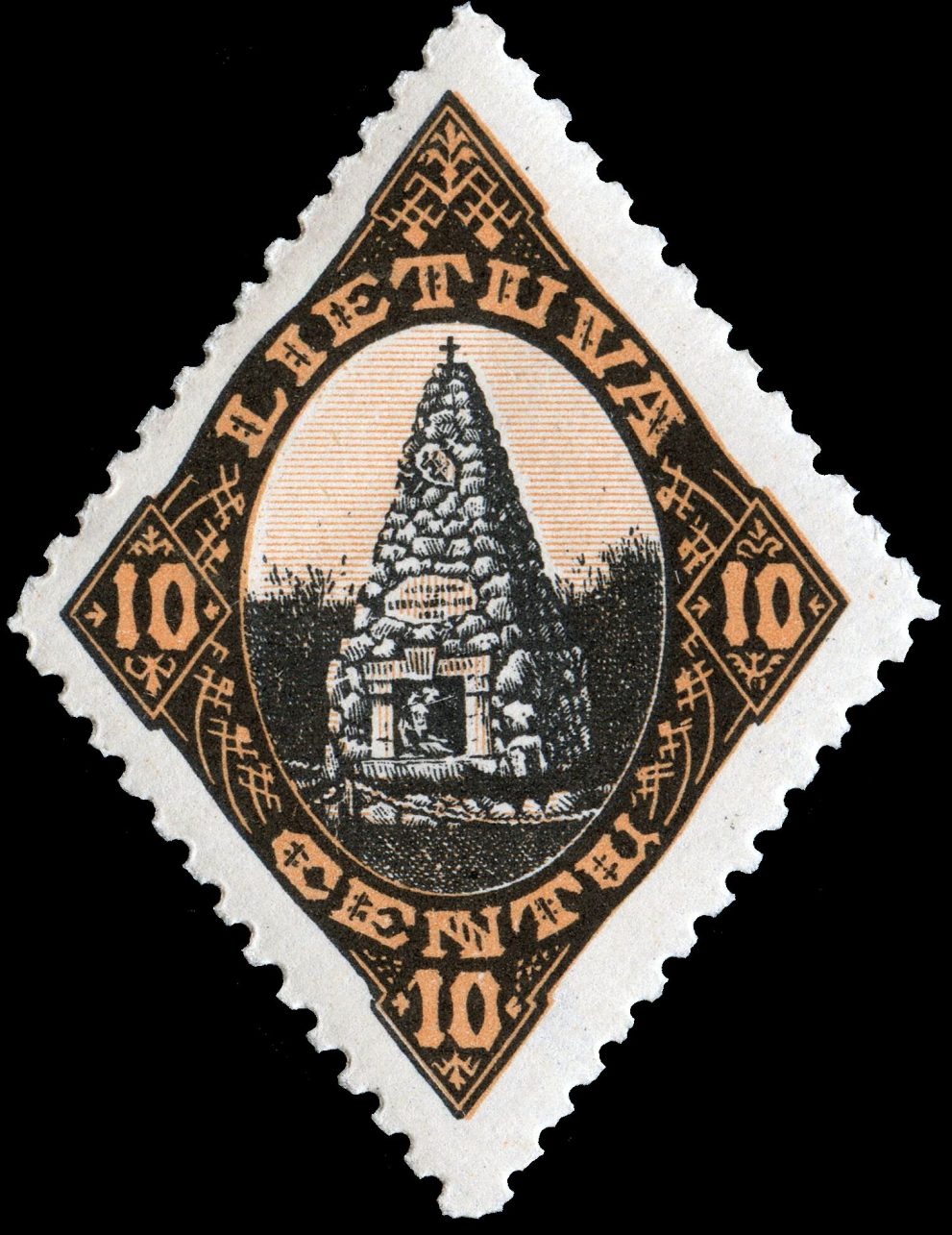
“The war museum might have had some hidden materials. After all, finding a map of the Independence battles is not so easy. Based on the iconography, a project to rebuild the monument was started,” continues A. Žalpys.
Not only did people contribute, but also various institutions. The interviewee recalls that Kauno tiltai provided transport from all over Lithuania to bring the stones back. Written sources also mention a ritual services company, which later became UAB Akmelita and is still operating on Jovarų Street.
I’m grateful to fate for bringing me together with all those wonderful, driven people.
According to memoirs, the design for the restoration of the monument To Those Who Died for Lithuania’s Freedom was recreated by architects from the Kaunas branch of the Monument Design and Restoration Institute, led by Kęstutis Žalnierius. The altar of the Unknown Soldier was designed by another architect from the same institute, Kaunas native Vytautas Liaudanskas.
Although much of the work was organized on a voluntary basis, the restoration itself was a long and costly process. The Lithuanian Cultural Foundation commissioned the construction company Struktūra to rebuild the monument for a relatively modest sum of 13,000 rubles. The pyramid was completed within a month, built inside a closed tent.
A symbolic bridge to the past
“After the first expedition, we brought back the stones and poured them out in the garden, just behind the fence on Donelaitis Street. The next day we came back, and it was clear that some stones were missing. It was unpleasant. After that, all the other stones were brought to my yard in Vičiūnai,” the interviewee recalls.
However, the most vivid memories were not of the small thefts but of meetings and communication with contemporaries. The organizers were looking for witnesses who were still alive and who remembered the unveiling of the sculpture during the interwar period. After much effort, they found aviator Simonas Stanaitis.

Arvydas says, “The man was already elderly; I found him in a nursing home in Panemunė. We talked a lot – I took him to all the ceremonies. He had even flown with Steponas Darius himself. That was our symbolic bridge – a connection to the demolished monument.”
Archives for future generations
According to A. Žalpys, everything was carefully catalogued, archived, and preserved in the archive of the Lithuanian Cultural Foundation. For those wishing to explore the topic of the restoration of Kaunas’ pantheon in greater depth, this collection of documents should prove to be of extraordinary value.

“Everyone must pay a certain tribute to their country. It seems to me that I paid it very honestly. I’m grateful to fate for bringing me together with all those wonderful, driven people,” Arvydas says in parting. “When the monument was completed, a capsule was placed inside it containing the names of the restoration organizers, the stone collectors, and others who contributed. Future generations will find it. It would be interesting to find the old archive too,” he adds.
In my mind, I’m already drafting an inquiry. I hope to find it because the restoration of the monument To Those Who Died for the Freedom of Lithuania and the Tomb of the Unknown Soldier, symbols of our memorial identity, is only a part of this remarkable initiative surrounding the garden – one that deserves its own page in Kaunas’ history.