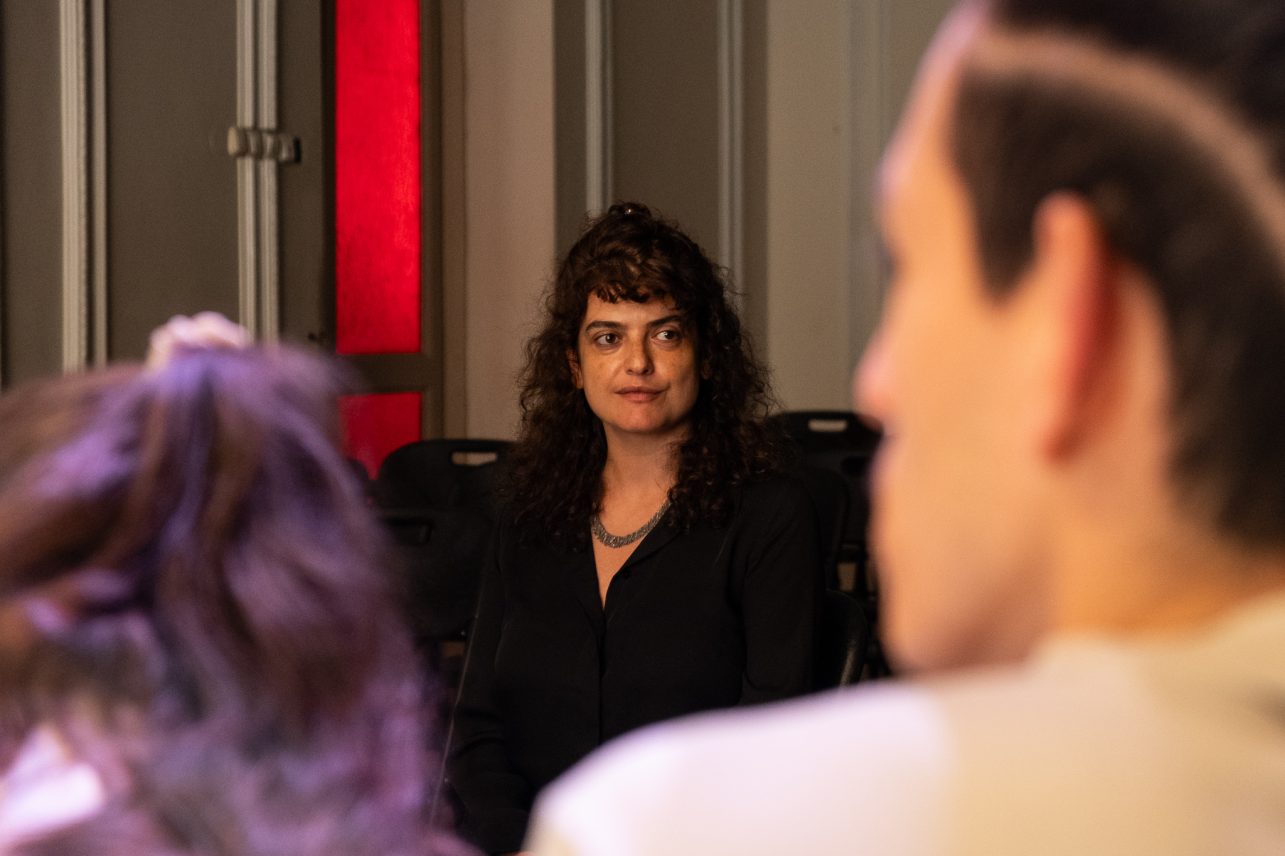
“When you discover how much potential exists in this community, it becomes senseless to call them disabled. Most non-disabled people have not experienced any of the obstacles that people with disabilities overcome every day,” shares Maka Chkhaidze as we reflect on her latest residency. Maka is a Georgian artist, curator, and founder of InForm – Platform for Inclusive Minds, a non-profit organisation supporting disability inclusion in Georgia’s performing arts scene.
She spent August in Kaunas as part of a Magic Carpets residency at Akvila Camphill, a social hub for people with intellectual disabilities and their family members. There, Maka created a dance performance together with members of the community. The performance was presented in Kaunas this September. In our conversation, Maka reflects on the creative process, inclusive artistic practice, and movement as a tool for bringing different realities together.
Thanks for joining me for a conversation. Was the Magic Carpets residency your first visit to Lithuania?
Yes, I spent one month here. I really loved Kaunas. It was a city with an atmosphere and a lifestyle that I needed at that moment. I hear that it is not as calm and quiet during the year as it is in August, but I had a lot to see and experience, and it is a very comfortable city to walk around. You do not get too tired of everyday life and everyday needs. When I was there, the ConTempo Festival was taking place, and it was amazing to see the transformation of the city through artistic events. It was very special. And I absolutely loved working at Akvila and with Magic Carpets.
How did this residency come into your life?
This project and this residency were very important to me. A few months before coming to Kaunas, we started a programme in day-care centres in Tbilisi, Georgia. The main idea was to offer free contemporary dance classes to people with disabilities who spend time in these institutions and do not have opportunities to take part in other artistic activities. When I heard about the Magic Carpets residency and this community, it was a wonderful match. I plan to use a similar residency model in Tbilisi: to bring artists from different disciplines to work with the community over a period of time and develop new artistic projects together with people who spend time at the day-care centres.
During your residency, you created a dance performance together with the Akvila community. Tell me more about your time there.
It was the first time I had to create a performance in such a short period with a group I had never met before. I work a lot with people with disabilities, and I have observed many similarities across different groups. But of course, there are factors that make each group very distinct as well. In the beginning, I wanted to get to know the group, learn how they spend their time, understand what the centre offers its residents, and gain a better sense of how the centre operates as a whole. One month at Akvila was not enough. I really value the process and the time we spent together. The performance created is like the cherry on top, but it is not the most important thing.
I went there every day and led two-hour classes for the group, sometimes also offering individual sessions. We had lunch and spent our breaks together, and I joined them for their morning ritual. I learned a lot from these morning gatherings. We had a language barrier, but that was also valuable because dance is universal, and we could communicate through movement.
Did you plan beforehand what the performance would look like?
The whole process was based on the idea that everything we created would come from the participants. We did this through games, exercises, and some talks. We tried to define what was important to them, what they loved, and how they imagined things. It was this kind of exploration of movement and interests, and based on that, I built the structure of the performance. Of course, I had some kind of idea of what the performance should look like, but surprisingly and intuitively, all the material that I gathered from the group was in tune with my idea.
In the end, watching the performance, I was surprised by how smoothly all its parts came together. The whole team, the Akvila community, was very interested, motivated, and supportive in every way. And I think this project was very exciting for our participants. One professional dancer, Carlo (editor’s note: Adrian Carlo Bibiano), took part in the performance. We wanted to have a professional dancer in the group as well. His involvement brought a different quality to the work and set a different standard that the participants strived to meet. They did very well.
You mentioned the group of people who participated. How was this group formed?
I like that the people at Akvila are called “villagers”, so I will use this word. In total, eleven people appeared on stage: two social workers, one professional dancer, and eight villagers. The administration asked some participants if they wanted to join, while others were recommended because the staff knew their interests and could assess who would have enough stamina. It is hard work to focus on something particular every day for two hours. You have to be dedicated.
The performance is now complete, and it sounds as though the whole experience was very interesting and fruitful, both for you personally and for the group.
We created a 15-minute performance. Their competence and motivation had increased so much throughout the process that I thought we could extend it, but it is good the way it is now. Sometimes, it was a very tiring process, and we had some struggles, but it’s natural. People should enjoy the process, and if they are not, then it is time to stop. Having this freedom to stop, knowing that you are not obliged to continue, removes the pressure and creates a more relaxed approach.
You anticipated some of the struggles in the process, as this was not your first time working with people with disabilities. In 2022, you founded InForm – Platform for Inclusive Minds, a non-profit organisation dedicated to bringing disability narratives into the performing arts scene in Georgia. When did you become interested in these “parallel realities”, as you call them?
My first experience of this was while studying acting in Tbilisi. As a student, I began teaching acting at one of the day-care centres. This environment made such a strong impression on me that I have now been involved with this community for more than twenty years. In 2022, during the pandemic, like many other people, I went through an existential crisis and began thinking about the direction I wanted my career to take and what I really enjoyed doing. My inner voice told me that working with people with disabilities met all my expectations of what I wanted from my work. Since then, I have devoted all my time and experience to establishing InForm and building a stable organisation that works consistently towards the inclusion of people with disabilities in contemporary art.
What did you want to establish with InForm?
Many activities take place separately – I mean activities intended only for people with disabilities. There are various projects and events, but they lack continuity, and this work is not part of the wider art scene. This is what I wanted to change, at least in the performing arts. I wanted to finally hear artists speak not of colleagues with disabilities, but simply of colleagues, and to hear about events for people, rather than events specifically for people with disabilities. I wanted all of this to become part of contemporary art practice.
Every year, we have performance productions where I invite professional directors, dancers, musicians, visual artists and actors who work together with people with disabilities. At one point, I realised that we were working with only a certain number of people who were able to come to our dance studio. Even leaving home and getting to the studio can be difficult. Then I decided that we needed to go to the places where they spend most of their time, instead of inviting them to the studio. This, by the way, is exactly where our paths crossed with Magic Carpets, as they have a similar vision.
In Georgia, we are known in both the disability and art scenes as a dance theatre that always offers something interesting to the audience. People who see our performances change their perception of inclusion and disability. Their understanding of their own position, their way of life, and how they see themselves in society also changes. At present, society focuses primarily on the needs of non-disabled people and on environments designed for them. Once you enter this inclusive environment, you see how diverse reality and life can be.
What have you discovered through these experiences? Have they changed the way you see community and human connection?
You change how you see yourself. When we call them people with disabilities, we are not really choosing the most appropriate way to describe them. Throughout their lives, they face so many obstacles and boundaries, including physical and social issues. There are limitations placed on them, and they struggle a lot. They win these battles most of the time, and they have enormous life energy, curiosity, openness, and love for life and the people around them. When you discover how much potential exists in this community, it becomes senseless to call them disabled. Most non-disabled people have not experienced any of the obstacles that people with disabilities overcome every day.
Disability culture teaches you that there is a rhythm a person cannot change, and when you wake up in the morning, you have to adapt to that rhythm in order to function. Non-disabled people can be very harsh with their bodies and energy. From disability culture, we can learn to listen to our bodies and minds, recognise our needs, and let them guide us.
During the residency, you explored themes of interpersonal bonds, support, and solidarity within communities. What does everyday solidarity mean to you?
Solidarity starts with listening to and hearing each other. This takes time. Sometimes, our lives are so busy that most of our connections with other people can remain superficial. When I start working and building connections with people with disabilities, I get to know their personalities in depth and learn to understand them better. I connect solidarity to this kind of moment when you take the time, connect with a person, and start listening to them. You start accepting the environment and circumstances around the other person. You are merging these realities together. Listening to each other, being curious, and connecting with each other can, in the end, bring bigger changes.
From time to time, I hear the notion that one has to “learn” how to dance, although I always feel that moving our bodies to a rhythm is an ingrained part of what makes us human. How can dance help communities and people in general build stronger ties with each other?
Absolutely. When you are in a dance class, you experience different kinds of connections compared with usual situations. You roll on the floor, make physical contact with others, develop an awareness of the space and the people in it, and learn to communicate non-verbally. It makes you feel very connected and closer to the person next to you.
For a long time, you have worked with the body, movement, sound, and their connections. When did you become interested in movement?
I am not a dancer, but dancing has always been part of my life. I was very much involved in movement and physical theatre during my studies and afterwards. I never saw contemporary dance as something separate from theatre. But I would say that it is movement, not dance, that I am working on. Movement is much more democratic and open, and you can integrate a lot of things into it. There are not as many boundaries as there are in traditional theatre.
When I was thinking about the best way for a person with a disability to feel comfortable on stage, dance and movement were the most democratic ways to present different bodies and minds. Contemporary dance is now becoming very inclusive. What we work on has a larger mission: to show how much people with disabilities can do and how interesting they can be on stage and outside it. Dance is the best way to put this idea into practice.
I’d like to end our conversation by returning to where we started: Kaunas. The dance performance you created with the community was presented at the event ‘For a Moment I Am You’. What do you think happens in this moment of transformation? Is it possible to let go of oneself and become another person?
In general, performance holds this power: you can identify with the person on stage. This title resonates with many performances we see. A viewer can recognise themselves on stage, and that experience can change something. We aimed to create that kind of connection during our performance as well.
I really wanted to offer the audience a mirror image of ourselves: how we wander, how we get lost, how we find our way, and how many journeys and how much curiosity it takes before we finally find each other and ourselves.
Magic Carpets is co-funded by the European Union’s Creative Europe programme. In Lithuania, the project is co-funded by the Lithuanian Culture Institute.